
Despedir vs Despedirse
Despedir = to fire someone. Despedirse = to say goodbye.
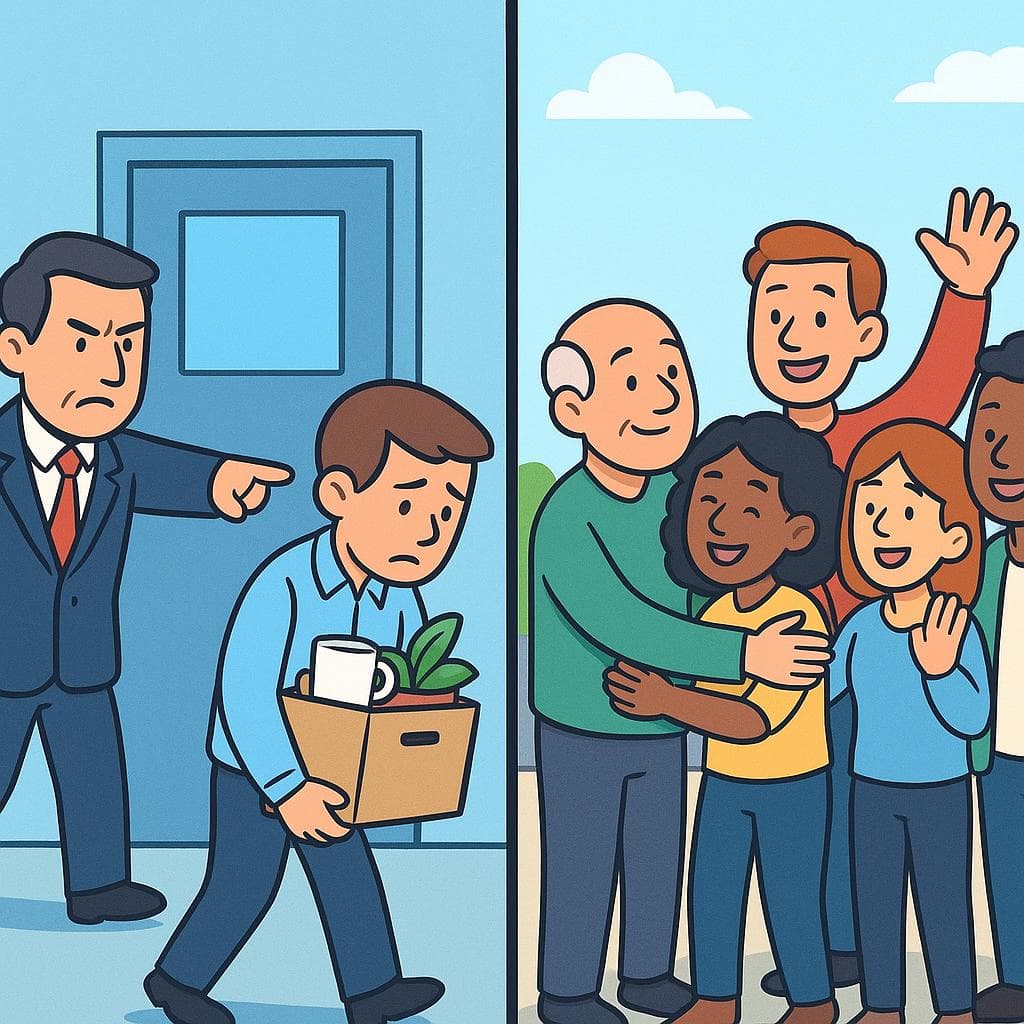
despedir
To fire someone from a job; to see someone off; to give off (a smell, light).
des-peh-DEERdespedirse
To say goodbye; to take one's leave; to give up on something.
des-peh-DEER-sehQuick Rule
Despedir = to fire someone. Despedirse = to say goodbye.
Think: You fire someone *else*, but you say goodbye for *yourself* (the reflexive 'se' part).
- Despedir can also mean 'to give off' a smell or light.
- You can 'despedir a alguien' at the airport, meaning 'to see them off', which is a form of saying goodbye.
Comparison Table
| Context | despedir | despedirse | Why? |
|---|---|---|---|
| Leaving a Job | El jefe lo despidió. | Él se despidió de su trabajo. | Despedir is the action of firing. Despedirse is the action of saying goodbye (or quitting). |
| Interacting with People | Voy a despedir a mi mamá. | Voy a despedirme de mi mamá. | Despedir focuses on the act of seeing her off. Despedirse focuses on the personal act of saying the words 'goodbye' to her. |
| Grammar Structure | Despedir a alguien. | Despedirse de alguien. | Despedir takes a direct object (the person fired/seen off). Despedirse is reflexive and uses the preposition 'de'. |
When to Use "despedir / despedirse"
despedir
To fire someone from a job; to see someone off; to give off (a smell, light).
des-peh-DEER
To fire someone from a job
El jefe despidió a tres empleados.
The boss fired three employees.
To see someone off (e.g., at a station)
Fui al aeropuerto para despedir a mi hermana.
I went to the airport to see my sister off.
To give off or emit something
La flor despide un aroma dulce.
The flower gives off a sweet scent.
despedirse
To say goodbye; to take one's leave; to give up on something.
des-peh-DEER-seh
To say goodbye to someone (uses 'de')
Me despedí de mis amigos y me fui.
I said goodbye to my friends and left.
To take one's leave
Bueno, ya es tarde, tenemos que despedirnos.
Well, it's late, we have to say goodbye/leave.
To give up on an idea (figurative)
Despídete de la idea de ir a la playa, está lloviendo.
Say goodbye to the idea of going to the beach, it's raining.
Contrast Examples
With "despedir":
La empresa despidió a Ana.
The company fired Ana.
With "despedirse":
Ana se despidió de sus colegas.
Ana said goodbye to her colleagues.
The Difference: Despedir is the one-way action of terminating employment. Despedirse is the social act of saying farewell. One action (firing) often leads to the other (saying goodbye).
With "despedir":
Vinimos a despedir a Juan.
We came to see Juan off.
With "despedirse":
Nos despedimos de Juan.
We said goodbye to Juan.
The Difference: These are very close in meaning. 'Despedir a Juan' emphasizes the action of watching him leave. 'Despedirnos de Juan' emphasizes the personal interaction of saying the words 'goodbye'. In practice, they are often interchangeable in this context.
With "despedir":
El coche viejo despedía mucho humo.
The old car gave off a lot of smoke.
With "despedirse":
Puedes despedirte de tu coche viejo; compramos uno nuevo.
You can say goodbye to your old car; we bought a new one.
The Difference: Here the meanings are completely different. Despedir means to emit or release. Despedirse is used figuratively to mean leaving something behind or giving it up.
Common Mistakes
Yo despido a mis amigos en la fiesta.
Yo me despido de mis amigos en la fiesta.
Unless you're firing your friends, you need the reflexive 'me' and the preposition 'de' to say goodbye. 'Despedir a mis amigos' sounds very dramatic!
El gerente se despidió al empleado por llegar tarde.
El gerente despidió al empleado por llegar tarde.
Firing is a direct action done *to* someone else, so you don't use the reflexive 'se'. 'El gerente se despidió' would mean the manager himself said goodbye and left.
Quick Practice
Quick Quiz: Despedir vs Despedirse
Question 1 of 2
Which verb completes the sentence? 'Mi jefe me ___ por llegar tarde todos los días.'
Related Grammar
Want to understand the grammar behind this pair? Explore these lessons for a deep dive:
Key Words


Tags
Build the instinct, not just the rule
Rules help you get it right; context makes it automatic. Read 200+ illustrated and narrated Spanish stories to see confusing pairs chosen correctly — over and over — until you stop thinking about it.
Frequently Asked Questions
Why does 'despedirse' almost always need 'de' after it?
Think of 'despedirse de' as a set phrase meaning 'to say goodbye to'. The 'de' is the connector word that links your action of saying goodbye to the person you're saying it to. You say goodbye *of* someone: 'Me despido de ti'.
Is it ever correct to say 'despedir' to mean 'say goodbye'?
Yes, but only in the specific context of 'seeing someone off'. For example: 'Fuimos a la estación a despedir a nuestros amigos'. Here, you are performing the action *to* your friends. It focuses on the gesture of being there for their departure. If you focus on the words exchanged, you'd use 'Nos despedimos de ellos'.