
Equivocar vs Equivocarse
Equivocar = to mistake X for Y. Equivocarse = to BE mistaken (to make a mistake).
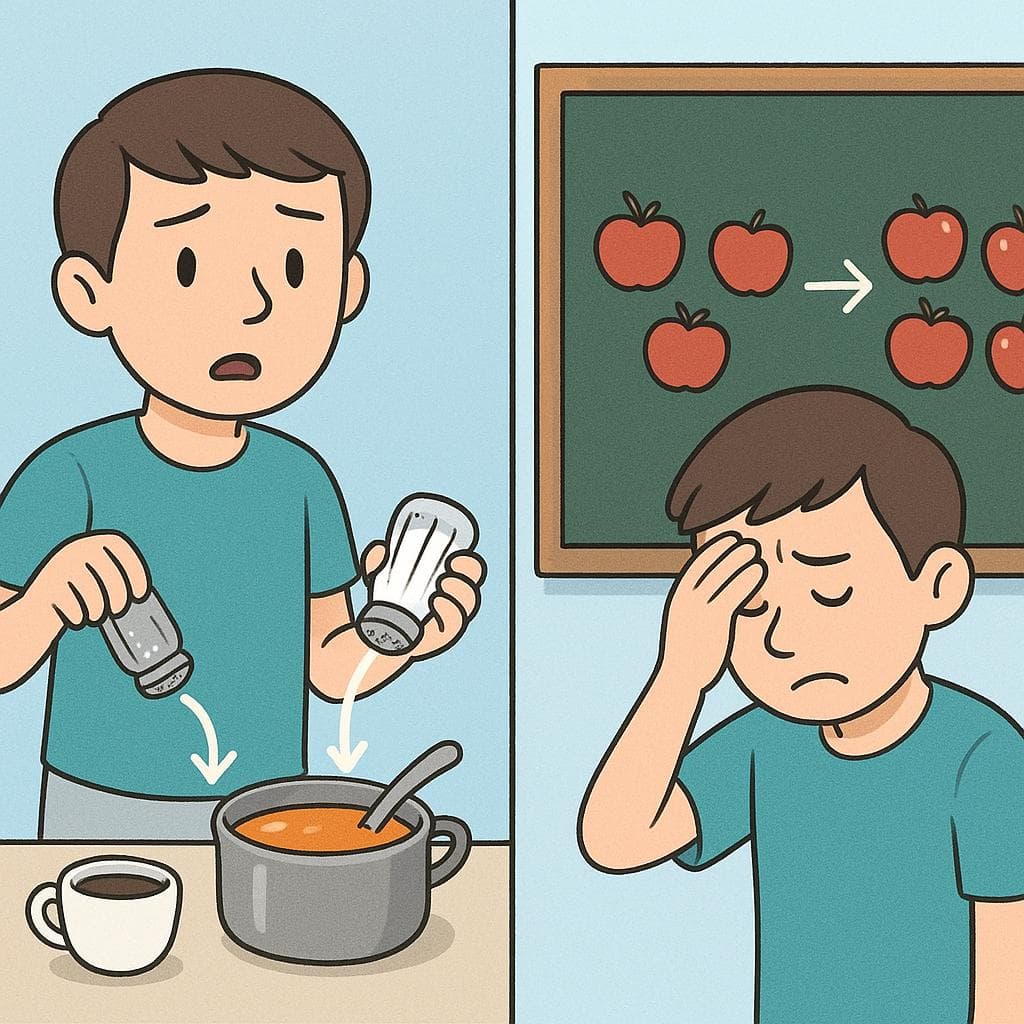
equivocar
To mistake one thing/person for another; to mix up. This verb needs an object.
eh-kee-boh-KARequivocarse
To be wrong, to be mistaken, to make an error. The action reflects back on the person.
eh-kee-boh-KAR-sehQuick Rule
Equivocar = to mistake X for Y. Equivocarse = to BE mistaken (to make a mistake).
Think: The 'se' is for 'self'. EquivocarSE is when you yourSElf make a mistake.
- When specifying WHAT you got wrong with 'equivocarse', you must use the preposition 'de' (e.g., 'Me equivoqué de número').
Comparison Table
| Context | equivocar | equivocarse | Why? |
|---|---|---|---|
| General Meaning | No equivoques amistad con amor. | Me equivoqué. | Equivocar is about confusing two specific things. Equivocarse is the general act of being wrong. |
| Grammar Structure | Equivoqué tu casa con la de Ana. | Me equivoqué de casa. | Equivocar takes a direct object (X) often followed by 'con' (Y). Equivocarse uses 'de' to specify the thing you got wrong. |
| Focus of the Error | El turista equivocó el camino. | El turista se equivocó. | Equivocar focuses on the external thing that was wrong (the path). Equivocarse focuses on the person who made the error. |
When to Use "equivocar / equivocarse"
equivocar
To mistake one thing/person for another; to mix up. This verb needs an object.
eh-kee-boh-KAR
Mistaking a person for another
Perdón, te equivoqué con tu hermano.
Sorry, I mistook you for your brother.
Mixing up two objects or concepts
Siempre equivoco la sal con el azúcar.
I always mix up the salt and the sugar.
To choose the wrong thing (less common)
Equivocó el botón y apagó la computadora.
He hit the wrong button and turned off the computer.
equivocarse
To be wrong, to be mistaken, to make an error. The action reflects back on the person.
eh-kee-boh-KAR-seh
Admitting you are wrong
Tienes razón, yo me equivoqué.
You're right, I was wrong.
Telling someone they are mistaken
Creo que te equivocas.
I think you are mistaken.
Specifying what you got wrong (with 'de')
Nos equivocamos de calle y nos perdimos.
We took the wrong street and got lost.
Making a mistake in an action (with 'al')
Se equivocó al escribir mi nombre.
She made a mistake when writing my name.
Contrast Examples
With "equivocar":
Equivoqué tu calle con la de al lado.
I mistook your street for the one next to it.
With "equivocarse":
Me equivoqué de calle.
I got the street wrong.
The Difference: Equivocar specifies the two things you confused. Equivocarse simply states that you made an error about a single thing (the street).
With "equivocar":
Por favor, no equivoques mi silencio con indiferencia.
Please, don't mistake my silence for indifference.
With "equivocarse":
Si piensas que no me importa, te equivocas.
If you think I don't care, you are mistaken.
The Difference: Equivocar is about not confusing two concepts. Equivocarse describes a person's state of being incorrect.
Common Mistakes
Yo equivoco.
Yo me equivoco.
To say 'I am wrong' or 'I make a mistake', you must use the reflexive form 'equivocarse'. 'Yo equivoco' is incomplete; it needs an object, like 'Yo equivoco tu nombre' (I get your name wrong).
Me equivoqué el número.
Me equivoqué de número.
When specifying *what* you got wrong after 'equivocarse', you must use the preposition 'de'. Think of it as 'I was mistaken *of* the number'.
Quick Practice
Quick Quiz: Equivocar vs Equivocarse
Question 1 of 2
Which sentence means 'I made a mistake'?
Related Grammar
Want to understand the grammar behind this pair? Explore these lessons for a deep dive:
Key Words

Tags
Build the instinct, not just the rule
Rules help you get it right; context makes it automatic. Read 200+ illustrated and narrated Spanish stories to see confusing pairs chosen correctly — over and over — until you stop thinking about it.
Frequently Asked Questions
Is 'equivocar' without 'se' ever used?
Yes, but it's less common in everyday conversation. It's used when you are actively mistaking one specific thing for another, like 'Él equivocó el optimismo con la ingenuidad' (He mistook optimism for naivete). For the general act of being wrong, you'll almost always use 'equivocarse'.
Can I say 'Estoy equivocado'?
Yes, absolutely! 'Estoy equivocado/a' means 'I am mistaken' or 'I am wrong'. It describes your current state. 'Me equivoqué' refers to the action of making the mistake, usually in the past. Both are very common.