
Ese vs Aquel
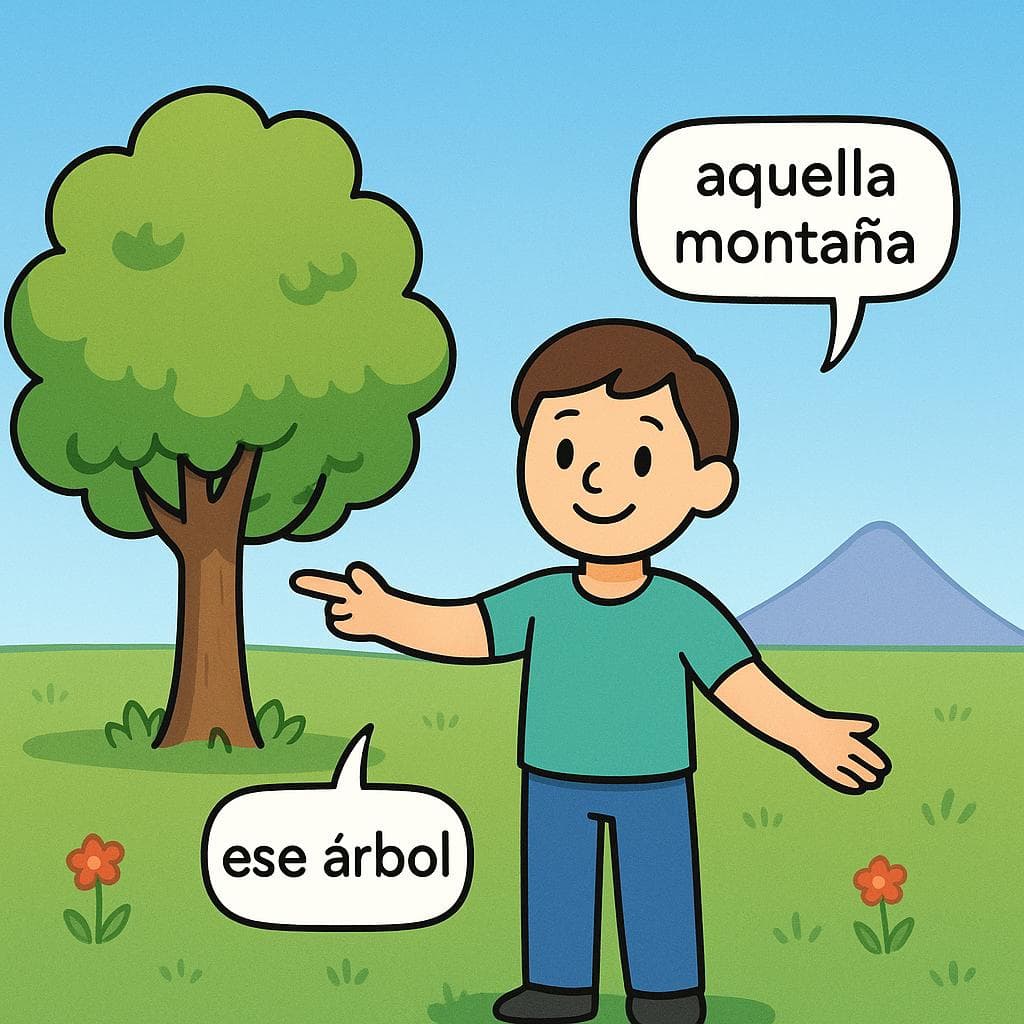
Ese = that (nearby). Aquel = that (way over there).
ese
That / Those (at a medium distance, often near the listener)
EH-sehaquel
That / Those (far away from both speaker and listener)
ah-KEHLQuick Rule
Ese = that (nearby). Aquel = that (way over there).
Think of three zones: 'este' (this here), 'ese' (that there), 'aquel' (that way over there).
- The same rule applies to time: 'ese día' (that recent day) vs. 'aquel día' (that day long ago).
- 'Aquel' can also mean 'the former' when comparing two things mentioned previously.
Comparison Table
| Context | ese | aquel | Why? |
|---|---|---|---|
| Physical Distance | Pásame esa silla. | ¿De quién es aquella casa en la colina? | Use 'ese' for things you could probably walk to in a moment. Use 'aquel' for things far off in the distance. |
| Time | Esa reunión de la mañana fue larga. | En aquellos tiempos no había celulares. | 'Ese' refers to the recent past (today, yesterday, last week). 'Aquel' refers to the distant past (childhood, historical eras). |
| Abstract Ideas | Eso que dijiste es interesante. | Aquellos ideales de la revolución... | 'Eso' refers to a specific, recently mentioned idea. 'Aquellos' refers to more remote, grand, or historical ideas. |
When to Use "ese / aquel"
ese
That / Those (at a medium distance, often near the listener)
EH-seh
Object near the listener
¿Me pasas ese libro que está a tu lado?
Can you pass me that book that's next to you?
Object at a medium distance
Ese perro al otro lado de la calle es muy grande.
That dog on the other side of the street is very big.
Referring to the recent past
Esa película que vimos ayer fue fantástica.
That movie we saw yesterday was fantastic.
Referring to something just said
—No quiero ir. —Pero, ¿por qué dices eso?
—I don't want to go. —But, why do you say that?
aquel
That / Those (far away from both speaker and listener)
ah-KEHL
Object far away
¿Ves aquella montaña en el horizonte?
Do you see that mountain on the horizon?
Object very far away
Aquel avión que vuela tan alto es casi invisible.
That plane flying so high is almost invisible.
Referring to the distant past
Recuerdo aquellos veranos de mi infancia.
I remember those summers from my childhood.
Referring to something abstract or famous
En aquel entonces, la vida era muy diferente.
Back in those days, life was very different.
Contrast Examples
With "ese":
Vivimos en esa casa de allí.
We live in that house over there. (The one nearby).
With "aquel":
Vivimos en aquella casa, en la colina.
We live in that house, on the hill. (The one way over there).
The Difference: The choice of 'esa' vs 'aquella' paints a mental map for your listener, telling them whether to look nearby or far into the distance.
With "ese":
Ese año pasado fue muy difícil.
That past year was very difficult. (Referring to last year).
With "aquel":
Aquel año que nos conocimos fue mágico.
That year we met was magical. (Referring to a year long ago).
The Difference: The distinction isn't just about time, but also about emotional distance. 'Aquel' often carries a nostalgic or historical feeling.
Common Mistakes
Me gusta aquella camisa que llevas puesta.
Me gusta esa camisa que llevas puesta.
Since the shirt is on the person you're talking to, it's 'near the listener'. Therefore, 'esa' is the correct choice, not 'aquella'.
Recuerdo ese verano de 1990.
Recuerdo aquel verano de 1990.
For memories in the distant past, 'aquel' is used to create a sense of remoteness in time. 'Ese' would imply a more recent summer.
Mira ese pájaro en la cima de la montaña.
Mira aquel pájaro en la cima de la montaña.
If something is far away, like the top of a distant mountain, 'aquel' is the correct word to indicate that large distance.
Quick Practice
Quick Quiz: Ese vs Aquel
Question 1 of 3
You see a mountain far in the distance. You say: 'Mira ___ montaña.'
Related Grammar
Want to understand the grammar behind this pair? Explore these lessons for a deep dive:
Key Words



Tags
Build the instinct, not just the rule
Rules help you get it right; context makes it automatic. Read 200+ illustrated and narrated Spanish stories to see confusing pairs chosen correctly — over and over — until you stop thinking about it.
Frequently Asked Questions
What about 'este'? How does it fit in?
Think of it as a three-level system of distance. 'Este/esta' is for things right here, within your reach ('this'). 'Ese/esa' is for things over there, often near the listener ('that'). 'Aquel/aquella' is for things way over there, far from everyone ('that way over there').
Do I have to change the ending for masculine/feminine and plural?
Yes, absolutely. They act just like other adjectives. You have: ese, esa, esos, esas. And for the other one: aquel, aquella, aquellos, aquellas. They must always match the noun they are describing in gender and number.
Is 'aquel' very common in everyday conversation?
It's less common than 'ese' in many regions, especially for physical objects. Some speakers might just use 'ese' and point. However, it's essential for talking about the distant past ('en aquellos tiempos') and is used frequently in writing and more formal speech. Learning it is key to sounding more natural.