
Levantar vs Levantarse
Levantar = to lift something else. Levantarse = to lift yourself (to get up).
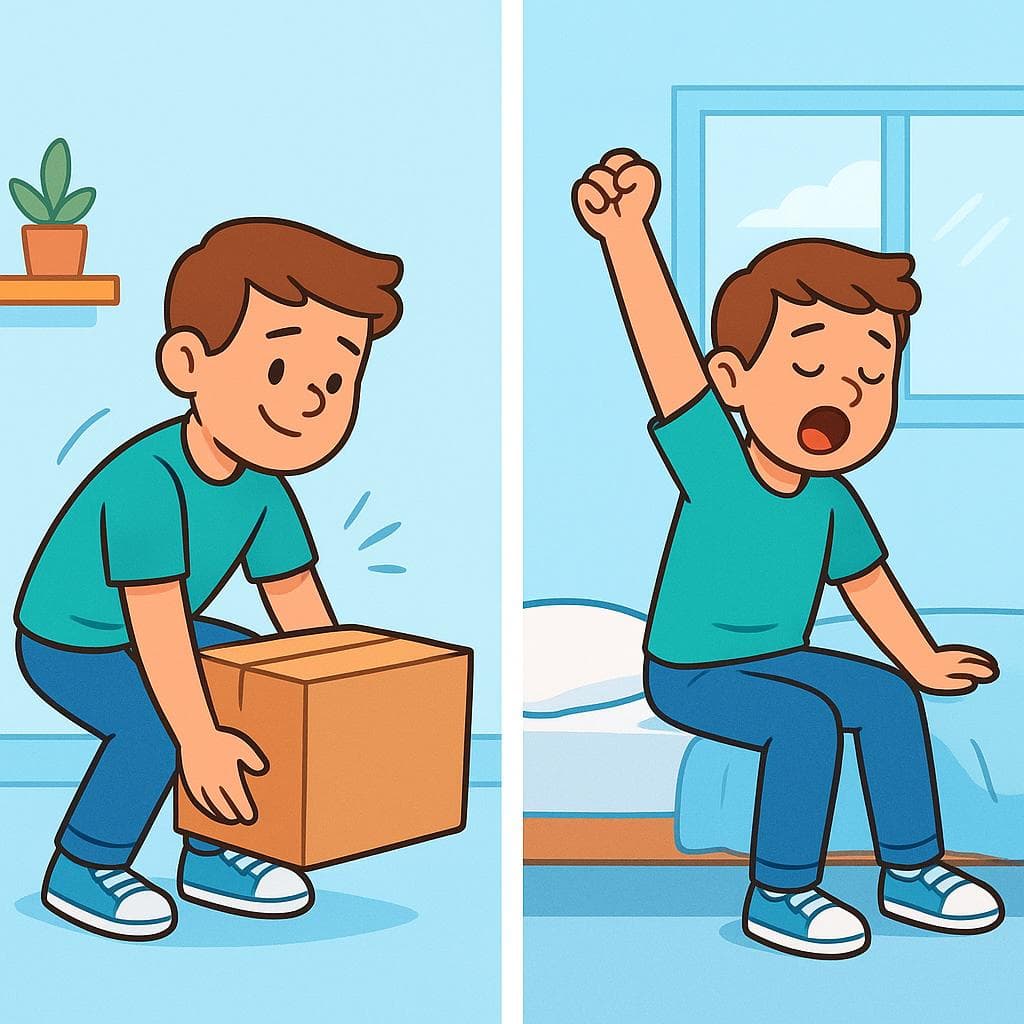
levantar
To lift, to raise (an object, a body part, or another person). The action is done TO something or someone else.
leh-bahn-TARlevantarse
To get up, to stand up. This is a reflexive verb, meaning the action is done TO oneself.
leh-bahn-TAR-sehQuick Rule
Levantar = to lift something else. Levantarse = to lift yourself (to get up).
Think: 'levantar' is for lifting a 'T'hing. 'levantarSE' is for lifting your'SE'lf.
- 'Levantar la mano' (to raise your hand) is not reflexive, even though it's your own hand.
Comparison Table
| Context | levantar | levantarse | Why? |
|---|---|---|---|
| Morning Routine | La madre levanta a su hijo. | El hijo se levanta. | Levantar: The mother acts on the son. Levantarse: The son acts on himself. |
| In the Classroom | El profesor levantó el libro. | El estudiante se levantó. | Levantar is used for an object (the book). Levantarse is used for a person standing up. |
| At the Gym | Voy a levantar pesas. | Me levanto del banco. | Use 'levantar' for the exercise of lifting weights. Use 'levantarse' for the action of getting up from the bench. |
When to Use "levantar / levantarse"
levantar
To lift, to raise (an object, a body part, or another person). The action is done TO something or someone else.
leh-bahn-TAR
Lifting a physical object
Ayúdame a levantar la caja, por favor.
Help me lift the box, please.
Raising a body part
Levanta la mano si sabes la respuesta.
Raise your hand if you know the answer.
Picking someone up
El padre levantó a su hijo en brazos.
The father lifted his son into his arms.
levantarse
To get up, to stand up. This is a reflexive verb, meaning the action is done TO oneself.
leh-bahn-TAR-seh
Getting out of bed
Normalmente me levanto a las siete.
I normally get up at seven.
Standing up from a seated position
Cuando entró el director, todos se levantaron.
When the principal entered, everyone stood up.
Getting up after a fall
Se cayó, pero se levantó sin ayuda.
He fell, but he got up without help.
Contrast Examples
With "levantar":
Tengo que levantar a los niños.
I have to get the kids up. (I perform the action on them.)
With "levantarse":
Los niños no quieren levantarse.
The kids don't want to get up. (They perform the action on themselves.)
The Difference: Levantar focuses on who is doing the waking. Levantarse focuses on who is getting up.
With "levantar":
Levantó la mano para hablar.
He raised his hand to speak. (The hand is the object being lifted.)
With "levantarse":
Se levantó para hablar.
He stood up to speak. (He lifted his whole body.)
The Difference: Use 'levantar' for a part of you (like your hand), and 'levantarse' for your whole self.
Common Mistakes
Yo levanto a las siete de la mañana.
Yo me levanto a las siete de la mañana.
When you are talking about yourself getting up, you must use the reflexive form 'levantarse'. 'Yo levanto' means 'I lift something'.
Me levanto la caja del suelo.
Levanto la caja del suelo.
You are lifting the box (an object), not yourself. The action is on the box, so you use the non-reflexive 'levantar'.
Quick Practice
Quick Quiz: Levantar vs Levantarse
Question 1 of 2
Every morning, I ___ at 7 AM.
Related Grammar
Want to understand the grammar behind this pair? Explore these lessons for a deep dive:
Key Words


Tags
Build the instinct, not just the rule
Rules help you get it right; context makes it automatic. Read 200+ illustrated and narrated Spanish stories to see confusing pairs chosen correctly — over and over — until you stop thinking about it.
Frequently Asked Questions
Why does Spanish have so many reflexive verbs like 'levantarse'?
Reflexive verbs are very common in Spanish and other Romance languages. They are used to show that the subject of the verb is also the object—the person doing the action is also receiving it. English does this sometimes ('I wash myself'), but Spanish uses it much more frequently, especially for daily routines.
Is 'levantarse' conjugated differently than 'levantar'?
The verb ending is conjugated the same, but you have to add the correct reflexive pronoun (me, te, se, nos, os, se) before the conjugated verb. For example: 'Yo levanto' (I lift) becomes 'Yo me levanto' (I get up). 'Tú levantas' (You lift) becomes 'Tú te levantas' (You get up).