
Mover vs Moverse
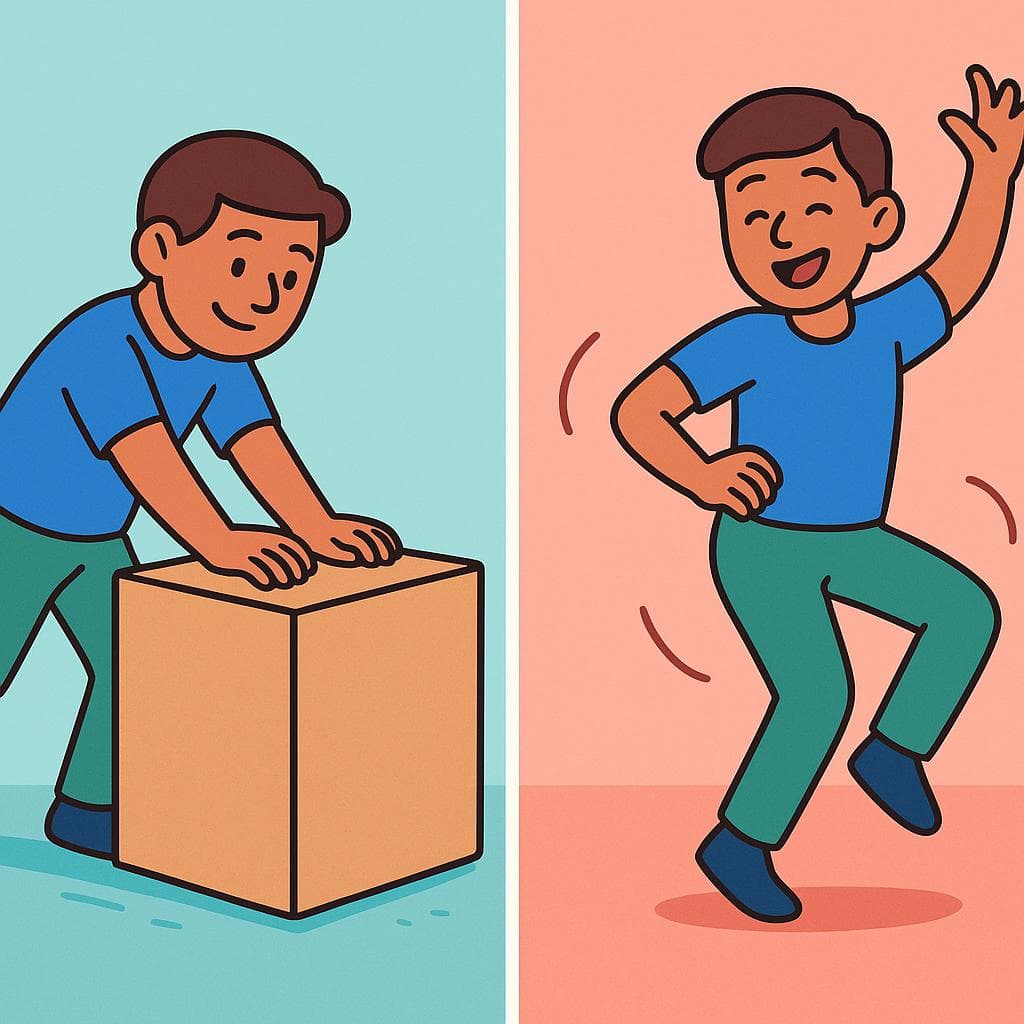
Mover = move an object. Moverse = move your body.
mover
To move (an object or someone else)
moh-BEHRmoverse
To move (one's own body); to be in motion
moh-BEHR-sehQuick Rule
Mover = move an object. Moverse = move your body.
Mover has no 'se', so you move something elSE. MoverSE has 'se', so you move yourSElf.
- Objects that move on their own use 'moverse', like 'El coche se mueve' (The car is moving).
Comparison Table
| Context | mover | moverse | Why? |
|---|---|---|---|
| Giving a command | Mueve la caja. | ¡Muévete de ahí! | Mover commands someone to act on an object. Moverse commands someone to move their own body. |
| Describing an action | Él mueve los muebles. | Él se mueve mucho cuando duerme. | Mover needs an object (the furniture). Moverse describes the subject's own bodily movement. |
| Inanimate objects | El terremoto movió los edificios. | Los edificios se movieron. | Mover identifies the external force (earthquake). Moverse describes the object's action (the buildings moved). |
When to Use "mover / moverse"
mover
To move (an object or someone else)
moh-BEHR
Move a physical object
Necesito mover la mesa para limpiar.
I need to move the table to clean.
To shake or stir
Mueve la sopa para que no se pegue.
Stir the soup so it doesn't stick.
To affect emotionally ('to move')
La historia de la película me movió mucho.
The movie's story moved me a lot.
moverse
To move (one's own body); to be in motion
moh-BEHR-seh
Move your own body / change location
Me muevo a la izquierda para que puedas pasar.
I'm moving to the left so you can pass.
To get going or hurry up
¡Muévete! Vamos a llegar tarde.
Move it! We're going to be late.
An object moving on its own
Las hojas se mueven con el viento.
The leaves move with the wind.
Contrast Examples
With "mover":
El guardia movió a la gente.
The guard moved the people.
With "moverse":
La gente se movió para dejarlo pasar.
The people moved to let him pass.
The Difference: With 'mover', the guard is the one physically making the people move. With 'moverse', the people are moving on their own.
With "mover":
El viento fuerte mueve las ramas.
The strong wind moves the branches.
With "moverse":
Las ramas se mueven mucho.
The branches are moving a lot.
The Difference: 'Mover' identifies the agent causing the action (the wind). 'Moverse' simply describes the state of the object (the branches are in motion).
With "mover":
Moví mi pieza en el tablero de ajedrez.
I moved my piece on the chessboard.
With "moverse":
Me moví al otro lado de la cancha.
I moved to the other side of the court.
The Difference: 'Mover' is for acting on an external object (the chess piece). 'Moverse' is for moving your entire body from one place to another.
Common Mistakes
Yo muevo para ver mejor.
Yo me muevo para ver mejor.
When you are changing the position of your own body, you must use the reflexive form 'moverse'.
¿Me mueves la sal, por favor?
¿Mueves la sal, por favor? / ¿Me pasas la sal?
You're asking someone to move an object (the salt), not you. The 'me' here would be an indirect object, better expressed with 'pasar'.
Quick Practice
Quick Quiz: Mover vs Moverse
Question 1 of 2
Which is correct? 'Para limpiar el piso, tengo que ___ todos los muebles.'
Related Grammar
Want to understand the grammar behind this pair? Explore these lessons for a deep dive:
Key Words

Tags
Build the instinct, not just the rule
Rules help you get it right; context makes it automatic. Read 200+ illustrated and narrated Spanish stories to see confusing pairs chosen correctly — over and over — until you stop thinking about it.
Frequently Asked Questions
Why do objects like cars or leaves use 'moverse' if they can't move themselves?
Think of 'moverse' as meaning 'to be in motion'. Even though an external force (like an engine or the wind) is the cause, we use 'moverse' to describe the state of the object itself. 'El coche se mueve' focuses on the car's movement, while 'El motor mueve el coche' focuses on what is causing the movement.
Is 'mover' always about physical objects?
Not always! It can also be used figuratively to mean 'to emotionally affect' someone. For example, 'Esa canción me mueve' means 'That song moves me'. In this case, the song is the 'object' that is causing an emotional change in you.