
Para vs Hacia (Direction)
Para = final destination. Hacia = toward a direction.
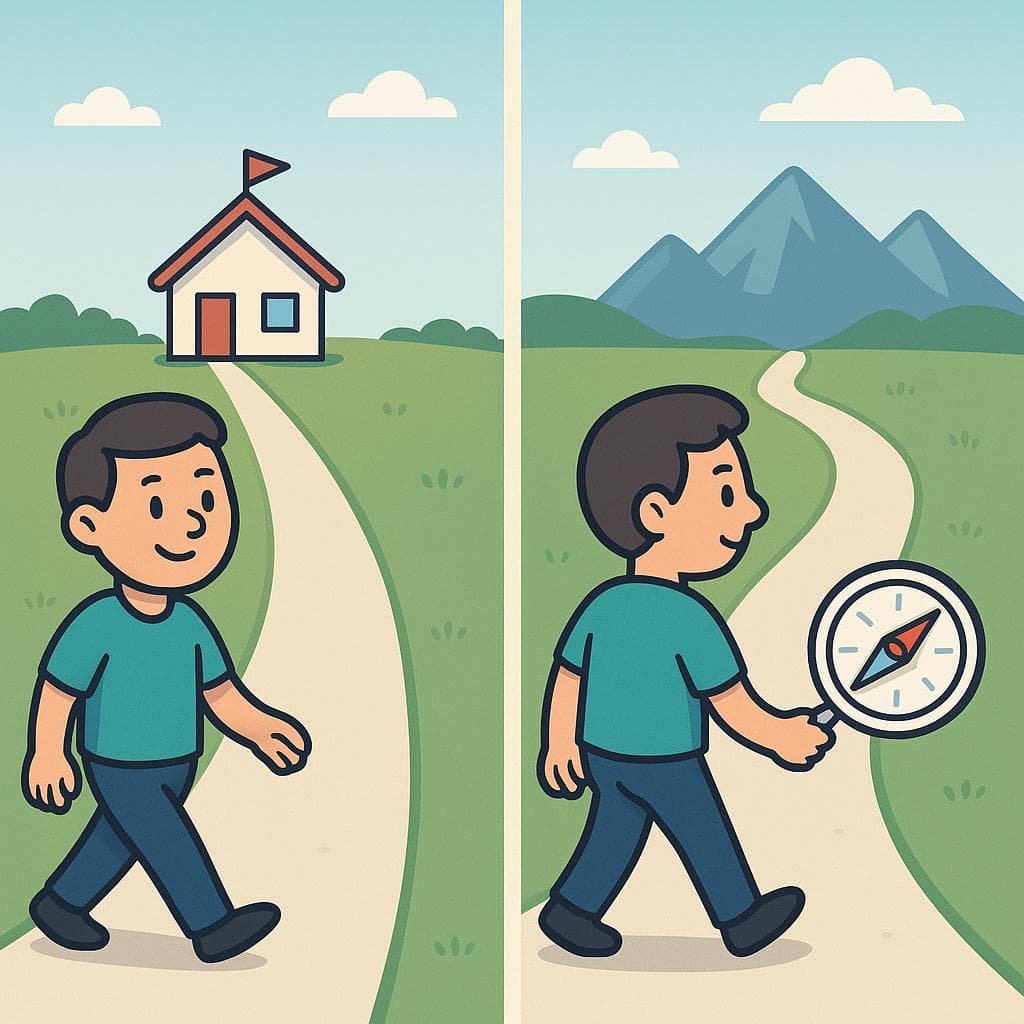
para
Indicates the final destination or the specific endpoint of a movement.
PAH-rahhacia
Indicates movement in the general direction of something, without necessarily arriving.
AH-syahQuick Rule
Para = final destination. Hacia = toward a direction.
Think: Para = Point of arrival. Hacia = Heading toward.
- Both can sometimes be translated as 'to' in English, which is the main source of confusion.
- When the destination and direction are the same, the choice emphasizes either the endpoint (para) or the path (hacia).
Comparison Table
| Context | para | hacia | Why? |
|---|---|---|---|
| Going to a city | Voy para Sevilla mañana. | El coche va hacia Sevilla. | Para is for the final destination. Hacia is for the direction of travel on the way. |
| Walking in a plaza | Voy para la fuente. | Camino hacia la fuente. | Para implies the fountain is your goal. Hacia just describes the direction you're walking. |
| Giving directions | Sigue recto para el museo. | Sigue recto hacia el río. | Para is for the final goal (the museum). Hacia is for a landmark to guide your direction (the river). |
When to Use "para / hacia"
para
Indicates the final destination or the specific endpoint of a movement.
PAH-rah
Final Destination
Voy para la oficina.
I'm going to the office. (That's my final stop.)
Specific Endpoint of a Route
Este tren va para Madrid.
This train goes to Madrid. (It's the train's destination.)
Leaving for a Place
Salimos para la playa a las ocho.
We're leaving for the beach at eight.
hacia
Indicates movement in the general direction of something, without necessarily arriving.
AH-syah
General Direction
Caminamos hacia el parque.
We're walking toward the park. (But maybe won't go all the way in.)
Facing or Pointing Toward
La ventana mira hacia el sur.
The window faces south.
Approximate Direction
Voy hacia el centro, ¿quieres venir?
I'm heading toward downtown, do you want to come?
Contrast Examples
With "para":
Salgo para Barcelona mañana.
I'm leaving for Barcelona tomorrow. (It's my final destination.)
With "hacia":
Conduzco hacia Barcelona, pero pararé en Zaragoza.
I'm driving toward Barcelona, but I'll stop in Zaragoza.
The Difference: Para states that Barcelona is the end of the trip. Hacia means it's the general direction you're heading, but not necessarily the final stop.
With "para":
Voy para el lago.
I'm going to the lake. (To sit there, meet someone, etc.)
With "hacia":
Camino hacia el lago.
I'm walking toward the lake. (Maybe just for the view on my way somewhere else.)
The Difference: Para suggests the lake is your specific goal or purpose. Hacia just describes the direction of your walk.
With "para":
Ve para la salida.
Go to the exit. (Leave the building.)
With "hacia":
Ve hacia la salida y luego gira a la derecha.
Go toward the exit and then turn right.
The Difference: Para indicates the final point of the instruction. Hacia uses the exit as a reference point for the next step in the directions.
Common Mistakes
Miro para la montaña.
Miro hacia la montaña.
When you are just looking 'in the direction of' something, use hacia. 'Miro para la montaña' would incorrectly imply you intend to travel there.
El avión va hacia su destino final.
El avión va para su destino final.
Because it's the 'final destination,' it's a specific endpoint. Para is the correct choice to emphasize this.
Quick Practice
Quick Quiz: Para vs Hacia (Direction)
Question 1 of 2
I'm driving *toward* the coast, but I might stop before I get there. 'Conduzco ___ la costa.'
Related Grammar
Want to understand the grammar behind this pair? Explore these lessons for a deep dive:
Key Words



Tags
Build the instinct, not just the rule
Rules help you get it right; context makes it automatic. Read 200+ illustrated and narrated Spanish stories to see confusing pairs chosen correctly — over and over — until you stop thinking about it.
Frequently Asked Questions
Can 'para' and 'hacia' ever be interchangeable?
Sometimes the difference is very subtle. If you are walking toward a store and it is also your final destination, both could technically work. However, native speakers will choose 'para' to emphasize the destination and 'hacia' to emphasize the journey or direction. When in doubt, stick to the 'destination vs. direction' rule.
Does 'hacia' have other meanings besides direction?
Yes! It can also mean 'around' or 'about' when talking about time. For example, 'Llegaré hacia las cinco' means 'I'll arrive around five o'clock'. This is a separate usage from its meaning of direction.