
Perder vs Perderse
Perder is to lose an object. Perderse is to get lost or miss out on an experience.
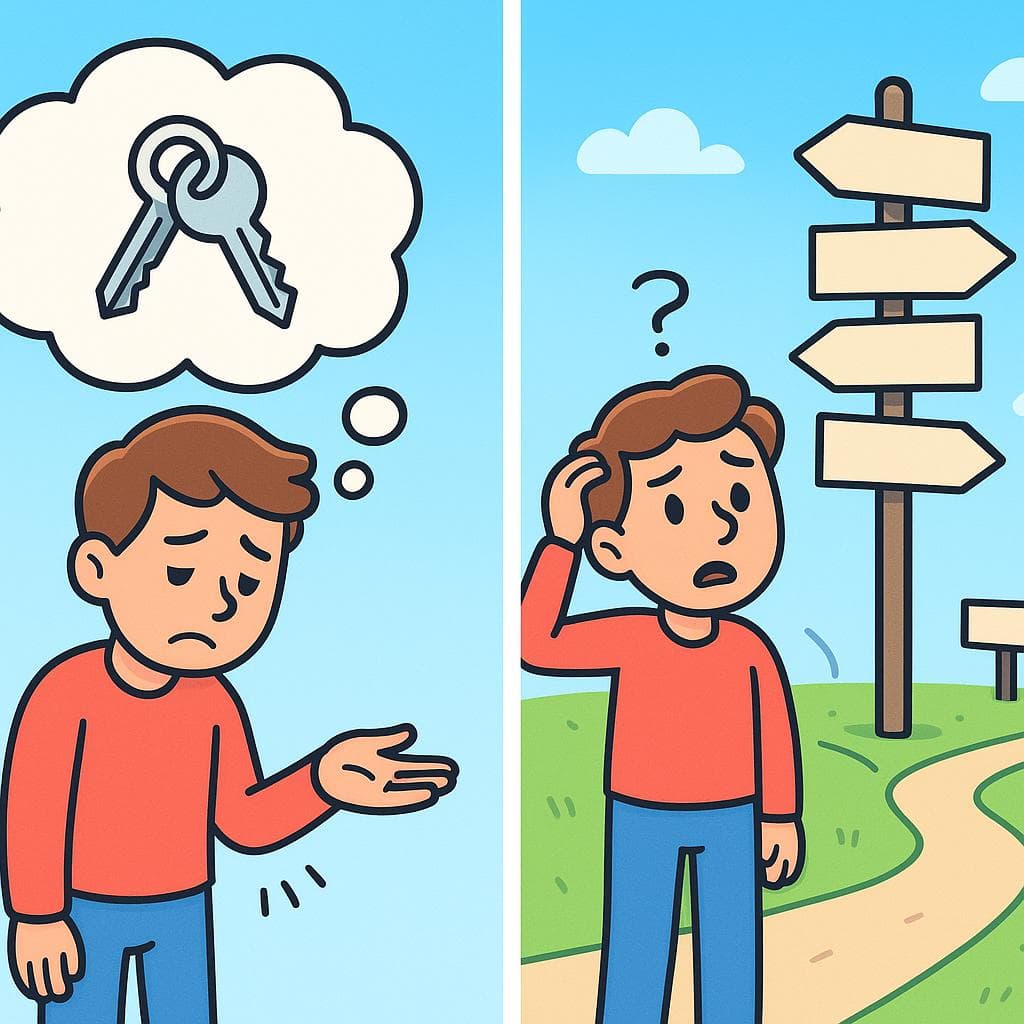
perder
To lose (an object), miss (transportation), or waste (time)
pehr-DEHRperderse
To get lost, to miss out on (an event or experience)
pehr-DEHR-sehQuick Rule
Perder is to lose an object. Perderse is to get lost or miss out on an experience.
Think: Perder = Lose a thing. Perderse = Lose your-SE-lf (or miss something).
- For transportation like buses, trains, or planes, you use 'perder' (e.g., 'perder el tren') to mean 'to miss'.
Comparison Table
| Context | perder | perderse | Why? |
|---|---|---|---|
| Losing vs. Getting Lost | Perdí el mapa. | Me perdí en la ciudad. | 'Perder' needs an object you lost (the map). 'Perderse' describes what happened to you (you got lost). |
| Missing Something | Perdí el autobús. | Me perdí el concierto. | Use 'perder' for missing transportation, but 'perderse' for missing out on an event or experience. |
| A Child in a Park | El padre perdió a su hijo. | El niño se perdió. | 'Perder' focuses on the father's action of losing someone. 'Perderse' describes the state of the child being lost. |
When to Use "perder / perderse"
perder
To lose (an object), miss (transportation), or waste (time)
pehr-DEHR
Losing a physical object
Perdí mis llaves en la playa.
I lost my keys on the beach.
Missing transportation
¡Corre! Vamos a perder el autobús.
Run! We're going to miss the bus.
Losing a game or competition
Nuestro equipo perdió el partido 2-1.
Our team lost the game 2-1.
Wasting time or an opportunity
No pierdas esta oportunidad.
Don't waste this opportunity.
perderse
To get lost, to miss out on (an event or experience)
pehr-DEHR-seh
Getting physically lost
Nos perdimos en el bosque.
We got lost in the forest.
Missing out on an event
Estaba enfermo, así que me perdí la boda.
I was sick, so I missed the wedding.
Getting absorbed or 'lost' in something
Me perdí en la historia del libro.
I got lost in the book's story.
Losing track of someone in a crowd
El niño se perdió en el supermercado.
The child got lost in the supermarket.
Contrast Examples
With "perder":
Perdí la entrada para el concierto.
I lost the ticket for the concert.
With "perderse":
Me perdí el concierto.
I missed (out on) the concert.
The Difference: 'Perder' means you lost the physical ticket. 'Perderse' means you didn't get to attend or experience the event itself, maybe because you were busy or sick.
With "perder":
Perdimos la brújula en el bosque.
We lost the compass in the forest.
With "perderse":
Nos perdimos en el bosque.
We got lost in the forest.
The Difference: Losing an object ('perder') is different from getting lost yourself ('perderse'). Losing the compass might be the reason you got lost.
With "perder":
El canal perdió los derechos del programa.
The channel lost the rights to the show.
With "perderse":
¡No te pierdas el próximo episodio!
Don't miss the next episode!
The Difference: 'Perder' refers to losing something tangible or legal, like rights. 'Perderse' is an invitation to not miss out on the experience of watching.
Common Mistakes
Perdí la fiesta anoche.
Me perdí la fiesta anoche.
When you 'miss out' on an event like a party, you need the reflexive form 'perderse'. 'Perder la fiesta' isn't a natural way to say this.
Me perdí mi cartera.
Perdí mi cartera.
To say you lost a physical object, use the simple verb 'perder'. 'Me perdí' means 'I got lost'.
Quick Practice
Quick Quiz: Perder vs Perderse
Question 1 of 3
Which is correct to say 'I got lost in Madrid'?
Related Grammar
Want to understand the grammar behind this pair? Explore these lessons for a deep dive:
Key Words
Tags
Build the instinct, not just the rule
Rules help you get it right; context makes it automatic. Read 200+ illustrated and narrated Spanish stories to see confusing pairs chosen correctly — over and over — until you stop thinking about it.
Frequently Asked Questions
Why is 'perder el autobús' correct but 'perder la fiesta' is wrong?
It's a fixed rule of thumb: for scheduled transportation (buses, trains, flights), Spanish uses 'perder'. For experiences, events, or opportunities you fail to enjoy (parties, concerts, episodes), it uses the reflexive 'perderse'. Think of it as 'missing out on' the fun.
Can 'perderse' mean something is leaking or being wasted?
Yes, although it's a more advanced usage. You might hear 'El agua se está perdiendo' to mean 'The water is being wasted/leaking'. For beginners, it's best to focus on the two main meanings: getting lost and missing out.