
Primero vs Primer
Use 'primer' right before a masculine noun. Use 'primero' for everything else.
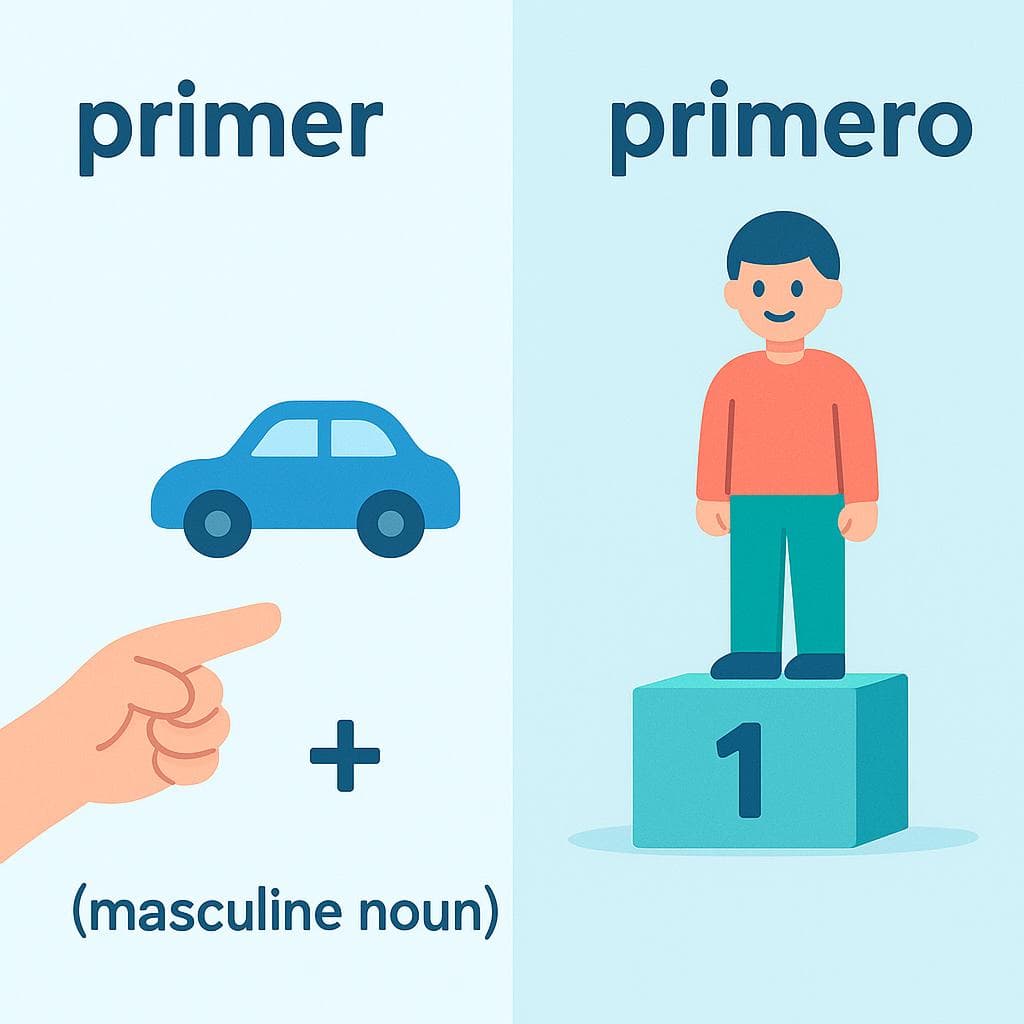
primero
First (used when it doesn't come directly before a masculine singular noun)
pree-MEH-rohprimer
First (used only as an adjective directly before a masculine singular noun)
pree-MEHRQuick Rule
Use 'primer' right before a masculine noun. Use 'primero' for everything else.
Think: 'Primer' is a *primer* coat; it goes on right *before* the main thing (the noun).
- This is a consistent rule, not an exception: for feminine nouns, you always use 'primera' (e.g., la primera vez).
Comparison Table
| Context | primero | primer | Why? |
|---|---|---|---|
| Before a masculine noun | ❌ incorrecto ('el primero coche') | ✅ El primer coche | When the adjective 'first' comes right before a singular masculine noun like 'coche', you must shorten it to 'primer'. |
| When standing alone | ✅ Él llegó primero. | ❌ incorrecto ('Él llegó primer.') | When 'first' is used as a pronoun or adverb without a noun immediately following, use the full form 'primero'. |
| As an adverb ('firstly') | ✅ Primero, escucha. | ❌ incorrecto ('Primer, escucha.') | To start a sequence of events, always use 'primero' to mean 'first of all'. |
| With a feminine noun | ✅ La primera vez (using 'primera') | ❌ incorrecto | This shortening rule only applies to masculine nouns. For feminine nouns, you always use 'primera'. |
When to Use "primero / primer"
primero
First (used when it doesn't come directly before a masculine singular noun)
pree-MEH-roh
Stands alone (as a pronoun)
Él fue el primero en terminar.
He was the first to finish.
As an adverb ('firstly')
Primero, vamos a cenar.
First, let's have dinner.
As an adjective after a masculine noun (less common)
Vivo en el piso primero.
I live on the first floor.
primer
First (used only as an adjective directly before a masculine singular noun)
pree-MEHR
Before a singular masculine noun
Es mi primer trabajo.
It's my first job.
Modifying a masculine noun
El primer capítulo es muy interesante.
The first chapter is very interesting.
Describing 'the first something' (masculine)
Fue un gran primer paso.
It was a great first step.
Contrast Examples
With "primero":
El día primero de enero es fiesta.
The first day of January is a holiday.
With "primer":
El primer día de enero es fiesta.
The first day of January is a holiday.
The Difference: Both are grammatically correct, but using 'primer' before the noun is much more common and sounds more natural in everyday speech. The 'word + primero' structure is more formal or used for things like floor numbers ('piso primero').
With "primero":
Primero, abre el libro.
First, open the book.
With "primer":
Abre el primer libro que veas.
Open the first book you see.
The Difference: 'Primero' is used as an adverb to order actions (first do this...). 'Primer' is an adjective that describes a specific noun (which book? The first one).
Common Mistakes
Es mi primero día en la oficina.
Es mi primer día en la oficina.
Because 'día' is a masculine singular noun, you must shorten 'primero' to 'primer' when it comes before it.
No sé quién ganó, pero yo llegué primer.
No sé quién ganó, pero yo llegué primero.
When 'first' stands alone and describes the order of arrival (acting as an adverb), you need the full form 'primero'.
Quick Practice
Quick Quiz: Primero vs Primer
Question 1 of 3
Which is correct? 'Hoy es el ___ día de la primavera.'
Related Grammar
Want to understand the grammar behind this pair? Explore these lessons for a deep dive:
Key Words



Tags
Build the instinct, not just the rule
Rules help you get it right; context makes it automatic. Read 200+ illustrated and narrated Spanish stories to see confusing pairs chosen correctly — over and over — until you stop thinking about it.
Frequently Asked Questions
Are there other words that do this in Spanish?
Yes! This shortening is called 'apócope'. It happens with a few other common adjectives before masculine singular nouns, like 'bueno' becoming 'buen' (un buen día), 'malo' becoming 'mal' (un mal momento), and 'grande' becoming 'gran' (un gran hombre).
What about plural nouns?
The shortening only happens before singular masculine nouns. For plurals, you always use the full form: 'los primeros días', 'las primeras semanas'.