pegar Present Conjugation
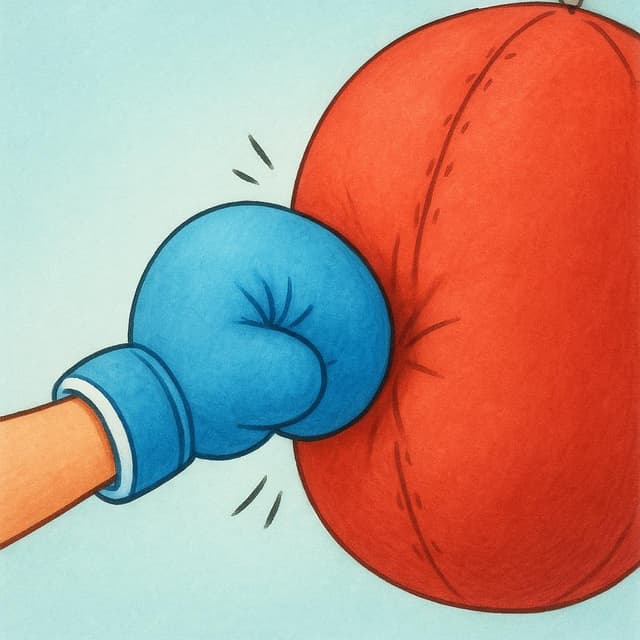
pegar — to hit
The present tense of pegar is completely regular: pego, pegas, pega, pegamos, pegáis, pegan.
pegar Present Forms
When to Use the Present
Use this for current habits, general truths (like glue sticking), or to say that two things (like clothes or colors) match well together.
Notes on pegar in the Present
Pegar is a regular -ar verb in the present tense. No spelling changes occur here.
Example Sentences
Yo pego las fotos en el álbum.
I stick the photos in the album.
yo
Ese color no pega con la pared.
That color doesn't match the wall.
él/ella/usted
Nosotros pegamos carteles en la calle.
We are putting up posters in the street.
nosotros
Common Mistakes
Mistake: Confusing 'pegar' (to hit/stick) with 'pagar' (to pay).
Correct: pego (I stick) vs. pago (I pay).
Why: These verbs differ by only one vowel but have completely different meanings.
Master Spanish verbs in context
Memorizing tables only gets you so far. Read 200+ illustrated and narrated Spanish stories to see verbs like 'pegar' used naturally — in the tenses you're learning.
Related Tenses
Preterite
yo: pegué
The preterite of pegar has a spelling change in the 'yo' form (pegué) to keep the hard 'g' sound.
Imperfect
yo: pegaba
The imperfect of pegar is regular: pegaba, pegabas, pegaba, pegábamos, pegabais, pegaban.
Future
yo: pegaré
The future tense of pegar is regular, using the full infinitive as the stem: pegaré, pegarás, pegará...
Conditional
yo: pegaría
The conditional of pegar is regular: pegaría, pegarías, pegaría, pegaríamos, pegaríais, pegarían.
Present Subjunctive
yo: pegue
The present subjunctive of pegar uses the 'gu' spelling change in all forms: pegue, pegues, pegue, peguemos, peguéis, peguen.
Imperfect Subjunctive
yo: pegara
The imperfect subjunctive of pegar is regular: pegara, pegaras, pegara, pegáramos, pegarais, pegaran.
Affirmative Imperative
yo: pega
Use 'pega' (tú) for commands, and remember the 'gu' change for 'pegue' (usted) and 'peguen' (ustedes).
Negative Imperative
yo: no pegues
Negative commands always use the 'gu' spelling: no pegues, no pegue, no peguemos, no peguéis, no peguen.