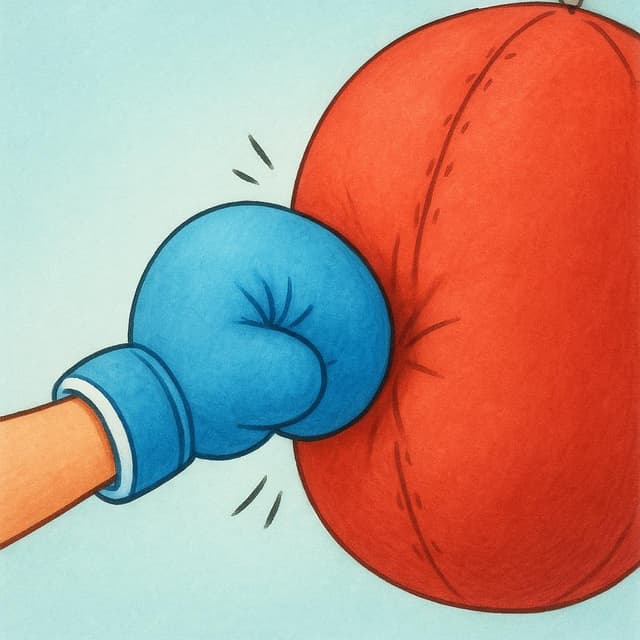
pegar Preterite Conjugation
pegar — to hit
The preterite of pegar has a spelling change in the 'yo' form (pegué) to keep the hard 'g' sound.
pegar Preterite Forms
When to Use the Preterite
Use the preterite to describe a specific time you hit something, glued an object, or when a style 'clicked' or matched perfectly in the past.
Notes on pegar in the Preterite
This is a -gar verb. In the 'yo' form, the 'g' changes to 'gu' (pegué) before the 'é' to maintain the hard 'g' sound. All other forms are regular.
Example Sentences
Ayer pegué el jarrón roto.
Yesterday I glued the broken vase.
yo
¿Le pegaste a la pelota?
Did you hit the ball?
tú
El niño le pegó a su hermano.
The boy hit his brother.
él/ella/usted
Sus zapatos no pegaron con el vestido.
Her shoes didn't match the dress.
ellos/ellas/ustedes
Common Mistakes
Mistake: Writing 'pegé' for the first person.
Correct: pegué
Why: In Spanish, 'ge' sounds like 'he'. You must add a 'u' to keep the hard 'g' sound of the infinitive.
Master Spanish verbs in context
Memorizing tables only gets you so far. Read 200+ illustrated and narrated Spanish stories to see verbs like 'pegar' used naturally — in the tenses you're learning.
Related Tenses
Present
yo: pego
The present tense of pegar is completely regular: pego, pegas, pega, pegamos, pegáis, pegan.
Imperfect
yo: pegaba
The imperfect of pegar is regular: pegaba, pegabas, pegaba, pegábamos, pegabais, pegaban.
Future
yo: pegaré
The future tense of pegar is regular, using the full infinitive as the stem: pegaré, pegarás, pegará...
Conditional
yo: pegaría
The conditional of pegar is regular: pegaría, pegarías, pegaría, pegaríamos, pegaríais, pegarían.
Present Subjunctive
yo: pegue
The present subjunctive of pegar uses the 'gu' spelling change in all forms: pegue, pegues, pegue, peguemos, peguéis, peguen.
Imperfect Subjunctive
yo: pegara
The imperfect subjunctive of pegar is regular: pegara, pegaras, pegara, pegáramos, pegarais, pegaran.
Affirmative Imperative
yo: pega
Use 'pega' (tú) for commands, and remember the 'gu' change for 'pegue' (usted) and 'peguen' (ustedes).
Negative Imperative
yo: no pegues
Negative commands always use the 'gu' spelling: no pegues, no pegue, no peguemos, no peguéis, no peguen.