





Using 'Quiero' Too Bluntly
Mistake: “Walking up to a counter and just saying 'Quiero un mapa.'”
Correction: Quisiera un mapa, por favor.
kee-see-EH-rah oon MAH-pah, por fah-VOR
This is the gold standard for politely asking for a map. 'Quisiera' is a soft, courteous form of 'I would like' that is perfect for any situation, especially when talking to strangers in hotels, tourist offices, or shops.
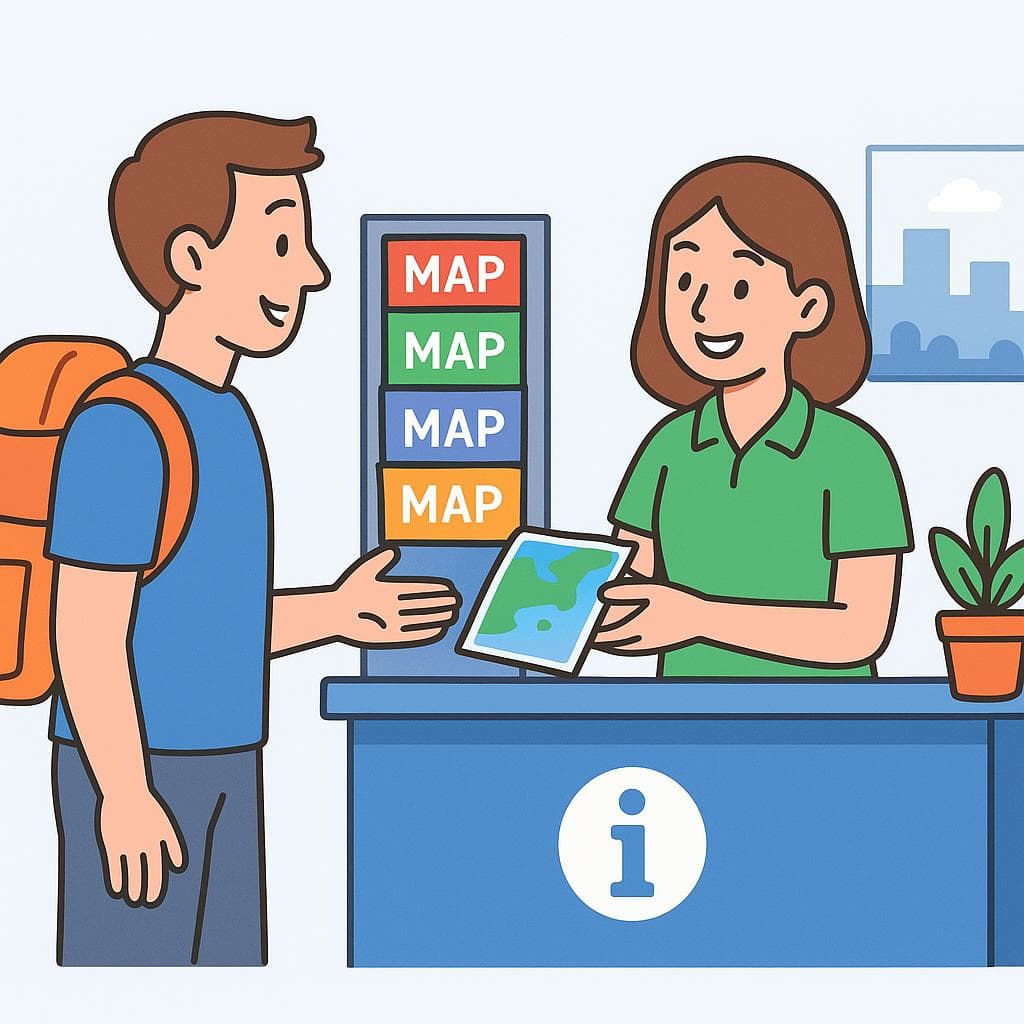
A simple, polite request like 'Quisiera un mapa, por favor' is your key to getting help and starting your adventure anywhere in the Spanish-speaking world.
I would like a map — in Spanish
meh goos-tah-REE-ah oon MAH-pah, por fah-VOR
This is another extremely common and polite way to say 'I would like a map.' It's interchangeable with 'Quisiera' in most contexts and is considered friendly and respectful.
KYEH-roh oon MAH-pah, por fah-VOR
This translates more directly to 'I want a map.' While it's very common, it can sound a bit blunt or demanding without a friendly tone and a clear 'por favor' (please).
meh PWEH-deh dar oon MAH-pah, por fah-VOR
This means 'Can you give me a map, please?' It's a very polite and complete sentence, showing respect for the person you're asking.
meh dah oon MAH-pah, por fah-VOR
A slightly more direct version of the above, this is like saying 'Will you give me a map, please?' It's very common in daily interactions in places like Spain.
neh-seh-SEE-toh oon MAH-pah, por fah-VOR
This means 'I need a map.' It's less of a request and more of a statement of necessity. It's perfectly fine but less polite than 'Quisiera' or 'Me gustaría.'
TYEH-neh oon MAH-pah
This simply means 'Do you have a map?' It's a great way to start the conversation before making the actual request. Often, the person will just hand you one if they have it.
Here’s a quick comparison of the most common ways to ask for a map, from most to least formal.
| Phrase | Formality | Best For | Avoid When |
|---|---|---|---|
| Quisiera un mapa. | Formal | Any situation where you want to be extra polite and respectful. | Never necessary to avoid; it's always a great choice. |
| Me gustaría un mapa. | Neutral/Formal | A friendly, all-purpose request that is polite and very common. | Also a safe bet in virtually all situations. |
| ¿Me da un mapa? | Neutral | Everyday, transactional situations like at a kiosk or info booth. | In very formal settings, where 'Quisiera' is a bit more polished. |
| Quiero un mapa. | Informal | Casual contexts or when you need to be very direct. Always add 'por favor'. | You want to make a good first impression or in a formal environment. |
| Necesito un mapa. | Informal/Neutral | Stating a clear need, like when renting a car or planning a long trip. | Making a simple, polite request where 'want' or 'would like' is more fitting. |
The sounds are fairly straightforward for English speakers. The key is putting the emphasis on the right syllable: kee-see-EH-rah.
The concepts behind 'Quisiera' (subjunctive) and 'Me gustaría' (conditional/gustar structure) are complex, but you can learn them as fixed phrases without knowing the deep grammar.
The main nuance is choosing the right level of politeness. Using a more polite form than necessary is always better than the reverse.
Hola, buenos días. Quisiera un mapa de la ciudad, por favor.
Hello, good morning. I would like a city map, please.
Disculpe, ¿me puede dar un mapa de las rutas de senderismo?
Excuse me, can you give me a map of the hiking trails?
Voy a alquilar un coche. Necesito un mapa de carreteras de la región.
I'm going to rent a car. I need a road map of the region.
¿Tienen un plano del metro? Me gustaría uno, por favor.
Do you have a subway map? I would like one, please.
'Quisiera' is your secret weapon for politeness in Spanish. It's the past subjunctive form of 'querer' (to want), but you don't need to know the grammar. Just know that using it instead of 'quiero' (I want) instantly makes you sound more courteous and respectful, which is highly valued in Spanish-speaking cultures.
In English, we sometimes drop 'please' in casual requests. In Spanish, 'por favor' is almost always expected when asking for something from a service person or a stranger. Forgetting it can make you seem rude, even if you use a polite verb like 'quisiera'.
While 'mapa' is a general term for any map, you might also hear the word 'plano'. A 'plano' usually refers to a detailed map of a smaller, specific area, like a city layout ('plano de la ciudad') or a building floor plan. Using 'mapa' is always safe, but if you want a city street map, asking for a 'plano' can make you sound more precise.
Mistake: “Walking up to a counter and just saying 'Quiero un mapa.'”
Correction: Quisiera un mapa, por favor.
Mistake: “Yo gusto un mapa.”
Correction: Me gustaría un mapa.
Mistake: “Quisiera mapa.”
Correction: Quisiera un mapa.
If you can only remember one phrase, make it 'Quisiera un mapa, por favor.' It is universally understood, unfailingly polite, and appropriate for any context, from a five-star hotel to a rustic bus station.
You can easily ask for a specific type of map by adding 'de...' (of...). For example: 'Quisiera un mapa de la ciudad' (of the city), 'un mapa de carreteras' (a road map), or 'un mapa del metro' (a subway map).
After you ask, they might ask you a question back, like '¿De qué zona?' (Of what area?) or '¿Gratis o de pago?' (Free or for sale?). Be prepared to hear these and have a simple answer ready.
Spaniards often use '¿Me da...?' or '¿Me pone...?' for requests in shops and bars, which is very common and natural-sounding. They might also be more likely to use 'plano' for a city map.
Politeness is extremely important in Mexican culture, especially in service interactions. Using 'Me gustaría' or 'Quisiera' is highly recommended. You might also hear the very formal '¿Me podría...?' (Could you...?) frequently.
The use of 'vos' instead of 'tú' for informal address is standard. So an informal request would be '¿Me das...?' instead of '¿Me das...?'. However, using the formal 'usted' forms like 'Quisiera' is perfectly safe for travelers.
Claro, aquí tiene.
Of course, here you go.
Muchas gracias.
Thank you very much.
¿De la ciudad o de la región?
Of the city or of the region?
De la ciudad, por favor.
Of the city, please.
Cuesta dos euros.
It costs two euros.
Vale, aquí tiene.
Okay, here you go.
This silly visual connects the sound of the word to the positive feeling of receiving help, making it easier to recall.
The biggest difference is the cultural weight of politeness. In English, 'I want a map, please' is often perfectly acceptable. In Spanish, the direct translation 'Quiero un mapa, por favor' can sound demanding. Spanish heavily favors softer constructions like 'Quisiera' (I would like) or 'Me gustaría' (It would please me) to show respect in service situations.
Spanish requests are generally more indirect than in English. Using phrases that translate to 'Could you give me...?' or 'I would like...' is the cultural norm, whereas English can be more direct, especially in casual contexts.
Why it''s different: Learners often try to translate 'I would like' as 'Me gusta' (I like). 'Me gusta' expresses a general preference (e.g., 'I like looking at maps'), not a specific request for an item.
Use instead: For a specific request, you must use 'Me gustaría' (I would like) or 'Quisiera' (I would like).
Once you have your map, you'll need to ask where specific places are located.
This is the essential polite response after someone gives you the map.
Sometimes maps aren't free, so you'll need to be prepared to ask for the price.
A crucial phrase for any beginner traveler when the response to your question is too fast or complex.
Question 1 of 3
You're at a formal hotel concierge desk. What is the MOST polite way to ask for a map?
Knowing a phrase is one thing — using it at the right moment is another. Read 200+ illustrated and narrated Spanish stories to see phrases in the contexts where they actually belong.
Think of it like 'I would like' vs. 'I want'. 'Quisiera' is a soft, polite request, perfect for asking for things from people you don't know. 'Quiero' is a more direct statement of desire, which can sound a bit demanding if you're not careful with your tone and don't add 'por favor'.
For all practical purposes, yes. They are both very polite ways to say 'I would like a map' and are used interchangeably in most regions. You can't go wrong with either one. 'Quisiera' is sometimes considered a touch more formal, but both are excellent choices.
It's easy! Just add 'de' (of/from) after 'mapa'. For example: 'Quisiera un mapa DE LA CIUDAD' (a city map), 'un mapa DE CARRETERAS' (a road map), or 'un mapa DEL METRO' (a subway map).
Yes, it's a very good habit. While a friendly person might give you a map without it, adding 'por favor' is the cultural norm for politeness. It shows respect and will always get you a better reaction. When in doubt, always add it.
Yes, you can. This is a very common shortcut, similar to saying 'A map, please' in English. It's perfectly acceptable at a counter, but using a full sentence like 'Quisiera un mapa, por favor' sounds a little more complete and polite, especially for a learner.
Strengthen the grammar behind this phrase:
Dive deeper into related topics:
Find similar phrases to expand your Spanish vocabulary:
Browse our complete collection of Spanish phrases organized by situation, from basic greetings to advanced conversations. Perfect for travelers, students, and anyone learning Spanish.
View All Spanish Phrases →