
Caer vs Caerse
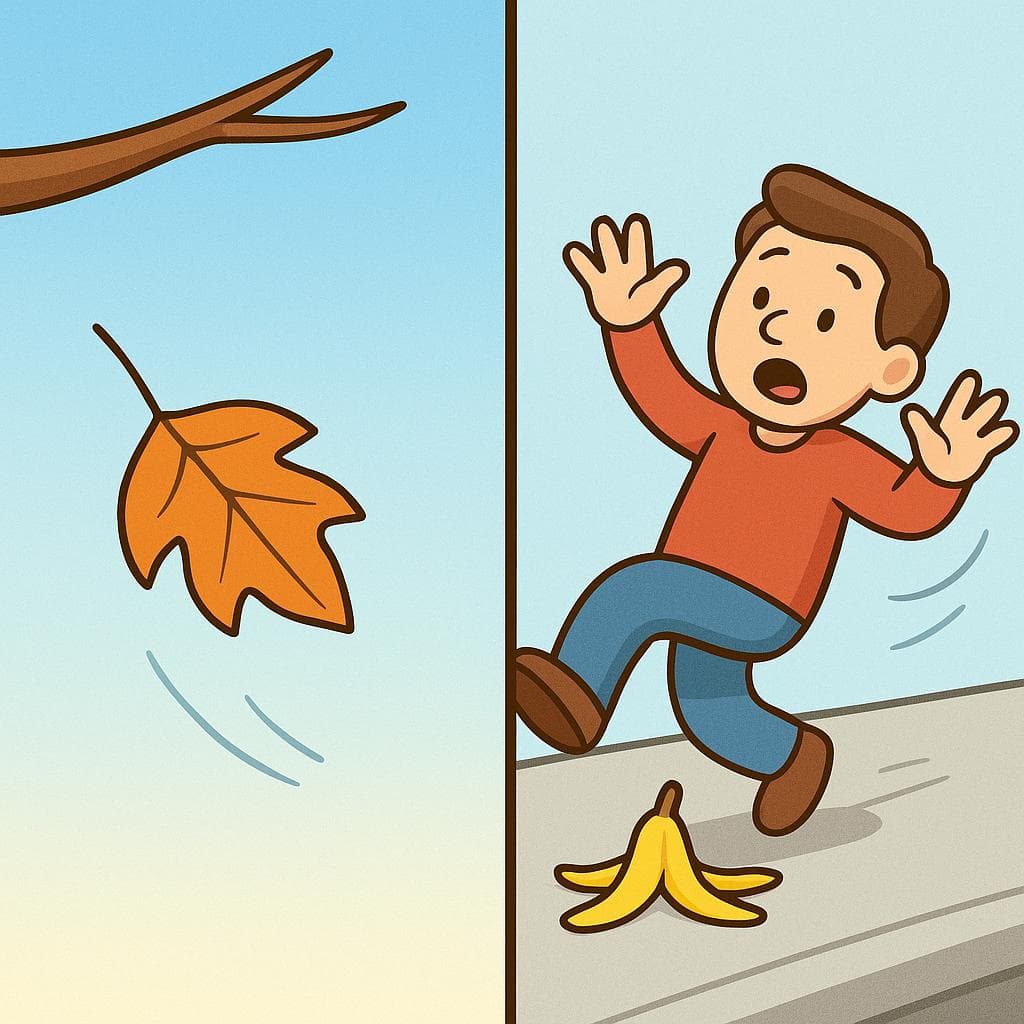
Caer = to fall (like rain or leaves). Caerse = to fall down (like a person or a vase).
caer
To fall, drop, or descend, often due to a natural force like gravity.
kah-EHRcaerse
To fall down, topple over, or collapse, usually involving a loss of balance or support.
kah-EHR-sehQuick Rule
Caer = to fall (like rain or leaves). Caerse = to fall down (like a person or a vase).
Think: The '-se' in 'caerse' attaches to your'se'lf or something that can topple over.
- The phrase 'caer bien/mal' (to like/dislike someone) is a special figurative use of 'caer'.
- To say you dropped something accidentally, you use a special structure with 'caerse': 'Se me cayó el teléfono' (I dropped my phone).
Comparison Table
| Context | caer | caerse | Why? |
|---|---|---|---|
| Weather vs. People | La nieve cae lentamente. | El esquiador se cae. | Caer for natural phenomena. Caerse for a person losing balance. |
| Objects | La fruta madura cae del árbol. | El cuadro se cayó de la pared. | Caer for a natural downward process. Caerse implies something was in a position and then toppled over. |
| Dropping Things | Dejó caer la carta en el buzón. | Se me cayó la carta al suelo. | Caer (with 'dejar') can imply intent. Caerse (with 'se me/te/le') emphasizes an accident. |
| Figurative vs. Literal | El sol cae en el horizonte. | Me caí de la cama esta mañana. | Caer can be poetic or figurative. Caerse is almost always a literal, physical fall. |
When to Use "caer / caerse"
caer
To fall, drop, or descend, often due to a natural force like gravity.
kah-EHR
Natural phenomena (rain, snow, leaves)
Las hojas caen en otoño.
The leaves fall in autumn.
Dates or holidays
Este año, mi cumpleaños cae en viernes.
This year, my birthday falls on a Friday.
Figurative falling (like night or the sun)
La noche cae sobre la ciudad.
The night falls over the city.
To describe a general downward movement
La pelota cayó en el jardín del vecino.
The ball fell into the neighbor's yard.
caerse
To fall down, topple over, or collapse, usually involving a loss of balance or support.
kah-EHR-seh
People or animals falling down
¡Cuidado! Te vas a caer.
Be careful! You're going to fall down.
Objects toppling or falling off a surface
El vaso se cayó de la mesa.
The glass fell off the table.
Accidentally dropping something
Se me cayeron las llaves en la alcantarilla.
I dropped my keys in the sewer.
Structures collapsing
El viejo puente se cayó durante la tormenta.
The old bridge collapsed during the storm.
Contrast Examples
With "caer":
La manzana cae del árbol.
The apple falls from the tree.
With "caerse":
El gato se cae del árbol.
The cat falls down from the tree.
The Difference: 'Caer' describes the natural, expected fall of an inanimate object. 'Caerse' describes a living being losing its footing and falling down.
With "caer":
La demolición hizo caer el edificio.
The demolition made the building fall.
With "caerse":
El edificio se cayó en el terremoto.
The building fell down/collapsed in the earthquake.
The Difference: Using 'caer' with a verb like 'hacer' (to make) implies an external force causing the fall. 'Caerse' describes the building collapsing as an event, focusing on the building itself losing its structure.
Common Mistakes
Yo caí en el hielo.
Me caí en el hielo.
When you fall down yourself, it's a loss of balance, so you must use the reflexive form 'caerse'. 'Yo caí' sounds incomplete, like you're a raindrop.
La lluvia se cae.
La lluvia cae.
Rain doesn't have balance to lose, it just falls naturally due to gravity. Use the simple form 'caer' for weather.
Yo caí mi teléfono.
Se me cayó el teléfono.
In Spanish, you don't 'drop' things directly. You say 'it fell from me' using the 'se me cayó' structure. This is a very common and important pattern to learn.
Quick Practice
Quick Quiz: Caer vs Caerse
Question 1 of 3
Which is correct? 'Yesterday, I slipped on the ice and...'
Related Grammar
Want to understand the grammar behind this pair? Explore these lessons for a deep dive:
Key Words

Tags
Build the instinct, not just the rule
Rules help you get it right; context makes it automatic. Read 200+ illustrated and narrated Spanish stories to see confusing pairs chosen correctly — over and over — until you stop thinking about it.
Frequently Asked Questions
So 'caerse' is just the reflexive version of 'caer'?
Yes, exactly! Adding the reflexive pronoun (me, te, se, nos, os, se) changes the meaning from a general 'falling' to a specific 'falling down' or 'toppling over'. This is a common pattern in Spanish with verbs like ir/irse (to go/to leave) and dormir/dormirse (to sleep/to fall asleep).
Why is 'Se me cayó el libro' correct and not 'Yo caí el libro'?
Spanish has a special way of talking about accidents to remove blame. Instead of saying 'I dropped the book' (which sounds like you're the direct cause), you say 'Se me cayó el libro' (literally, 'The book fell from me'). It frames the event as something that happened to you, not something you did. It's a very common structure for dropping things, forgetting things, or breaking things by accident.