
Cambiar vs Cambiarse
Cambiar = to change SOMETHING. Cambiarse = to change YOURSELF.
cambiar
To change, exchange, or alter something external to you (an object, money, a plan, another person).
kahm-bee-ARcambiarse
To change something about yourself. This is a reflexive verb, meaning the action reflects back on the person doing it.
kahm-bee-AR-sehQuick Rule
Cambiar = to change SOMETHING. Cambiarse = to change YOURSELF.
Cambiarse has 'se' for 'self'. If the change is about you (your clothes, your house, your location), add the 'se'.
- The phrase 'cambiar de opinión' (to change one's mind) is not reflexive, even though it's a personal change.
Comparison Table
| Context | cambiar | cambiarse | Why? |
|---|---|---|---|
| Clothes | Cambió el vestido en la tienda. | Se cambió de vestido para la fiesta. | Cambiar = to exchange an item. Cambiarse = to change what you are wearing. |
| House | Cambiaron los muebles de la casa. | Se cambiaron de casa. | Cambiar = to alter things inside the house. Cambiarse = to move to a new house. |
| Position | El jefe cambió a Juan de departamento. | Juan se cambió de departamento. | Cambiar = someone else moves you. Cambiarse = you move yourself. |
When to Use "cambiar / cambiarse"
cambiar
To change, exchange, or alter something external to you (an object, money, a plan, another person).
kahm-bee-AR
Changing an object
Voy a cambiar la bombilla.
I'm going to change the lightbulb.
Exchanging money or an item
¿Puedes cambiar un billete de 50?
Can you change a 50 bill?
Altering a plan or situation
Tuvimos que cambiar nuestros planes.
We had to change our plans.
Transforming something/someone else
La tecnología cambió el mundo.
Technology changed the world.
cambiarse
To change something about yourself. This is a reflexive verb, meaning the action reflects back on the person doing it.
kahm-bee-AR-seh
Changing your clothes
Me voy a cambiar para la cena.
I'm going to get changed for dinner.
Moving house (changing your home)
Mis vecinos se cambiaron el mes pasado.
My neighbors moved last month.
Switching jobs or schools
Ana se cambió de colegio.
Ana changed schools.
Moving your physical position
¿Te importa si me cambio de asiento?
Do you mind if I change seats?
Contrast Examples
With "cambiar":
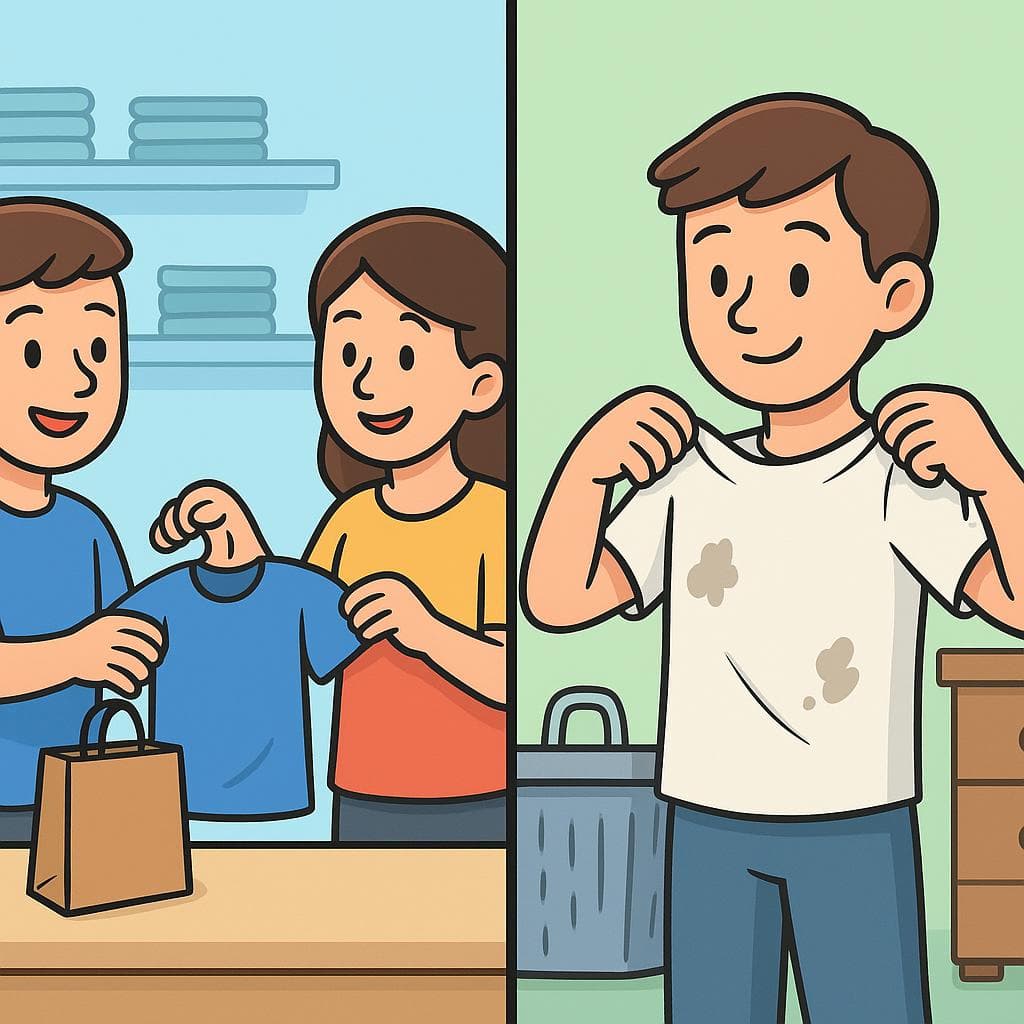
Cambié la camisa porque no me quedaba bien.
I exchanged the shirt (at the store) because it didn't fit me.
With "cambiarse":
Me cambié la camisa porque derramé café en ella.
I changed my shirt because I spilled coffee on it.
The Difference: 'Cambiar' implies an exchange of an item, usually at a store. 'Cambiarse' means to change the clothes you are currently wearing for different ones.
With "cambiar":
Cambiamos el color de las paredes.
We changed the color of the walls.
With "cambiarse":
Nos cambiamos de casa.
We moved house.
The Difference: 'Cambiar' affects an object or feature of the house. 'Cambiarse' means the people themselves have moved to a new location.
Common Mistakes
Voy a cambiar para la fiesta.
Voy a cambiarme para la fiesta.
When you are changing your own clothes, the action is on 'yourself', so you need the reflexive form 'cambiarse'.
Me cambié el aceite del coche.
Cambié el aceite del coche.
You are changing an object (the oil), not yourself. The action is external, so you use the non-reflexive 'cambiar'.
Me cambio de opinión.
Cambio de opinión.
This is a common exception. The set phrase 'to change one's mind' is 'cambiar de opinión', without the reflexive pronoun.
Quick Practice
Quick Quiz: Cambiar vs Cambiarse
Question 1 of 2
Which is correct for 'We moved to Madrid last year'?
Related Grammar
Want to understand the grammar behind this pair? Explore these lessons for a deep dive:
Key Words

Tags
Build the instinct, not just the rule
Rules help you get it right; context makes it automatic. Read 200+ illustrated and narrated Spanish stories to see confusing pairs chosen correctly — over and over — until you stop thinking about it.
Frequently Asked Questions
Is 'cambiarse' just the verb 'cambiar' with pronouns added?
Exactly! It's what we call a reflexive verb. You conjugate 'cambiar' as you normally would, but you add a reflexive pronoun (me, te, se, nos, os, se) before the verb to show that the action is being done by the person to themselves.
What does 'cambiar de...' mean without the 'se'?
'Cambiar de + [noun]' is a very common structure that means 'to switch' or 'to change one's [noun]'. For example, 'cambiar de tema' (to change the subject), 'cambiar de tren' (to change trains), or 'cambiar de opinión' (to change one's mind). It's a useful pattern to learn.