
lavar vs lavarse
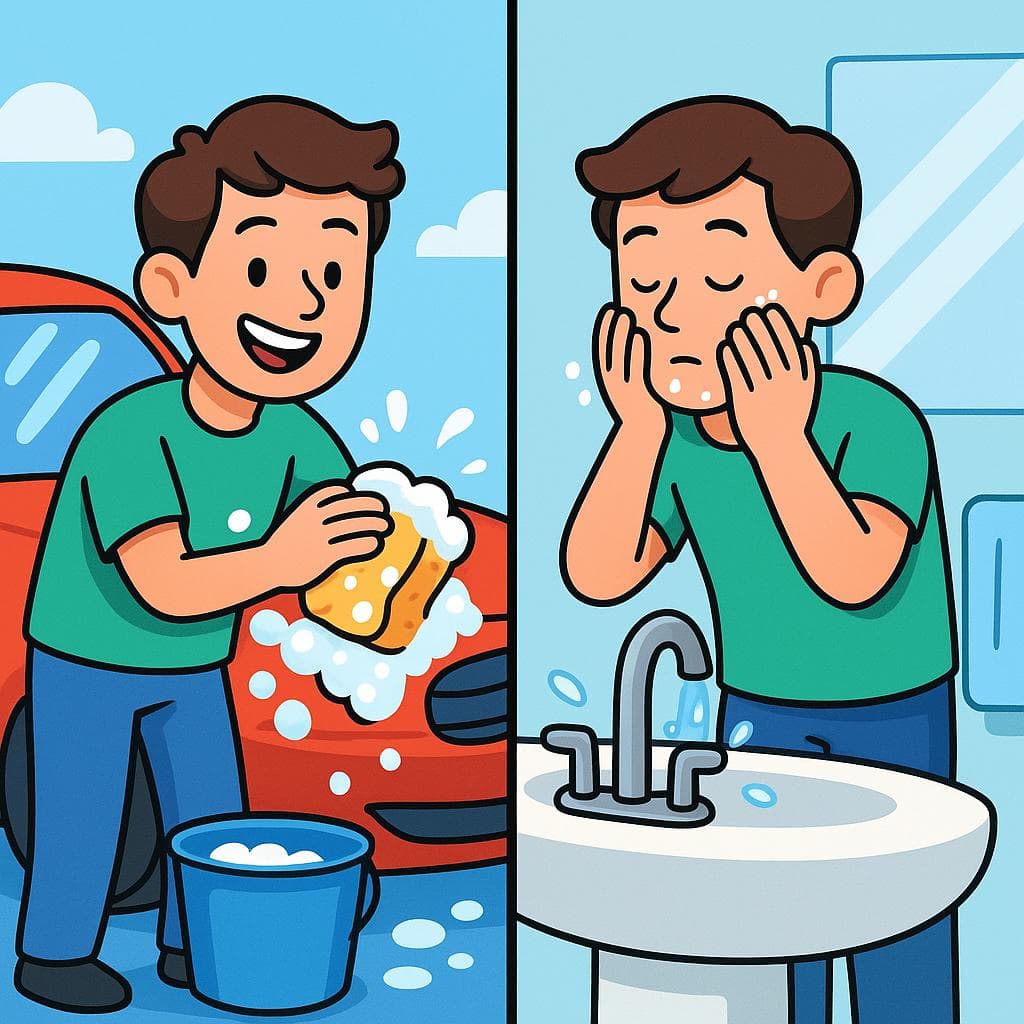
Lavar = wash something else. Lavarse = wash yourself.
lavar
To wash (an object or another person/thing)
lah-VARlavarse
To wash oneself (or a part of oneself)
lah-VAR-sehQuick Rule
Lavar = wash something else. Lavarse = wash yourself.
If you see the 'se', the action reflects on 'me' (or you, or him...)
- When washing a body part, it's always 'lavarse', e.g., 'Me lavo las manos' (I wash my hands), not the literal 'Lavo mis manos'.
Comparison Table
| Context | lavar | lavarse | Why? |
|---|---|---|---|
| The Action's Target | Lavo el plato. | Me lavo la cara. | Lavar acts on an external object (the plate). Lavarse acts on the subject (the person doing the action). |
| Who Gets Clean? | La madre lava al niño. | El niño se lava. | With lavar, the mother acts on the child. With lavarse, the child acts on himself. |
| Washing Body Parts | El peluquero lava mi pelo. | Me lavo el pelo. | Lavar is for when someone else washes you. Lavarse is for when you wash yourself. Note: 'Me lavo el pelo' is correct, not 'Lavo mi pelo'. |
When to Use "lavar / lavarse"
lavar
To wash (an object or another person/thing)
lah-VAR
Washing objects
Voy a lavar el coche.
I'm going to wash the car.
Washing clothes
Ella lava la ropa los sábados.
She washes the clothes on Saturdays.
Washing someone or something else
El padre lava al bebé.
The father washes the baby.
lavarse
To wash oneself (or a part of oneself)
lah-VAR-seh
Washing your whole body
Normalmente me lavo por la noche.
I normally wash (myself) at night.
Washing a part of your body
¿Te lavas las manos antes de comer?
Do you wash your hands before eating?
Action done to oneself
Nos lavamos el pelo con este champú.
We wash our hair with this shampoo.
Contrast Examples
With "lavar":
Lavo la toalla.
I wash the towel.
With "lavarse":
Me lavo la cara.
I wash my face.
The Difference: Lavar is for washing an object (the towel). Lavarse is for washing a part of yourself (your face). The action is directed outwards vs. inwards.
With "lavar":
El peluquero lava el pelo del cliente.
The hairdresser washes the client's hair.
With "lavarse":
Yo me lavo el pelo.
I wash my (own) hair.
The Difference: Use lavar when someone washes someone else's hair. Use lavarse when you wash your own hair. The 'se' (or 'me', 'te', etc.) tells you the action is happening to the subject.
Common Mistakes
Yo lavo mis manos.
Yo me lavo las manos.
When you do an action to your own body, use the reflexive form ('me lavo') and a definite article ('las manos'), not a possessive adjective like 'mis'.
Yo lavo en la ducha.
Yo me lavo en la ducha.
If you don't specify *what* you are washing, it's assumed you are washing yourself. Therefore, you must use the reflexive form 'lavarse'.
Quick Practice
Quick Quiz: lavar vs lavarse
Question 1 of 3
Choose the correct verb: 'Yo ___ el coche los domingos.'
Related Grammar
Want to understand the grammar behind this pair? Explore these lessons for a deep dive:
Key Words
Tags
Build the instinct, not just the rule
Rules help you get it right; context makes it automatic. Read 200+ illustrated and narrated Spanish stories to see confusing pairs chosen correctly — over and over — until you stop thinking about it.
Frequently Asked Questions
Why can't I say 'Lavo mis manos'?
While it's grammatically understandable, it's not how native speakers talk. In Spanish, when the person doing the action is the same person who owns the body part, you must use a reflexive verb. 'Me lavo las manos' literally means 'I wash for myself the hands'—it's already clear they are your hands.
Is every verb that ends in '-se' a reflexive verb?
Not always, but it's a great starting point! Most verbs ending in '-se' in their dictionary form (the infinitive) are reflexive, meaning the action reflects back on the doer. There are other uses for 'se', but thinking of it as 'to oneself' will be correct most of the time for beginners.