
Colgar vs Tender
Colgar = hang from a point (hook, hanger). Tender = spread out to dry (clothesline).
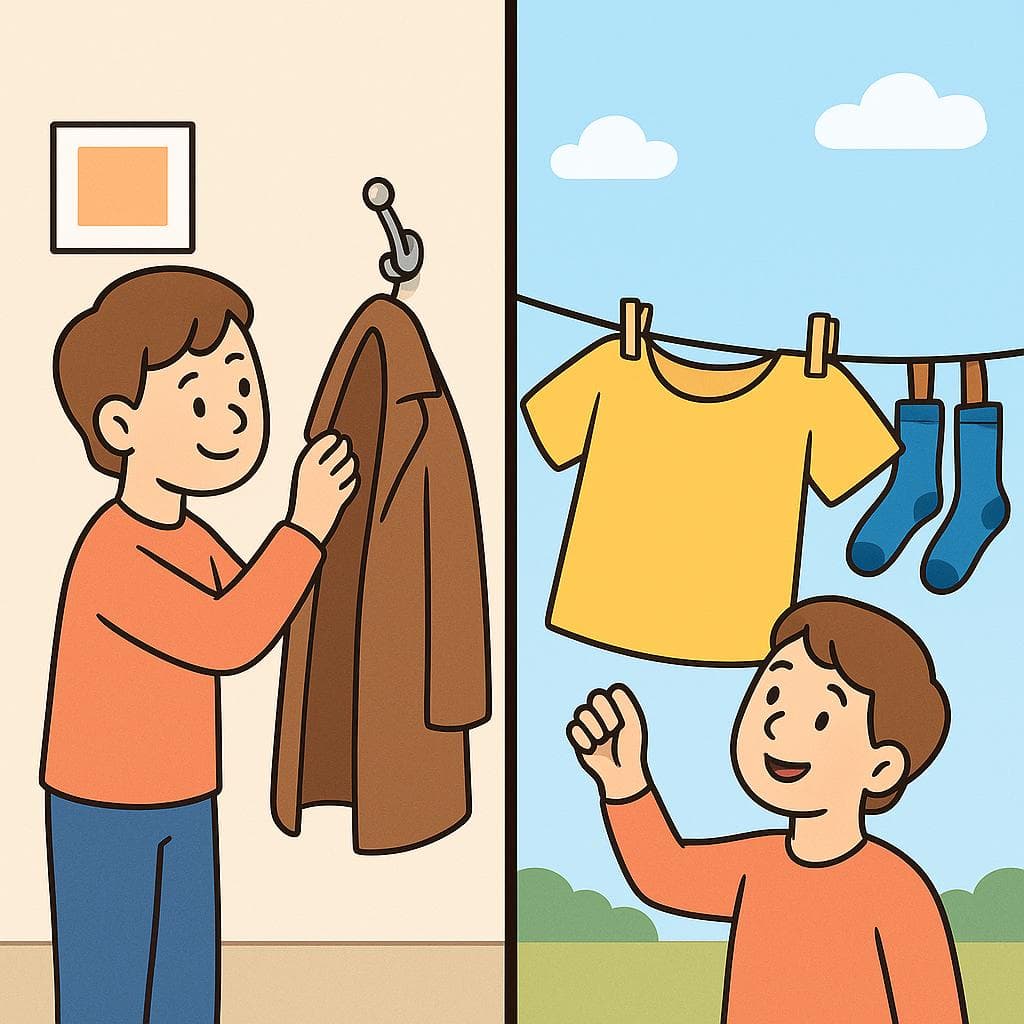
colgar
To hang something up, usually from a single point like a hook, nail, or hanger. Also, to hang up a phone.
kol-GARtender
To spread something out, especially clothes on a line to dry. Can also mean to lay something flat or extend something.
ten-DERQuick Rule
Colgar = hang from a point (hook, hanger). Tender = spread out to dry (clothesline).
Think: Colgar uses a 'C'oat hanger. Tender makes clothes 'T'aut on a line.
- 'Colgar el teléfono' means 'to hang up the phone', even though there's no hook anymore.
Comparison Table
| Context | colgar | tender | Why? |
|---|---|---|---|
| Putting away clothes | Cuelga la chaqueta en el perchero. | Tender la ropa mojada en la cuerda. | Colgar is for single points like hooks and hangers. Tender is for spreading clothes out on a line to dry. |
| Using a blanket | Colgó la manta en la ventana. | Tendió la manta sobre el césped. | Colgar means to suspend it vertically. Tender means to lay it out flat on a surface. |
| Body position | Sus piernas colgaban del borde. | Se tendió en la cama. | Colgar describes limbs dangling freely. Tender describes laying the whole body down. |
When to Use "colgar / tender"
colgar
To hang something up, usually from a single point like a hook, nail, or hanger. Also, to hang up a phone.
kol-GAR
Hanging clothes on a hanger
Voy a colgar mi camisa en el armario.
I'm going to hang my shirt in the closet.
Hanging decorations on a wall
Colgamos el cuadro nuevo en el salón.
We hung the new painting in the living room.
Ending a phone call
Me colgó sin decir adiós.
She hung up on me without saying goodbye.
Dangling from something
Los pies del niño colgaban de la silla alta.
The child's feet were dangling from the high chair.
tender
To spread something out, especially clothes on a line to dry. Can also mean to lay something flat or extend something.
ten-DER
Hanging laundry on a line
Hay que tender la ropa antes de que llueva.
We have to hang the clothes out before it rains.
Spreading something on a surface
Tendió el mapa sobre la mesa.
He spread the map out on the table.
Lying down
Se tendió en el sofá a descansar.
He lay down on the sofa to rest.
Extending a hand
Me tendió la mano para ayudarme a levantar.
He held out his hand to help me up.
Contrast Examples
With "colgar":
Cuelga la toalla en el gancho del baño.
Hang the towel on the hook in the bathroom.
With "tender":
Tender la toalla en el balcón para que se seque bien.
Spread the towel out on the balcony so it dries well.
The Difference: Both are ways to hang a towel. 'Colgar' implies using a single point like a hook, which might not be best for drying. 'Tender' implies spreading it out over a railing or line to dry properly.
With "colgar":
Colgó la tela del techo como decoración.
He hung the fabric from the ceiling as decoration.
With "tender":
Tendió la tela en el suelo para pintar.
He spread the fabric on the floor to paint.
The Difference: 'Colgar' means to suspend something vertically from a high point. 'Tender' means to lay it out flat across a surface.
Common Mistakes
Voy a tender mi abrigo en la percha.
Voy a colgar mi abrigo en la percha.
For hangers ('perchas') and hooks, always use 'colgar'. You hang it from a single point.
Por favor, cuelga las sábanas en la cuerda para que se sequen.
Por favor, tiende las sábanas en la cuerda para que se sequen.
For clotheslines ('cuerdas'), where the goal is to spread things out to dry, the correct verb is 'tender'.
Quick Practice
Quick Quiz: Colgar vs Tender
Question 1 of 3
To hang a wet t-shirt on a clothesline, you should...
Related Grammar
Want to understand the grammar behind this pair? Explore these lessons for a deep dive:
Key Words




Tags
Build the instinct, not just the rule
Rules help you get it right; context makes it automatic. Read 200+ illustrated and narrated Spanish stories to see confusing pairs chosen correctly — over and over — until you stop thinking about it.
Frequently Asked Questions
Can I ever use 'colgar' for laundry?
Yes, but only if you are hanging items individually on hangers to dry. For example, you might 'colgar una blusa en una percha' (hang a blouse on a hanger) and let it air dry. But for a clothesline, you always 'tender la ropa'.
Does 'tender' have other meanings?
Yes, 'tender a + [infinitive]' means 'to tend to do something' (e.g., 'tiendo a olvidar las llaves' - I tend to forget my keys). However, when talking about physical objects, it almost always means to spread, stretch, or lay out.