
Parar vs Pararse
Parar = stop something/someone. Pararse = stop yourself (or stand up).
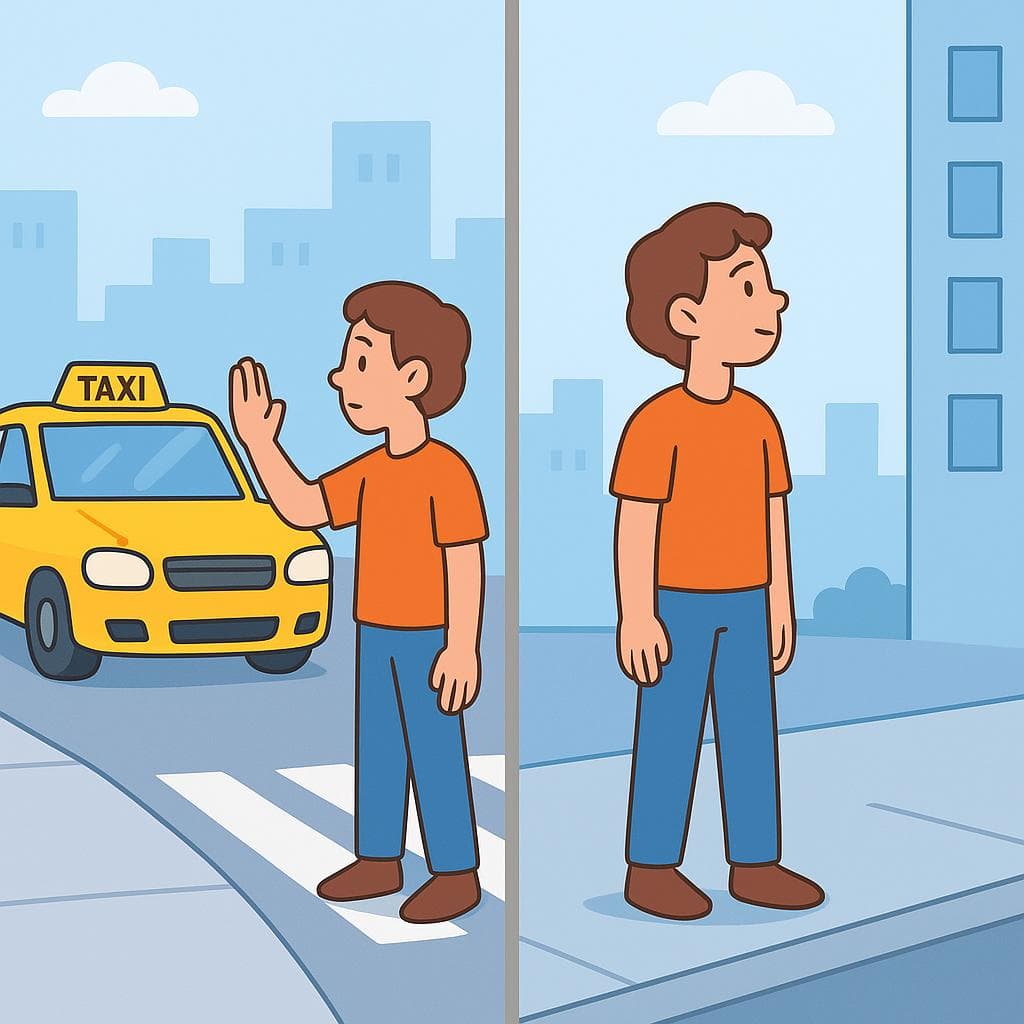
parar
To stop something or someone; to bring an action or process to a halt.
pah-RAHRpararse
To stop one's own movement; to come to a halt; to stand up.
pah-RAHR-sehQuick Rule
Parar = stop something/someone. Pararse = stop yourself (or stand up).
Think: Parar = Put the brakes on something. Pararse = Stand up straight.
- When a bus or train stops on its route, you often use 'parar': 'El autobús para aquí.' (The bus stops here.)
- To say 'stop doing something', you use 'parar de + infinitive', not 'pararse'.
Comparison Table
| Context | parar | pararse | Why? |
|---|---|---|---|
| A person's movement | La madre paró al niño. | El niño se paró. | Parar: someone stops someone else. Pararse: someone stops themselves. |
| A vehicle | Paré el taxi. | El taxi se paró de repente. | Parar: you actively stopped it (e.g., hailed it). Pararse: it stopped on its own (e.g., broke down). |
| An action | Para de hablar. | Se paró para hablar. | Parar de: cease an action. Pararse para: stop moving in order to do something. |
| A machine | Tienes que parar la impresora. | La impresora se paró. | Parar: you manually stop it. Pararse: it stopped working by itself. |
When to Use "parar / pararse"
parar
To stop something or someone; to bring an action or process to a halt.
pah-RAHR
Stopping a vehicle or machine
El taxista paró el coche.
The taxi driver stopped the car.
Stopping an action (parar de + infinitive)
¡Para de hacer eso!
Stop doing that!
Stopping another person
La policía me paró en la carretera.
The police stopped me on the highway.
A scheduled stop (like a bus)
Este tren no para en Sevilla.
This train doesn't stop in Seville.
pararse
To stop one's own movement; to come to a halt; to stand up.
pah-RAHR-seh
Stopping your own movement
Me paré para admirar la vista.
I stopped (myself) to admire the view.
To stand up
Por favor, párate para que te pueda ver.
Please, stand up so I can see you.
A machine stopping on its own
El reloj se paró a las tres.
The clock stopped at three.
To end up or land somewhere
No sé cómo el gato se paró en el techo.
I don't know how the cat ended up on the roof.
Contrast Examples
With "parar":
El policía paró el coche.
The police officer stopped the car.
With "pararse":
El coche se paró en la autopista.
The car stopped (broke down) on the highway.
The Difference: Parar is an action done *to* the car by an external force. Pararse is something the car does by itself, usually implying a malfunction.
With "parar":
Su amigo lo paró antes de que cometiera un error.
His friend stopped him before he made a mistake.
With "pararse":
Se paró en seco cuando vio el precio.
He stopped dead in his tracks when he saw the price.
The Difference: Parar needs an object: someone stops someone else. Pararse is reflexive: the person stops their own movement.
With "parar":
Para de mover la silla, por favor.
Stop moving the chair, please.
With "pararse":
Párate de la silla, por favor.
Stand up from the chair, please.
The Difference: This shows the two very different core meanings. 'Parar de' means to cease an activity. 'Pararse' often means to get on your feet.
Common Mistakes
Yo paré en la calle para ver el mapa.
Yo me paré en la calle para ver el mapa.
When you stop your own body's movement, you need the reflexive form 'pararse'. 'Yo paré' implies you stopped something else, like a car.
¡Párate de quejarte!
¡Para de quejarte!
The command to 'stop doing something' is 'parar de + infinitive'. 'Pararse' means to stop moving or to stand up.
El coche paró en la autopista.
El coche se paró en la autopista.
While 'parar' can be used for scheduled stops, 'pararse' is used for unexpected stops, like a car breaking down. The first sentence isn't strictly wrong, but the second is more natural for a breakdown.
Quick Practice
Quick Quiz: Parar vs Pararse
Question 1 of 3
Which sentence means 'The clock broke and stopped'?
Related Grammar
Want to understand the grammar behind this pair? Explore these lessons for a deep dive:
Key Words

Tags
Build the instinct, not just the rule
Rules help you get it right; context makes it automatic. Read 200+ illustrated and narrated Spanish stories to see confusing pairs chosen correctly — over and over — until you stop thinking about it.
Frequently Asked Questions
Why does Spanish have two versions of 'to stop'?
It's not really two versions of 'to stop', but one verb that can be used reflexively. The reflexive pronoun 'se' changes the focus of the action from an external object back to the subject itself. This is a common pattern in Spanish with many verbs, like ir/irse (to go/to leave) and dormir/dormirse (to sleep/to fall asleep).
Can I ever say 'Yo paré' without saying what I stopped?
It's rare and can sound incomplete. A listener would be waiting for the object: '¿Qué paraste?' (What did you stop?). If you mean you stopped your own movement, it's always clearer and more natural to say 'Yo me paré'.
Is 'pararse' the same as 'detenerse'?
They are very similar! 'Detenerse' is a slightly more formal synonym for 'pararse' (to stop oneself). 'La policía me detuvo' is also a more formal way of saying 'La policía me paró'. For everyday conversation, 'parar' and 'pararse' are more common.