
Pasar vs Pasarse
Pasar = to pass or happen. Pasarse = to go too far or cross a limit.
pasar
To pass, to happen, to spend time, to hand over.
pah-SARpasarse
To go too far, to overdo, to spoil (food), to miss (a stop), to switch.
pah-SAR-sehQuick Rule
Pasar = to pass or happen. Pasarse = to go too far or cross a limit.
Think: 'Pasar' passes by, but 'Pasarse' surpasses the limit.
- The phrase 'se me pasó' means 'it slipped my mind' or 'I forgot'.
- The set phrase 'pasarlo bien/mal' means 'to have a good/bad time' and uses 'pasar'.
Comparison Table
| Context | pasar | pasarse | Why? |
|---|---|---|---|
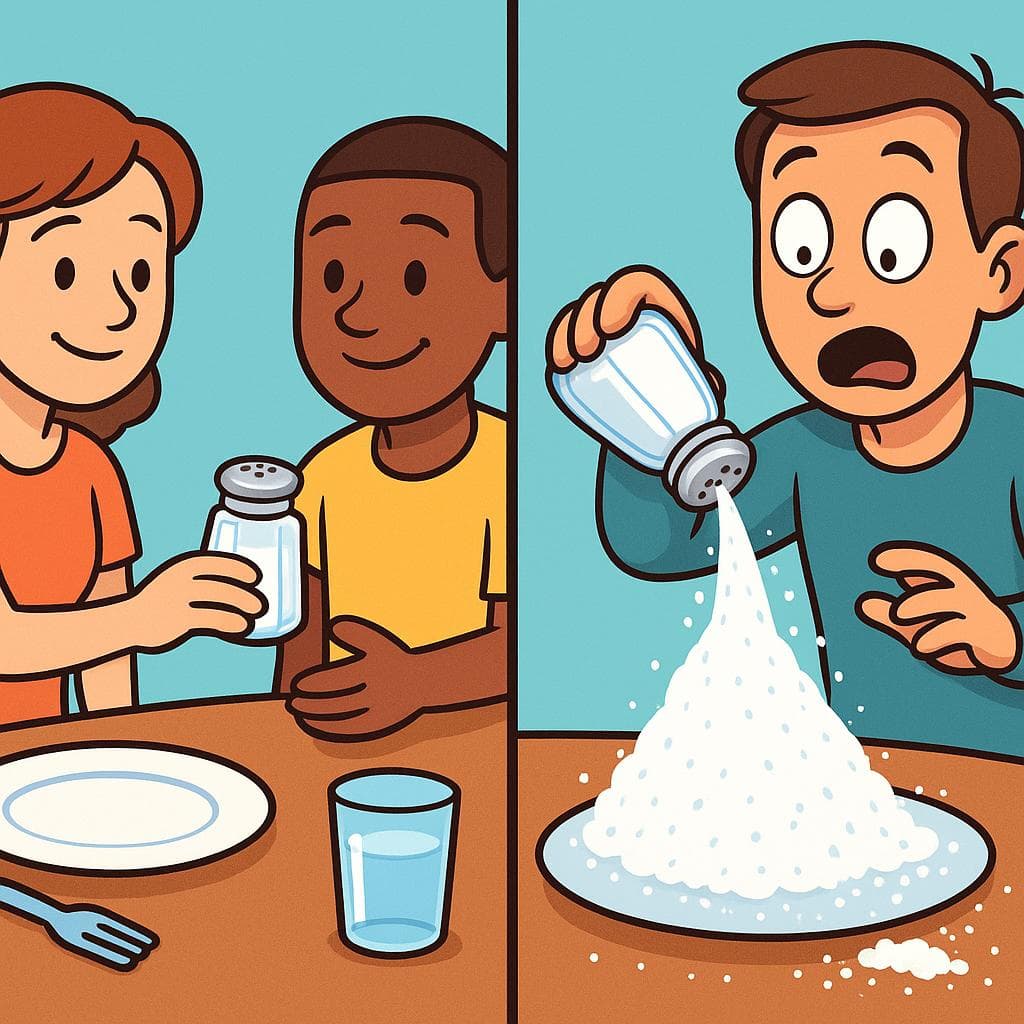
| Cooking with ingredients | Pasa la sal. | Te pasaste con la sal. | Pasar is a simple action (hand it over). Pasarse means you used an excessive amount. |
| Time | El tiempo pasa muy rápido. | Se me pasó la hora de la cita. | Pasar describes the general flow of time. Pasarse (reflexively) means you missed a specific point in time. |
| Cooking food | El pollo debe pasar 20 minutos en el horno. | El pollo se pasó; está muy seco. | Pasar refers to the duration of cooking. Pasarse means it went past the ideal time and is now overcooked. |
| Behavior | ¿Qué te pasa? | ¡No te pases! | Pasar asks what is happening to someone. Pasarse is a command not to cross a line or be out of line. |
When to Use "pasar / pasarse"
pasar
To pass, to happen, to spend time, to hand over.
pah-SAR
To happen or occur
¿Qué pasa aquí?
What's happening here?
To spend time
Pasamos el fin de semana en las montañas.
We spent the weekend in the mountains.
To pass by or go through
El desfile pasa por la calle principal.
The parade passes through the main street.
To hand something to someone
¿Me pasas el azúcar, por favor?
Can you pass me the sugar, please?
pasarse
To go too far, to overdo, to spoil (food), to miss (a stop), to switch.
pah-SAR-seh
To go too far or overdo it
Te pasaste con esa broma, no fue graciosa.
You went too far with that joke, it wasn't funny.
For food to go bad or be overcooked
Deja el arroz en el fuego o se va a pasar.
Take the rice off the heat or it's going to get overcooked.
To miss something unintentionally (like a stop or date)
¡Ay, se me pasó la parada del autobús!
Oh no, I missed the bus stop!
To switch allegiance or sides
El jugador se pasó al equipo rival.
The player switched to the rival team.
Contrast Examples
With "pasar":
Pasa el coche a la derecha.
Move the car to the right.
With "pasarse":
Te pasaste el semáforo en rojo.
You went through (and passed) the red light.
The Difference: Pasar is a simple instruction to move something. Pasarse implies crossing a boundary or limit you shouldn't have, like a red light.
With "pasar":
Pasa la línea amarilla.
Cross the yellow line.
With "pasarse":
Te pasaste de la línea.
You went too far over the line.
The Difference: Pasar is the neutral action of crossing. Pasarse implies you've exceeded the limit, gone too far, or broken a rule associated with that line.
With "pasar":
Pasa por ser muy listo.
He passes for (is considered) very clever.
With "pasarse":
Se pasó de listo y lo atraparon.
He tried to be a smart-aleck and they caught him.
The Difference: 'Pasar por' means to have a reputation for something. 'Pasarse de listo' is a negative idiom meaning to be a smart-aleck or try to be too clever, usually with bad results.
Common Mistakes
La leche pasó.
La leche se pasó.
To say food or drink has spoiled or gone bad, you must use the reflexive form 'pasarse'.
Yo pasé mi parada.
Se me pasó la parada.
While the first sentence is understandable, the most natural way to say you unintentionally missed a stop, appointment, or deadline is with the 'se me pasó' structure.
Tú pasas con tus comentarios.
Te pasas con tus comentarios.
To tell someone they are 'going too far' or 'crossing the line' with their behavior, you need the reflexive 'pasarse'.
Quick Practice
Quick Quiz: Pasar vs Pasarse
Question 1 of 2
Which sentence means 'You went overboard with the sugar'?
Related Grammar
Want to understand the grammar behind this pair? Explore these lessons for a deep dive:
Key Words

Tags
Build the instinct, not just the rule
Rules help you get it right; context makes it automatic. Read 200+ illustrated and narrated Spanish stories to see confusing pairs chosen correctly — over and over — until you stop thinking about it.
Frequently Asked Questions
Why does adding '-se' change the meaning so much?
In Spanish, adding a reflexive pronoun like 'se', 'me', or 'te' to a verb can completely change its meaning. It's not just for actions you do to yourself (like 'lavarse' - to wash oneself). In cases like 'pasar' vs 'pasarse', the '-se' adds a nuance of completion, excess, or unintentional occurrence. It's a common pattern you'll also see in pairs like 'ir' (to go) vs 'irse' (to leave).
Can I use 'pasar' to say 'I passed the exam'?
No, that's a common 'false friend' from English. To say you passed an exam, you should use the verb 'aprobar'. For example, 'Aprobé el examen de español'. If you say 'pasé el examen', it could be misinterpreted as 'I skipped the exam' or 'I handed over the exam paper'.