
Ponerse a vs Empezar a
Ponerse a = a sudden start. Empezar a = a general start.
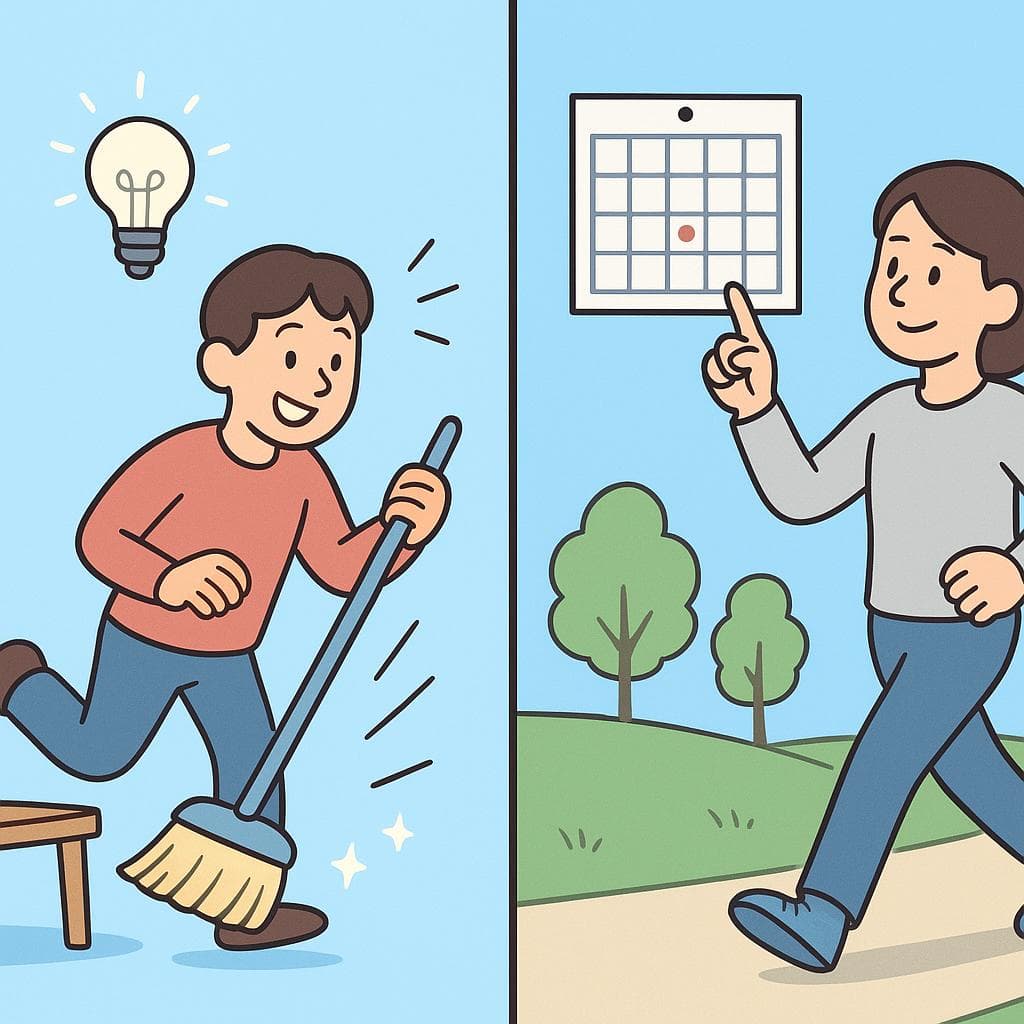
ponerse a
To start doing something, often suddenly, impulsively, or as a reaction.
poh-NEHR-seh ahempezar a
To start or begin doing something; the general, all-purpose term.
ehm-peh-SAR ahQuick Rule
Ponerse a = a sudden start. Empezar a = a general start.
Think 'ponerse' is like 'putting yourself into action' right now, often as a reaction. 'Empezar' is the safe, all-purpose 'begin'.
- In many casual contexts, they can be used interchangeably, but 'ponerse a' always adds a touch of suddenness or spontaneity.
- You can never use 'ponerse a' for scheduled events. Only 'empezar a' works.
Comparison Table
| Context | ponerse a | empezar a | Why? |
|---|---|---|---|
| Describing the weather | Se puso a nevar. | Empezó a nevar. | 'Ponerse a' implies it started unexpectedly. 'Empezar a' is a neutral statement. Both are correct. |
| Emotional reactions | Se puso a reír a carcajadas. | Empezó a reír. | 'Ponerse a' suggests a sudden burst of laughter. 'Empezar a' is a more general description of the action starting. |
| Starting a task | Me puse a cocinar. | Empecé a cocinar. | 'Ponerse a' suggests you decided on the spot and got to it. 'Empezar a' just states the fact that you started. |
| Scheduled events | (No se usa) | El concierto empieza a las 9. | Only 'empezar a' can be used for things that have a set schedule. 'Ponerse a' is incorrect here. |
When to Use "ponerse a / empezar a"
ponerse a
To start doing something, often suddenly, impulsively, or as a reaction.
poh-NEHR-seh ah
Sudden or spontaneous actions
De repente, se puso a llover.
Suddenly, it started to rain.
Emotional outbursts
Cuando le conté la noticia, se puso a llorar.
When I told her the news, she burst into tears.
Getting down to a task
Vi todo el trabajo y me puse a ordenar la oficina.
I saw all the work and I got down to organizing the office.
empezar a
To start or begin doing something; the general, all-purpose term.
ehm-peh-SAR ah
General start of an activity
Empecé a leer un libro nuevo.
I started reading a new book.
Scheduled events
La película empieza a las ocho.
The movie starts at eight.
Beginning a process or habit
Voy a empezar a estudiar francés la próxima semana.
I'm going to start studying French next week.
Contrast Examples
With "ponerse a":
El niño se puso a llorar sin motivo.
The child burst out crying for no reason.
With "empezar a":
El niño empezó a llorar cuando su madre se fue.
The child started to cry when his mother left.
The Difference: 'Ponerse a' emphasizes the sudden, almost dramatic start of the crying. 'Empezar a' is a more neutral description of the event.
With "ponerse a":
Llegué a casa y me puse a trabajar inmediatamente.
I got home and got right to work immediately.
With "empezar a":
Empecé a trabajar en esta empresa hace dos años.
I started working at this company two years ago.
The Difference: 'Ponerse a' refers to the specific, immediate action of starting a task. 'Empezar a' is used for the general beginning of a job, a project, or a period of time.
With "ponerse a":
Estábamos en el parque y de repente se puso a llover.
We were at the park and it suddenly started to rain.
With "empezar a":
El pronóstico dice que va a empezar a llover por la tarde.
The forecast says it's going to start raining in the afternoon.
The Difference: 'Ponerse a' is perfect for describing rain that starts out of the blue. 'Empezar a' is the standard verb for talking about when rain will begin, especially when planned or predicted.
Common Mistakes
La clase se pone a las diez.
La clase empieza a las diez.
For scheduled events like classes, movies, or meetings, you must use 'empezar'. 'Ponerse a' is for people (or things acting like people, like the weather) taking action.
Cuando vio el perro, se empezó a gritar.
Cuando vio el perro, se puso a gritar.
While 'empezó' is not grammatically wrong, 'se puso' is much more natural for a sudden, reflexive reaction like screaming at the sight of something.
Quick Practice
Quick Quiz: Ponerse a vs Empezar a
Question 1 of 3
Which sentence is correct for a scheduled event? 'El partido ___ a las 7.'
Related Grammar
Want to understand the grammar behind this pair? Explore these lessons for a deep dive:
Key Words


Tags
Build the instinct, not just the rule
Rules help you get it right; context makes it automatic. Read 200+ illustrated and narrated Spanish stories to see confusing pairs chosen correctly — over and over — until you stop thinking about it.
Frequently Asked Questions
Are 'empezar a' and 'comenzar a' the same?
Yes, for the most part, 'empezar a' and 'comenzar a' are perfect synonyms and completely interchangeable. 'Empezar a' is slightly more common in everyday conversation, while 'comenzar a' can feel a tiny bit more formal, but you can use either one.
Can I just always use 'empezar a' to be safe?
Yes, you absolutely can! 'Empezar a' is the universal, safe choice that will always be grammatically correct. Using 'ponerse a' is a great way to sound more natural and add nuance, but when in doubt, 'empezar a' is your best friend.