
Preguntar vs Preguntarse
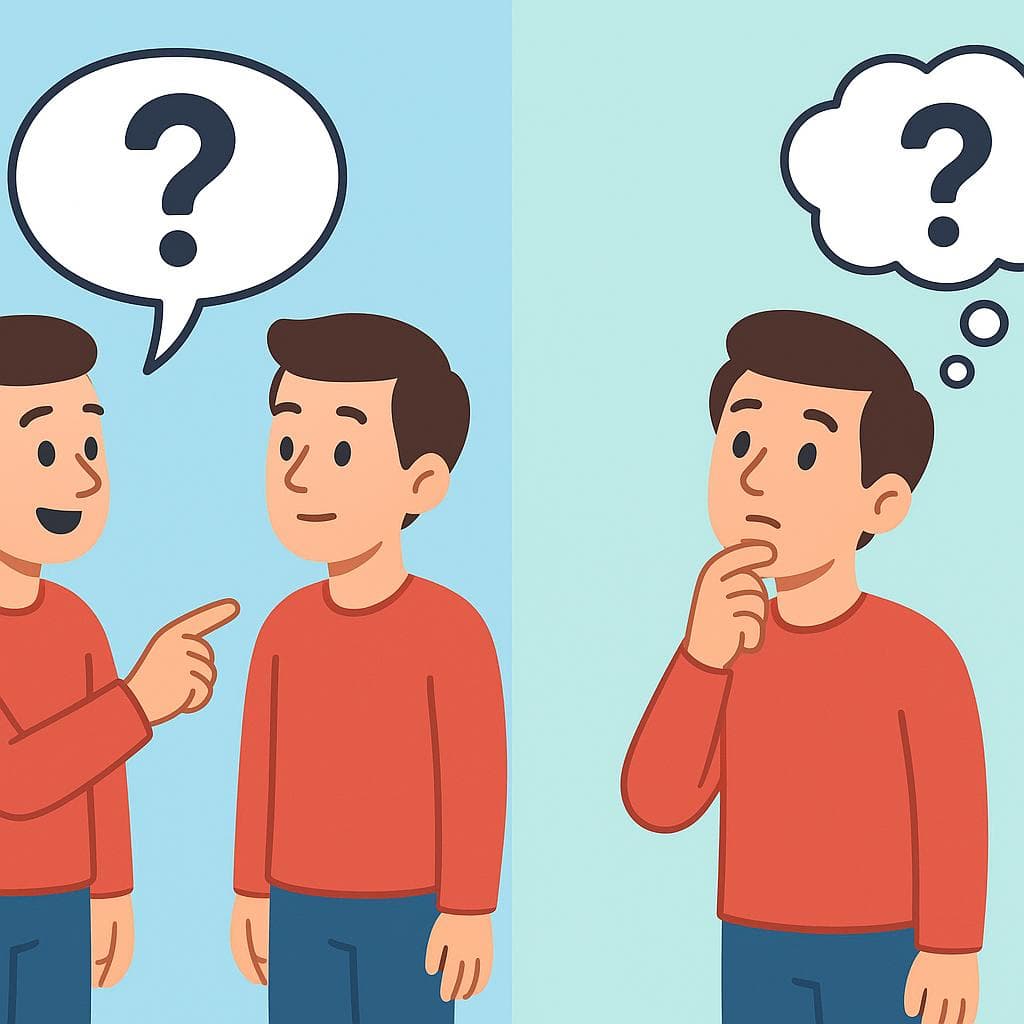
Preguntar = to ask someone. Preguntarse = to ask yourself (to wonder).
preguntar
To ask a question to another person; to inquire.
preh-goon-TARpreguntarse
To wonder; to ask a question to yourself internally.
preh-goon-TAR-sehQuick Rule
Preguntar = to ask someone. Preguntarse = to ask yourself (to wonder).
Preguntar points OUTWARD (to others). PreguntarSE points to yourSELF.
Comparison Table
| Context | preguntar | preguntarse | Why? |
|---|---|---|---|
| Basic Action | Pregunto su nombre. | Me pregunto su nombre. | Preguntar is asking someone directly. Preguntarse is wondering internally. |
| At the Office | El jefe preguntó por el informe. | El jefe se preguntó dónde estaba el informe. | The first is a direct inquiry to others. The second is an internal thought. |
| Planning an Event | Voy a preguntar si vienen a la fiesta. | Me pregunto si vendrán a la fiesta. | Use preguntar for the action of asking. Use preguntarse for the mental state of wondering. |
When to Use "preguntar / preguntarse"
preguntar
To ask a question to another person; to inquire.
preh-goon-TAR
Asking for information
Voy a preguntar la dirección.
I'm going to ask for the address.
Posing a direct question to someone
Le pregunté si quería café.
I asked him if he wanted coffee.
Inquiring about someone or something
Mi madre preguntó por ti.
My mother asked about you.
preguntarse
To wonder; to ask a question to yourself internally.
preh-goon-TAR-seh
Expressing curiosity or doubt
Me pregunto si lloverá mañana.
I wonder if it will rain tomorrow.
Pondering a situation or decision
Ella se pregunta qué debe hacer.
She wonders what she should do.
Reflecting on a past event
Nos preguntamos por qué no nos llamó.
We wonder why he didn't call us.
Contrast Examples
With "preguntar":
Le voy a preguntar el precio.
I'm going to ask him the price.
With "preguntarse":
Me pregunto cuál será el precio.
I wonder what the price is.
The Difference: Preguntar is the action you take to get the information from someone. Preguntarse is the state of not knowing and thinking about it yourself.
With "preguntar":
Pregúntale a Juan qué opina.
Ask Juan what he thinks.
With "preguntarse":
Me pregunto qué opina Juan.
I wonder what Juan thinks.
The Difference: The first is a command to ask someone else. The second is an internal thought expressing your own curiosity about his opinion.
Common Mistakes
Me pregunto la hora.
Te pregunto la hora. / ¿Qué hora es?
'Me pregunto' means 'I wonder'. To ask someone else the time, you need to direct the question outwards ('Te pregunto') or simply ask '¿Qué hora es?'.
Voy a preguntar si esto es una buena idea.
Me pregunto si esto es una buena idea.
If you are thinking to yourself and not asking a specific person, you are wondering. Use the reflexive form 'me pregunto'.
Quick Practice
Quick Quiz: Preguntar vs Preguntarse
Question 1 of 2
You are thinking about the weather tomorrow. Which sentence is correct?
Related Grammar
Want to understand the grammar behind this pair? Explore these lessons for a deep dive:
Key Words

Tags
Build the instinct, not just the rule
Rules help you get it right; context makes it automatic. Read 200+ illustrated and narrated Spanish stories to see confusing pairs chosen correctly — over and over — until you stop thinking about it.
Frequently Asked Questions
Is 'preguntarse' the only verb for 'to wonder'?
It's the most common and direct translation. You might also see phrases like 'tener curiosidad' (to be curious) or 'no estar seguro' (to be unsure), but 'preguntarse' specifically means to pose a question to yourself.
Why does the little 'se' change everything?
That 'se' is a reflexive pronoun. It signals that the action of the verb is being done by the subject to the subject. So, 'preguntar' is 'to ask (someone else)', but adding 'se' makes it 'to ask oneself'. This happens with many Spanish verbs, like 'ir' (to go) and 'irse' (to leave).