
Quedar en vs Quedarse en
Quedar en = to agree/arrange to meet. Quedarse en = to stay/remain in a place.
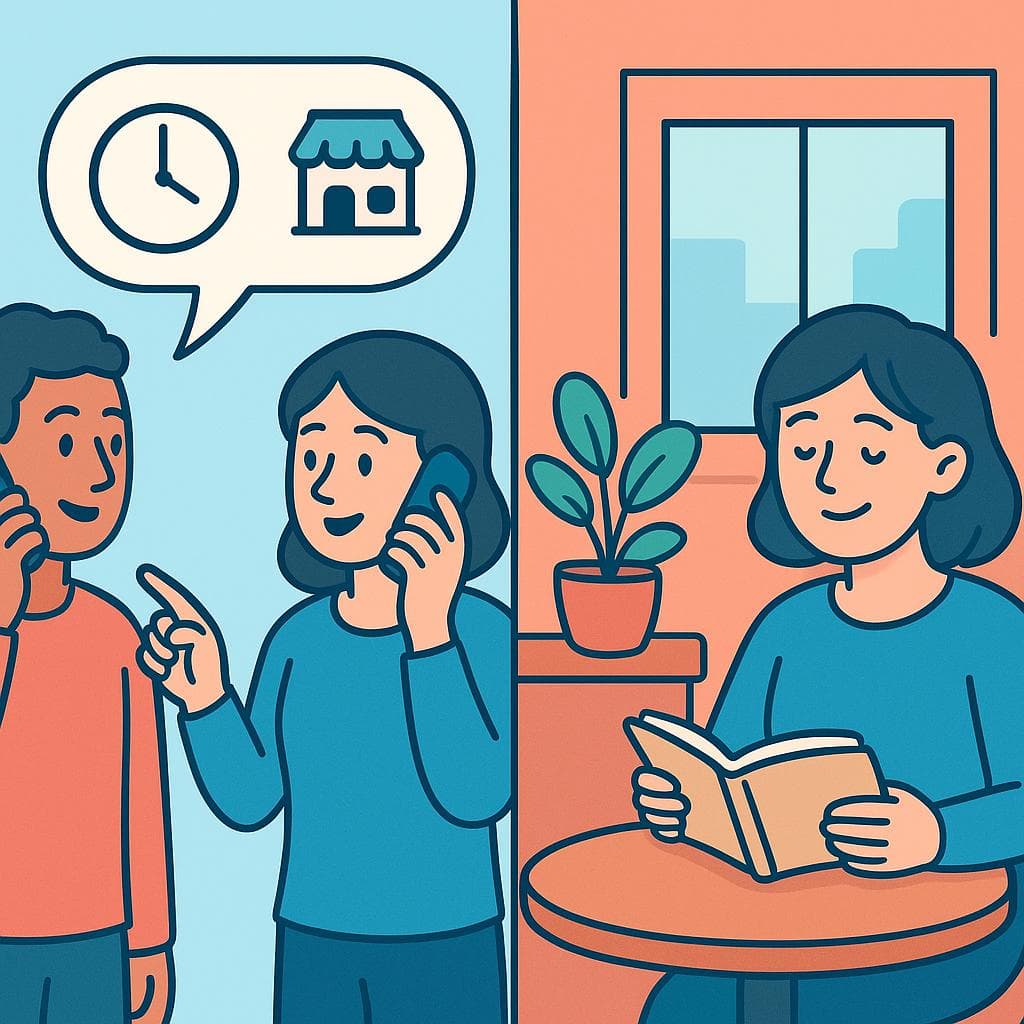
quedar en
To arrange or agree to meet someone at a specific place or time.
keh-DAR ehnquedarse en
To stay, remain, or be located in a place.
keh-DAR-seh ehnQuick Rule
Quedar en = to agree/arrange to meet. Quedarse en = to stay/remain in a place.
Think: Quedar = Arrange. Quedarse = Stay.
- Quedar can also mean 'to be located' (La oficina queda en el centro) or 'to have left' (Nos quedan dos galletas).
Comparison Table
| Context | quedar en | quedarse en | Why? |
|---|---|---|---|
| Social Plans | Quedamos en el cine. | Nos quedamos en el cine. | 'Quedar en' means we arranged to meet there. 'Quedarse en' means we stayed there (e.g., to watch a second movie). |
| At Home | Quedamos en tu casa para estudiar. | Me quedo en casa hoy. | 'Quedar en' sets the plan to meet at your house. 'Quedarse en' describes the action of not leaving the house. |
| During a Trip | Quedamos en la recepción del hotel. | Nos quedamos en un hotel céntrico. | 'Quedar en' is for the meeting point. 'Quedarse en' is for where you are lodging. |
When to Use "quedar en / quedarse en"
quedar en
To arrange or agree to meet someone at a specific place or time.
keh-DAR ehn
Arranging a meeting place
Quedamos en el café de la esquina.
We agreed to meet at the corner cafe.
Setting a time to meet
¿Quedamos en vernos a las ocho?
Shall we agree to see each other at eight?
Making a verbal agreement
Quedaron en que él pagaría la cena.
They agreed that he would pay for dinner.
quedarse en
To stay, remain, or be located in a place.
keh-DAR-seh ehn
Staying at a location
Me quedo en casa esta noche.
I'm staying at home tonight.
Remaining in a place for a period
Se quedaron en la fiesta hasta muy tarde.
They stayed at the party until very late.
Lodging or accommodation
¿Te vas a quedar en un hotel o en un Airbnb?
Are you going to stay in a hotel or an Airbnb?
Contrast Examples
With "quedar en":
Quedamos en el bar de la plaza.
We agreed to meet at the bar in the square.
With "quedarse en":
Nos quedamos en el bar de la plaza.
We stayed at the bar in the square.
The Difference: 'Quedar en' is about the plan *before* you are there. 'Quedarse en' is about the action of *remaining* there once you've arrived.
With "quedar en":
Quedamos en el hotel para la reunión.
We agreed to meet at the hotel for the meeting.
With "quedarse en":
Me quedo en el hotel esta noche.
I'm staying at the hotel tonight.
The Difference: 'Quedar en' is the meeting point. 'Quedarse en' is your accommodation, where you will remain or sleep.
Common Mistakes
Me quedo en el parque contigo a las 5.
Quedo contigo en el parque a las 5.
To arrange a meeting, use 'quedar'. 'Me quedo en el parque' means 'I am staying in the park,' which is about remaining there, not making a plan.
Quedé en casa todo el fin de semana.
Me quedé en casa todo el fin de semana.
To talk about remaining in a place, you need the reflexive form 'quedarse'. 'Quedar en casa' would imply you arranged to meet someone there.
Quick Practice
Quick Quiz: Quedar en vs Quedarse en
Question 1 of 2
To say 'I'm staying home tonight,' you should use...
Related Grammar
Want to understand the grammar behind this pair? Explore these lessons for a deep dive:
Key Words



Tags
Build the instinct, not just the rule
Rules help you get it right; context makes it automatic. Read 200+ illustrated and narrated Spanish stories to see confusing pairs chosen correctly — over and over — until you stop thinking about it.
Frequently Asked Questions
Why is there a 'se' on 'quedarse'?
That 'se' is a reflexive pronoun, and it changes the meaning of the verb. Verbs like this are common in Spanish (like 'ir' vs 'irse'). Think of it as creating a new, related verb: 'quedar' (to arrange/be left) and 'quedarse' (to stay/remain).
Can I just say 'Quedo en Madrid' to mean 'I'm staying in Madrid'?
No, that would sound like you're arranging to meet someone in Madrid. For lodging or staying in a city, you must use the reflexive form: 'Me quedo en Madrid'.
Does 'quedar' have other meanings?
Yes, lots! It can mean 'to be left over' (queda un trozo de pastel), 'to be located' (el museo queda lejos), or 'to suit' (ese color te queda bien). The distinction with 'quedarse' is the most common one to master first.