
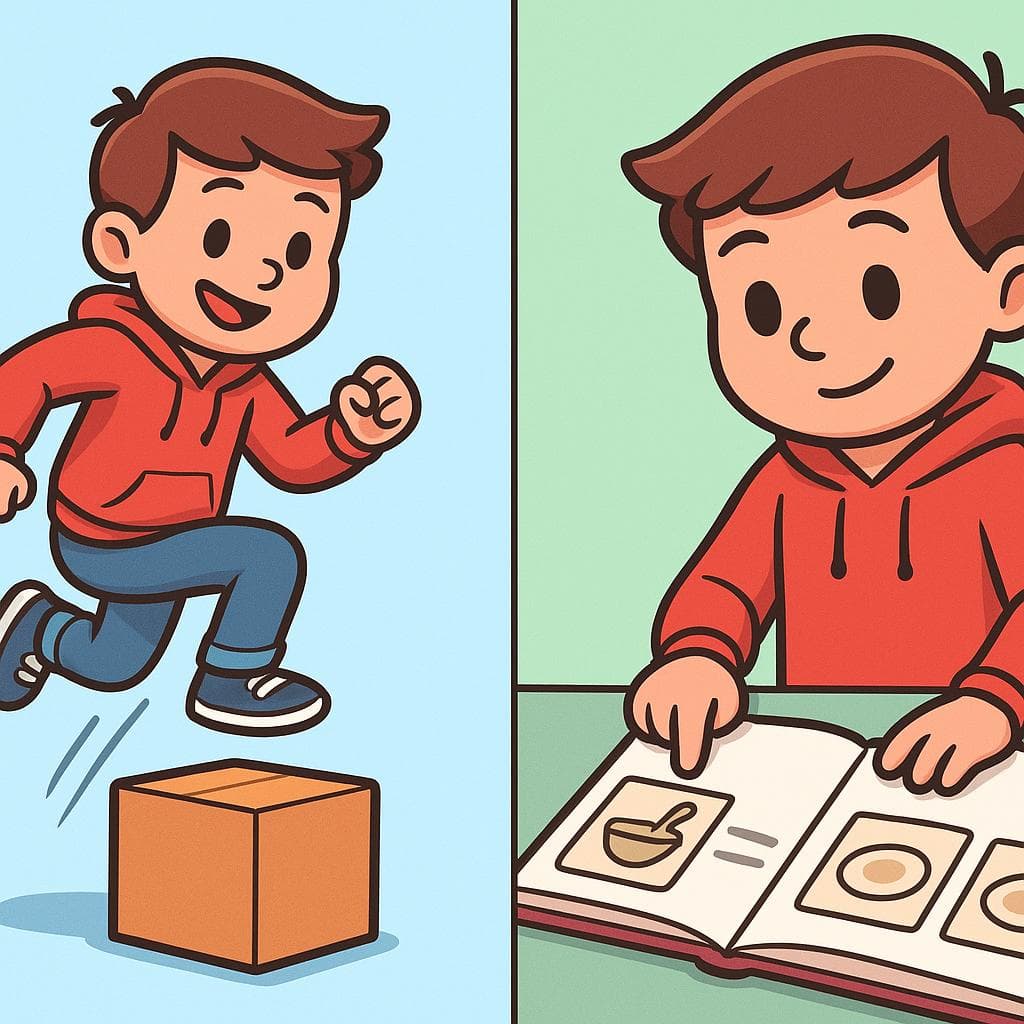
saltar
To jump, leap, or hop physically.
sahl-TARsaltarse
To skip, omit, or miss something on purpose.
sahl-TAR-sehQuick Rule
Saltar = to jump. Saltarse = to skip.
Think: You 'jump' (saltar) over a puddle, but you 'skip' (saltarse) a meeting.
- The phrase 'saltar a la vista' (to be obvious) uses 'saltar' figuratively.
- The idiom 'saltarse a la torera' means to blatantly ignore a rule or person.
Comparison Table
| Context | saltar | saltarse | Why? |
|---|---|---|---|
| Instructions | Salta tres veces. | Sáltate la primera pregunta. | Saltar is a physical command. Saltarse is a command to omit something. |
| Daily Routine | Salto la cuerda para hacer ejercicio. | Me salto el postre cuando estoy a dieta. | Saltar is a physical activity. Saltarse is deliberately missing a part of the routine. |
| Movement in a sequence | El gato saltó a la mesa. | Me salté mi parada de autobús. | Saltar describes a direct physical leap. Saltarse describes missing a point in a sequence (like bus stops). |
When to Use "saltar / saltarse"
saltar
To jump, leap, or hop physically.
sahl-TAR
Physical jumping
Los niños saltan en el trampolín.
The kids jump on the trampoline.
Jumping over an obstacle
El caballo saltó la valla con facilidad.
The horse jumped the fence easily.
Expressing sudden emotion
Saltó de alegría al recibir la noticia.
He jumped for joy upon receiving the news.
Something popping or bursting
El corcho de la botella saltó por el aire.
The bottle's cork popped into the air.
saltarse
To skip, omit, or miss something on purpose.
sahl-TAR-seh
Skipping a meal or part of a routine
A veces me salto el desayuno.
Sometimes I skip breakfast.
Skipping a class or meeting
No te puedes saltar la reunión de mañana.
You can't skip tomorrow's meeting.
Ignoring a rule or step
Se saltó la cola y todos se enojaron.
He skipped the line and everyone got angry.
Leaving out part of a story or text
Me salté las partes aburridas del libro.
I skipped the boring parts of the book.
Contrast Examples
With "saltar":
Ella salta para poder ver por encima de la gente.
She jumps to be able to see over the people.
With "saltarse":
Ella se salta la cola para no esperar.
She skips the line so she doesn't have to wait.
The Difference: Saltar is the physical action of jumping up and down. Saltarse is the social action of breaking the rules and not waiting your turn.
With "saltar":
La sorpresa en el libro me hizo saltar del susto.
The surprise in the book made me jump with fright.
With "saltarse":
Me salté el capítulo 3 porque era muy aburrido.
I skipped chapter 3 because it was very boring.
The Difference: Saltar is a physical reaction to something. Saltarse is a deliberate choice to omit or not read something.
With "saltar":
Para empezar, tienes que saltar a la pata coja.
To begin, you have to hop on one foot.
With "saltarse":
Puedes saltarte este paso si no tienes tiempo.
You can skip this step if you don't have time.
The Difference: Saltar describes the action you must perform. Saltarse describes an action you are allowed to omit.
Common Mistakes
Voy a saltar la clase de historia.
Voy a saltarme la clase de historia.
When you intentionally miss or 'skip' an event, meal, or step, you need the reflexive form 'saltarse'.
Me salto en la cama elástica.
Salto en la cama elástica.
For the physical act of jumping, use the non-reflexive 'saltar'. 'Me salto' would imply you are skipping something, which doesn't make sense here.
Quick Practice
Quick Quiz: Saltar vs Saltarse
Question 1 of 3
If you don't eat breakfast, you say: 'Yo ___ el desayuno.'
Related Grammar
Want to understand the grammar behind this pair? Explore these lessons for a deep dive:
Key Words


Tags
Build the instinct, not just the rule
Rules help you get it right; context makes it automatic. Read 200+ illustrated and narrated Spanish stories to see confusing pairs chosen correctly — over and over — until you stop thinking about it.
Frequently Asked Questions
Is 'saltarse' always about doing something wrong, like skipping class?
Not at all! It just means to omit something. You could say 'Puedes saltarte esta parte si ya la conoces' (You can skip this part if you already know it), which is perfectly neutral and helpful.
Can I use 'omitir' instead of 'saltarse'?
Yes, 'omitir' is a good synonym, but it's a bit more formal. In everyday conversation, 'saltarse' is much more common for things like skipping a meal, a page in a book, or a step in instructions.