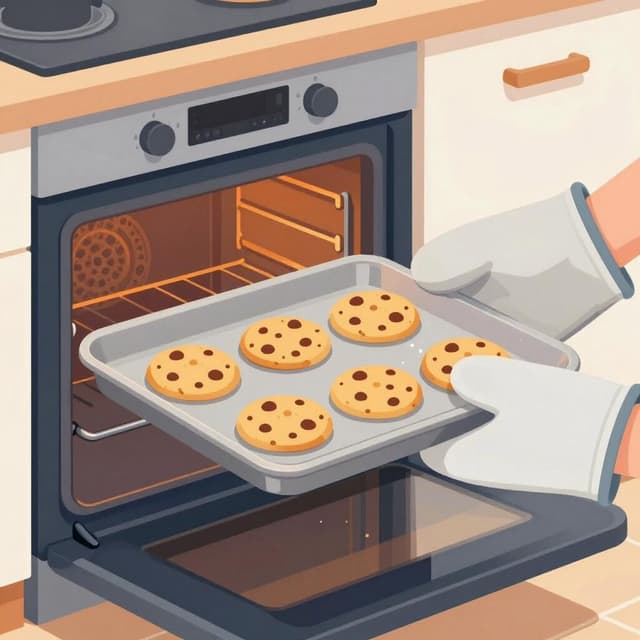
hornear Future Conjugation
hornear — to bake
Will bake: 'Hornearé pan' (I will bake bread) tomorrow.
hornear Future Forms
When to Use the Future
Use the future tense for actions that will definitely happen in the future. For 'hornear,' it's straightforward: 'Mañana hornearé un pastel' (Tomorrow I will bake a cake) or 'Ellos hornearán galletas para la feria' (They will bake cookies for the fair). It can also express probability about the present.
Notes on hornear in the Future
'Hornear' is regular in the future tense. The stem is the infinitive ('hornear-'), and the standard future endings are added.
Example Sentences
Yo hornearé el pavo para Acción de Gracias.
I will bake the turkey for Thanksgiving.
yo
¿Tú hornearás el postre para la cena?
Will you bake the dessert for dinner?
tú
Él horneará pan para vender en el mercado.
He will bake bread to sell at the market.
él/ella/usted
Nosotros horneararemos lasaña el sábado.
We will bake lasagna on Saturday.
nosotros
Ellos hornearán galletas para recaudar fondos.
They will bake cookies to raise funds.
ellos/ellas/ustedes
Common Mistakes
Mistake: Using the present tense to talk about a future plan.
Correct: For definite future actions, use the future tense (e.g., 'hornearé').
Why: While the present can sometimes imply the future, the future tense is clearer and more appropriate for planned events.
Mistake: Confusing the future stem with the present stem.
Correct: The future stem for 'hornear' is the full infinitive 'hornear-'.
Why: Unlike some irregular verbs, regular verbs like 'hornear' use their infinitive as the base for the future tense.
Master Spanish verbs in context
Memorizing tables only gets you so far. Read 200+ illustrated and narrated Spanish stories to see verbs like 'hornear' used naturally — in the tenses you're learning.
Related Tenses
Present
yo: horneo
Habits and current actions: 'Horneo pan' (I bake bread) often.
Preterite
yo: horneé
Completed actions: 'Horneé el pastel' (I baked the cake) yesterday.
Imperfect
yo: horneaba
Past habits/descriptions: 'Horneaba pan' (I used to bake bread) daily.
Conditional
yo: hornearía
Would bake: 'Hornearía un pastel' (I would bake a cake) if I had time.
Present Subjunctive
yo: hornee
Subjunctive used after wishes, doubts, emotions: 'Espero que hornees' (I hope you bake).
Imperfect Subjunctive
yo: horneara
Past subjunctive uses like 'si horneara' (if I baked) or 'ojalá horneara' (I wish he/she baked).
Affirmative Imperative
yo: hornea
Commands like '¡Hornea!' (you bake!) and '¡Horneen!' (you all bake!).
Negative Imperative
yo: no hornees
Negative commands like '¡No hornees!' (don't bake!) and '¡No horneen!' (you all don't bake!).