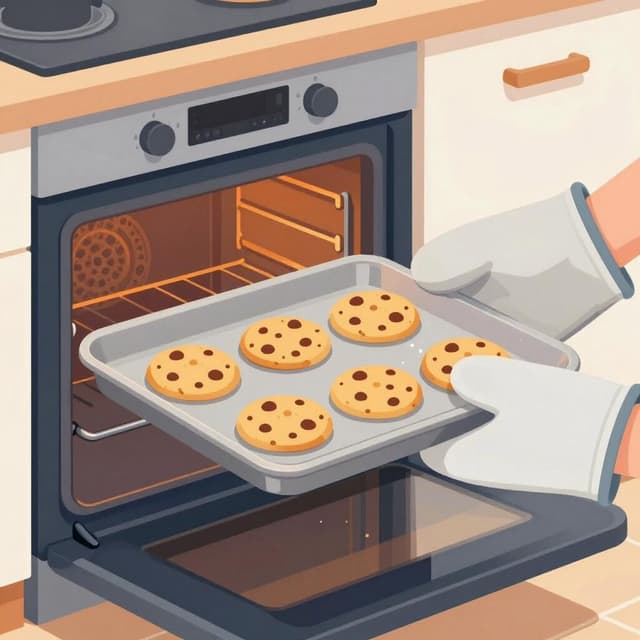
hornear Imperfect Conjugation
hornear — to bake
Past habits/descriptions: 'Horneaba pan' (I used to bake bread) daily.
hornear Imperfect Forms
When to Use the Imperfect
Use the imperfect for ongoing or habitual actions in the past, or to describe background settings. For 'hornear,' think of routines: 'Cuando era niño, mi abuela horneaba galletas todos los días' (When I was a child, my grandmother baked cookies every day) or 'El horno horneaba de manera uniforme' (The oven baked evenly - describing its characteristic).
Notes on hornear in the Imperfect
'Hornear' is a regular -ar verb and is completely regular in the imperfect indicative tense. All conjugations follow the standard pattern.
Example Sentences
Yo horneaba pan casero cuando vivía en el campo.
I used to bake homemade bread when I lived in the countryside.
yo
¿Tú horneabas pasteles para la escuela?
Did you used to bake cakes for the school?
tú
Él horneaba galletas de jengibre en Navidad.
He baked gingerbread cookies at Christmas.
él/ella/usted
Nosotros horneábamos postres para el café.
We used to bake desserts for the café.
nosotros
Ellos horneaban pan en un horno de leña.
They baked bread in a wood-fired oven.
ellos/ellas/ustedes
Common Mistakes
Mistake: Using the imperfect for a single, completed baking event.
Correct: For a specific, finished action in the past, use the preterite (e.g., 'horneé'). The imperfect describes ongoing or repeated past actions.
Why: The imperfect sets a scene or describes a past routine, while the preterite marks a specific event with a clear beginning and end.
Mistake: Confusing the imperfect 'horneábamos' (we baked) with the present 'horneamos' (we bake).
Correct: Pay attention to context. Past actions or descriptions require the imperfect.
Why: These forms sound similar, so understanding the time frame is crucial.
Master Spanish verbs in context
Memorizing tables only gets you so far. Read 200+ illustrated and narrated Spanish stories to see verbs like 'hornear' used naturally — in the tenses you're learning.
Related Tenses
Present
yo: horneo
Habits and current actions: 'Horneo pan' (I bake bread) often.
Preterite
yo: horneé
Completed actions: 'Horneé el pastel' (I baked the cake) yesterday.
Future
yo: hornearé
Will bake: 'Hornearé pan' (I will bake bread) tomorrow.
Conditional
yo: hornearía
Would bake: 'Hornearía un pastel' (I would bake a cake) if I had time.
Present Subjunctive
yo: hornee
Subjunctive used after wishes, doubts, emotions: 'Espero que hornees' (I hope you bake).
Imperfect Subjunctive
yo: horneara
Past subjunctive uses like 'si horneara' (if I baked) or 'ojalá horneara' (I wish he/she baked).
Affirmative Imperative
yo: hornea
Commands like '¡Hornea!' (you bake!) and '¡Horneen!' (you all bake!).
Negative Imperative
yo: no hornees
Negative commands like '¡No hornees!' (don't bake!) and '¡No horneen!' (you all don't bake!).