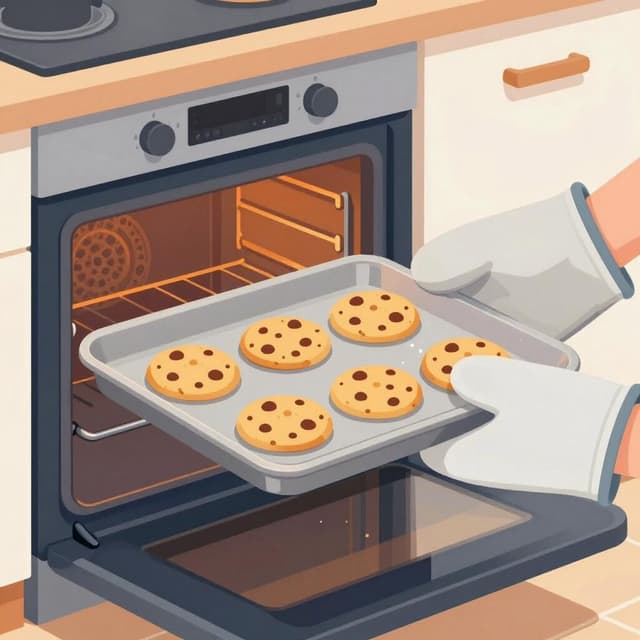
hornear Present Subjunctive Conjugation
hornear — to bake
Subjunctive used after wishes, doubts, emotions: 'Espero que hornees' (I hope you bake).
hornear Present Subjunctive Forms
When to Use the Present Subjunctive
Use the present subjunctive after expressions of desire, doubt, emotion, or uncertainty. For 'hornear,' it's like saying 'I hope you bake the cake' ('Espero que hornees el pastel') or 'It's important that we bake bread' ('Es importante que horneemos pan').
Notes on hornear in the Present Subjunctive
'Hornear' is regular in the present subjunctive. The forms are derived from the 'yo' form of the present indicative ('horneo'), dropping the '-o' and adding the opposite vowel endings (-e for -ar verbs).
Example Sentences
Espero que hornees unas galletas deliciosas.
I hope you bake some delicious cookies.
tú
Dudo que él hornee este postre a tiempo.
I doubt he will bake this dessert on time.
él/ella/usted
Queremos que horneemos el pastel para el cumpleaños.
We want us to bake the cake for the birthday.
nosotros
No creo que horneéis suficiente pan para todos.
I don't think you all will bake enough bread for everyone.
vosotros
El chef exige que horneen el pan a la temperatura correcta.
The chef demands that you all bake the bread at the correct temperature.
ellos/ellas/ustedes
Common Mistakes
Mistake: Using the present indicative instead of the present subjunctive.
Correct: After verbs expressing doubt, desire, or emotion, use the present subjunctive (e.g., 'espero que hornees', not 'espero que horneas').
Why: These trigger phrases require the subjunctive mood to express uncertainty or subjectivity.
Mistake: Incorrectly conjugating the 'vosotros' form.
Correct: The 'vosotros' present subjunctive of 'hornear' is 'hornéis'.
Why: It follows the standard pattern: drop '-ar', add '-éis', with an accent on the 'e'.
Master Spanish verbs in context
Memorizing tables only gets you so far. Read 200+ illustrated and narrated Spanish stories to see verbs like 'hornear' used naturally — in the tenses you're learning.
Related Tenses
Present
yo: horneo
Habits and current actions: 'Horneo pan' (I bake bread) often.
Preterite
yo: horneé
Completed actions: 'Horneé el pastel' (I baked the cake) yesterday.
Imperfect
yo: horneaba
Past habits/descriptions: 'Horneaba pan' (I used to bake bread) daily.
Future
yo: hornearé
Will bake: 'Hornearé pan' (I will bake bread) tomorrow.
Conditional
yo: hornearía
Would bake: 'Hornearía un pastel' (I would bake a cake) if I had time.
Imperfect Subjunctive
yo: horneara
Past subjunctive uses like 'si horneara' (if I baked) or 'ojalá horneara' (I wish he/she baked).
Affirmative Imperative
yo: hornea
Commands like '¡Hornea!' (you bake!) and '¡Horneen!' (you all bake!).
Negative Imperative
yo: no hornees
Negative commands like '¡No hornees!' (don't bake!) and '¡No horneen!' (you all don't bake!).