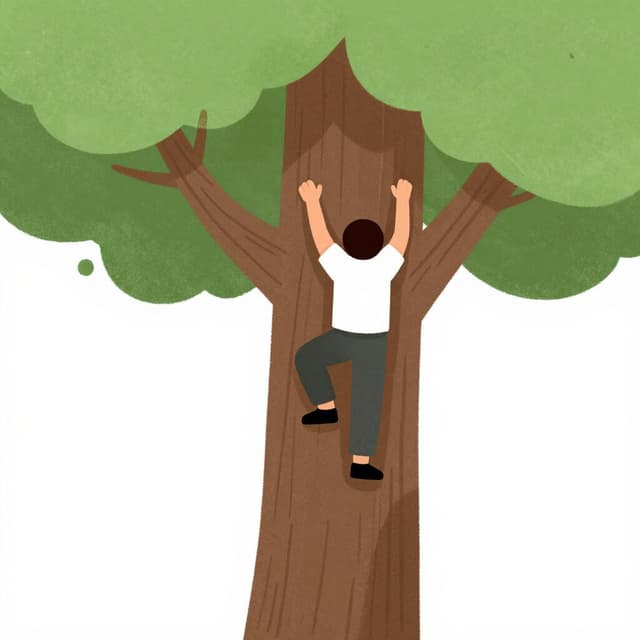
trepar Present Subjunctive Conjugation
trepar — to climb
Use 'trepe' and 'trepen' after expressions of doubt, desire, or emotion.
trepar Present Subjunctive Forms
When to Use the Present Subjunctive
The present subjunctive is triggered by certain verbs and expressions that convey doubt, desire, emotion, or uncertainty. For instance, 'Espero que trepes alto' means 'I hope you climb high'.
Notes on trepar in the Present Subjunctive
Trepar is regular in the present subjunctive. The yo, él/ella/usted forms are identical ('trepe').
Example Sentences
Dudo que él trepe esa pared sin ayuda.
I doubt he will climb that wall without help.
él/ella/usted
Quiero que tú trepes al escenario.
I want you to climb onto the stage.
tú
Es bueno que todos trepemos juntos.
It's good that we all climb together.
nosotros
El entrenador pide que los atletas trepen más rápido.
The coach asks that the athletes climb faster.
ellos/ellas/ustedes
Common Mistakes
Mistake: Using the indicative instead of the subjunctive.
Correct: After 'dudo que', use 'trepe', not 'trepa'.
Why: Expressions of doubt, desire, and emotion require the subjunctive mood.
Mistake: Forgetting the subjunctive endings for -ar verbs (-e, -es, -e, -emos, -éis, -en).
Correct: Remember the pattern: 'trepe', 'trepes', 'trepe', 'trepemos', 'trepéis', 'trepen'.
Why: These endings are specific to the present subjunctive and differ from the present indicative.
Master Spanish verbs in context
Memorizing tables only gets you so far. Read 200+ illustrated and narrated Spanish stories to see verbs like 'trepar' used naturally — in the tenses you're learning.
Related Tenses
Present
yo: trepo
Use 'trepo' and 'trepa' for actions happening now or habitual climbing.
Preterite
yo: trepé
Use 'trepé' and 'trepó' for completed climbing actions in the past.
Imperfect
yo: trepaba
Use 'trepaba' and 'trepaban' for ongoing or habitual climbing in the past.
Future
yo: treparé
Use 'treparé' and 'trepará' for actions that will happen in the future.
Conditional
yo: treparía
Use 'treparía' and 'treparían' for hypothetical 'would' scenarios.
Imperfect Subjunctive
yo: trepara
Use 'trepara' or 'trepara' for past hypotheticals or wishes, like 'If I climbed...'.
Affirmative Imperative
yo: trepa
Use 'trepa' and 'trepad' for direct commands to 'tú' and 'vosotros'.
Negative Imperative
yo: no trepes
Use 'no trepes' and 'no trepéis' for negative commands to 'tú' and 'vosotros'.