Inklingo

pasen

/PAH-sen/

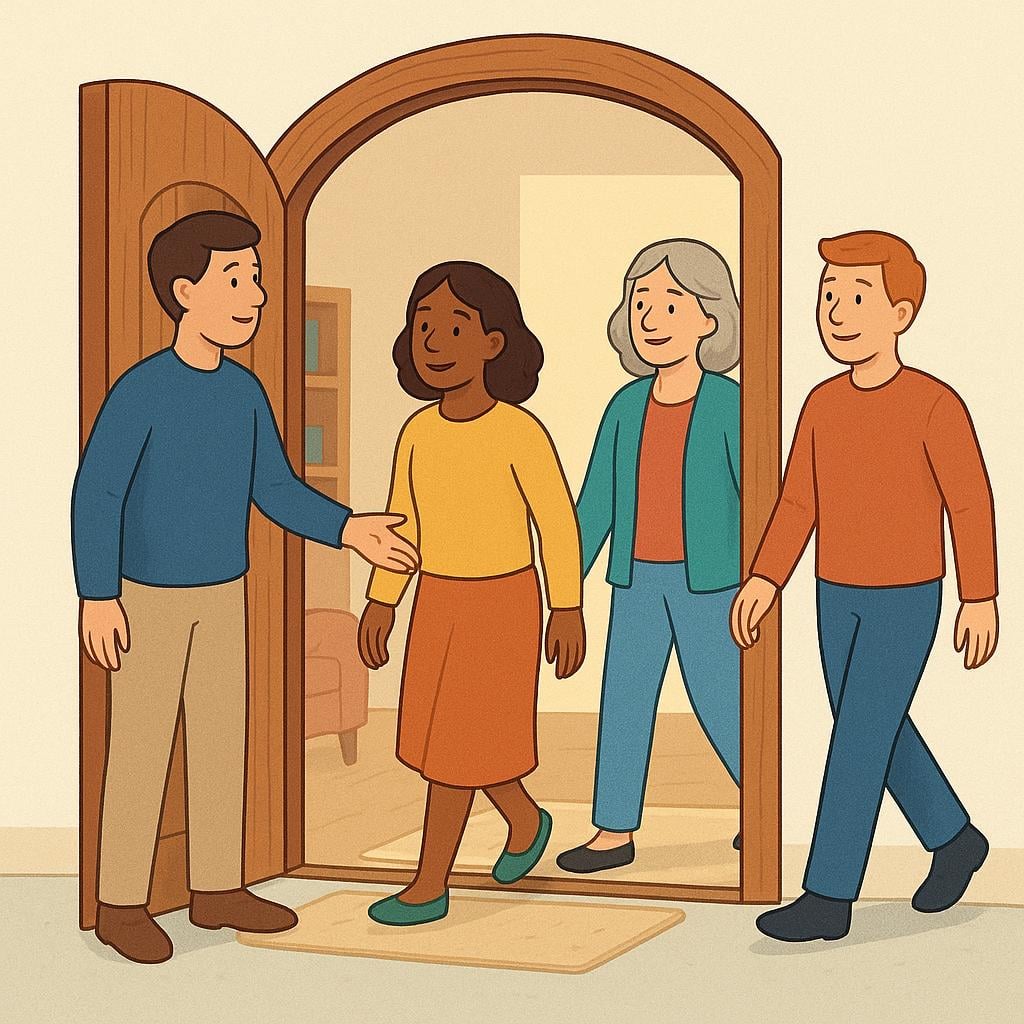
come in

A well-dressed figure stands at an open doorway, formally extending a hand in a welcoming gesture, inviting three people who are stepping across the threshold to enter the room.

Depicting the formal command, 'Come in.'

pasen(verb)

A1regular ar

come in

?

as a formal command to a group

,

enter

?

as a formal command to a group

Also:

step inside

?

invitation

📝 In Action

Pasen, por favor. Estamos listos para empezar la reunión.

A1

Come in, please. We are ready to start the meeting.

¡Pasen! No se queden en la puerta.

A2

Enter! Don't stay in the doorway.

Word Connections

Synonyms

Common Collocations

  • Pasen y veanStep right up and see (often used by vendors)

💡 Grammar Points

Formal Group Command

This form, 'pasen,' is used when you are giving a command to a group of people you address formally (ustedes). It is polite and respectful.

The 'AR' Rule

For commands to formal groups ('ustedes'), Spanish uses the verb form that ends in '-en' (for 'ar' verbs like pasar).

❌ Common Pitfalls

Confusing Formal and Informal

Mistake: "Using 'pasáis' when speaking to a formal group of adults."

Correction: Use 'Pasen' (formal group command) for respect. 'Pasáis' is only used in Spain for informal groups ('vosotros').

⭐ Usage Tips

Always Add 'Por Favor'

When using 'Pasen' as an invitation, adding 'por favor' (please) makes it sound much warmer and more natural.

A vivid blue sky dominates the scene, with three distinct white, fluffy clouds visibly drifting across the frame above a simple green landscape, symbolizing things passing or happening.

Illustrating the expression of desire or uncertainty, 'that they pass/happen.'

pasen(verb)

B1regular ar

that they pass/happen

?

expressing desire or uncertainty

,

that you (pl. formal) spend

?

referring to time, e.g., a weekend

Also:

that they go through

?

referring to an experience or location

📝 In Action

Quiero que pasen este examen sin problemas.

B1

I want them/you (formal) to pass this exam without problems.

Espero que pasen unas vacaciones estupendas.

B2

I hope you (formal group) spend/have a wonderful vacation.

Dudo que pasen por el centro de la ciudad.

B2

I doubt that they are passing through the city center.

💡 Grammar Points

The Subjunctive Trigger

This form ('pasen') is the special verb ending used when the main part of the sentence expresses a wish, doubt, emotion, or command concerning a different group of people (ellos/ustedes).

Connecting Clauses

You almost always find a 'que' (that) before 'pasen' when it's used in this way, linking the main desire to the action: 'Deseo que [ellos] pasen...'

❌ Common Pitfalls

Using the Indicative

Mistake: "Using the normal form: 'Espero que pasan un buen día.'"

Correction: After verbs like 'esperar' (to hope), you must use the special form: 'Espero que pasen un buen día.' (I hope they have a good day.)

⭐ Usage Tips

Remember the Meaning of 'Pasar'

When used with time (vacations, weekends), 'pasar' means 'to spend' time, not just 'to pass' time.

🔄 Conjugations

indicative

present

él/ella/ustedpasa
yopaso
pasas
ellos/ellas/ustedespasan
nosotrospasamos
vosotrospasáis

imperfect

él/ella/ustedpasaba
yopasaba
pasabas
ellos/ellas/ustedespasaban
nosotrospasábamos
vosotrospasabais

preterite

él/ella/ustedpasó
yopasé
pasaste
ellos/ellas/ustedespasaron
nosotrospasamos
vosotrospasasteis

subjunctive

present

él/ella/ustedpase
yopase
pases
ellos/ellas/ustedespasen
nosotrospasemos
vosotrospaséis

imperfect

él/ella/ustedpasara/pase
yopasara/pase
pasaras/pases
ellos/ellas/ustedespasaran/pasen
nosotrospasáramos/pasemos
vosotrospasarais/paseis

✏️ Quick Practice

💡 Quick Quiz: pasen

Question 1 of 1

Which sentence uses 'pasen' as a direct command?

Frequently Asked Questions

If I am speaking informally to my friends, should I still say 'Pasen'?

No. 'Pasen' is the formal plural command (for 'ustedes'). If you are speaking informally to a group of friends, you should use the informal plural command (used mainly in Spain), which is '¡Pasad!' (or 'Pásenle' in some parts of Latin America).

How does 'pasen' relate to the word 'paso'?

'Paso' means 'a step' or 'a pass.' 'Pasen' is a form of the verb 'pasar,' which means 'to take a step' or 'to pass through.' They share the same root related to movement.