tornillo
“tornillo” means “screw” in Spanish. It has 2 different meanings depending on context:
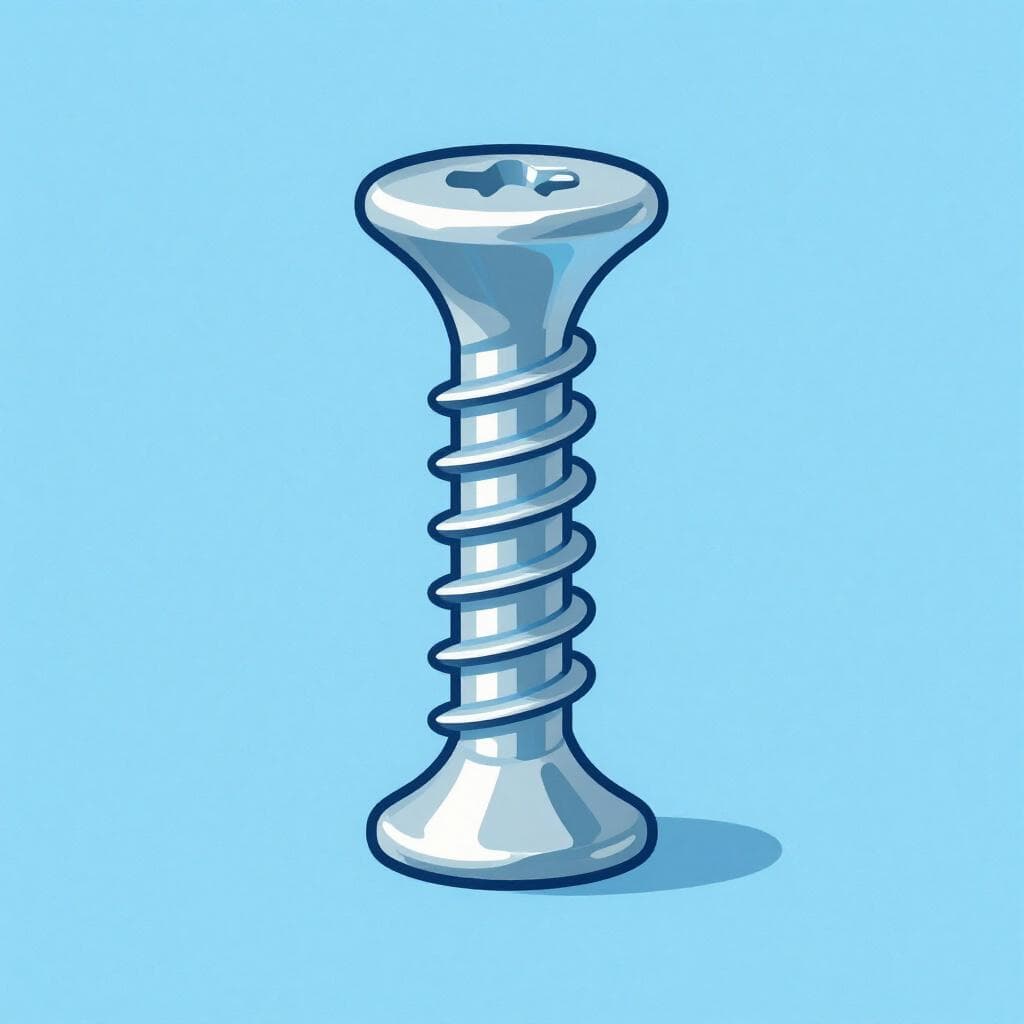

screw
Also: bolt
📝 In Action
Necesito un tornillo para este mueble.
A1I need a screw for this furniture.
El tornillo está flojo y la puerta hace ruido.
A2The screw is loose and the door is making noise.
Gira el tornillo hacia la derecha para apretarlo.
B1Turn the screw to the right to tighten it.
vise

📝 In Action
Pon la madera en el tornillo de banco.
B2Put the wood in the bench vise.
Sujeta la pieza con el tornillo para poder lijarla.
B2Hold the piece with the vise so you can sand it.
El tornillo de banco es esencial en cualquier taller.
C1The bench vise is essential in any workshop.
✏️ Quick Practice
Quick Quiz: tornillo
Question 1 of 3
What does the idiom 'Faltarle un tornillo' mean?
📚 More Resources
👥 Word Family▼
📚 Etymology▼
From the word 'torno' (lathe or winch), which comes from Latin 'tornus' (a turn or circle). The '-illo' ending makes it look like a 'little turn'.
First recorded: 15th century
Cognates (Related words)
💡 Master Spanish
Take your Spanish to the next level. Read 200+ illustrated and narrated Spanish stories tailored to your level with the Inklingo app!
Frequently Asked Questions
Is 'tornillo' used for a bolt too?
Yes, in everyday conversation, people use 'tornillo' for both screws and bolts. Technically, a bolt is 'un perno', but 'tornillo' is much more common.
What is the difference between 'tornillo' and 'tuerca'?
The 'tornillo' is the long piece with threads (the screw), and the 'tuerca' is the small hexagonal nut that screws onto it.
How do I describe a flat-head vs. a Phillips-head screw?
A Phillips-head is 'tornillo de estrella' (star screw) or 'de cruz' (cross). A flat-head is 'tornillo plano' or 'de pala'.