





Literal Translation: 'Solo en caso'
Mistake: “Using 'solo en caso' because it's a word-for-word translation of 'just in case'.”
Correction: Por si acaso.
por see ah-KAH-so
This is the universally understood, go-to phrase for 'just in case' in Spanish. It fits perfectly in almost any situation, from casual chats to more formal contexts.
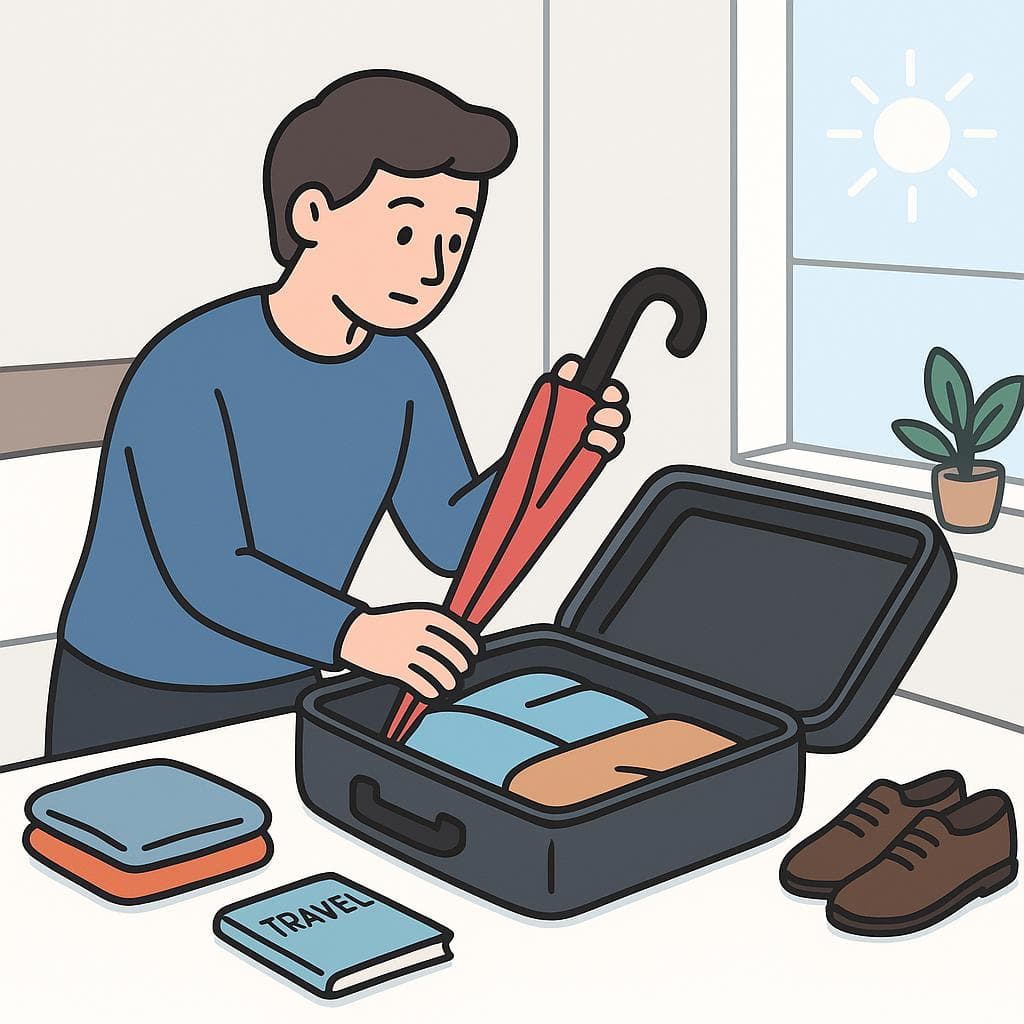
Always be prepared for the unexpected. Packing an umbrella on a sunny day is a perfect example of doing something 'por si acaso' (just in case).
Just in case — in Spanish
por see lahs MOHS-kahs
A very common and colorful informal expression. It literally means 'for if the flies,' and it's a friendly, casual way to say 'just in case.'
por lahs DOO-dahs
This is the standard, everyday way to say 'just in case' in the River Plate region (Argentina, Uruguay). It translates to 'for the doubts.' Using this will make you sound like a local there.
KOH-moh meh-DEE-dah deh preh-cow-see-OHN
A much more formal equivalent, meaning 'as a precautionary measure.' It's not for everyday chat but is perfect for professional, legal, or official contexts.
PAH-rah keh no EYE-ah pro-BLEH-mahs
This phrase means 'so there are no problems' and serves a similar function to 'just in case,' explaining the reason for a preventative action.
en KAH-so deh keh
Meaning 'in the event that...' or 'in case...', this is a clause starter that introduces a potential situation. It's often followed by a verb in the subjunctive mood, which is a more advanced grammar topic.
Here’s a quick guide to choosing the best 'just in case' phrase for your situation.
| Phrase | Formality | Best For | Avoid When |
|---|---|---|---|
| Por si acaso | Neutral | Almost any situation. It's the universal, all-purpose choice. | Never! It's always a safe and correct option. |
| Por si las moscas | Informal | Casual conversations with friends, family, and peers. | In formal business meetings, writing, or when speaking to someone you should show respect to (e.g., an elderly person you don't know). |
| Por las dudas | Informal | Sounding like a local in Argentina, Uruguay, or Paraguay. | Outside of the Southern Cone, as it may not be as commonly used or understood. |
| Como medida de precaución | Formal | Official documents, work emails, safety instructions, or any serious context. | Casual, everyday conversations, where it would sound overly stiff and bureaucratic. |
The sounds are straightforward for English speakers. The main challenge is putting the stress on the right syllable: ah-KAH-so.
As a set phrase, it's very easy to use. The grammar of the clause that follows can be more complex for advanced learners, but for basic use, it's simple.
The main phrase is easy, but knowing the different regional and informal variations is key to sounding natural and connecting with locals.
Lleva una chaqueta, por si acaso hace frío por la noche.
Take a jacket, just in case it gets cold at night.
Voy a guardar el archivo en la nube y en mi disco duro, por si las moscas.
I'm going to save the file in the cloud and on my hard drive, just in case.
El vuelo sale a las 10, pero vamos al aeropuerto a las 7, por las dudas.
The flight leaves at 10, but we're going to the airport at 7, just in case.
¿Por qué trajiste tanta comida? —Por si acaso.
Why did you bring so much food? —Just in case.
Como medida de precaución, hemos cambiado todas las contraseñas del sistema.
As a precautionary measure, we have changed all the system passwords.
The quirky phrase 'por si las moscas' (for if the flies) likely comes from the old practice of covering food to protect it from flies. You cover it 'just in case' they show up. It's a charming, rustic image that has stuck in the language as a very common informal expression.
Using phrases like 'por si acaso' is very common in Spanish-speaking cultures. It reflects a practical mindset of being prepared for the unexpected, similar to the English 'better safe than sorry.' It's a way of showing foresight and care.
If you want to blend in while in Buenos Aires or Montevideo, using 'por las dudas' is a fantastic way to do it. It's such a strong regional marker that it will immediately make you sound more like a local. It shows you've paid attention to the specific way people speak there.
Mistake: “Using 'solo en caso' because it's a word-for-word translation of 'just in case'.”
Correction: Por si acaso.
Mistake: “Saying 'Llevo paraguas por si acaso de lluvia.'”
Correction: Llevo paraguas por si acaso llueve OR en caso de lluvia.
Mistake: “Saying 'Como medida de precaución, traje más cervezas' at a casual party.”
Correction: Por si acaso, traje más cervezas. OR Por si las moscas...
'Por si acaso' works perfectly on its own. If someone asks why you did something (like bringing an umbrella on a cloudy day), you can simply reply, 'Por si acaso.' It's a complete thought.
You can easily add 'por si acaso' to the end of a sentence to explain your reasoning. For example, 'Voy a salir diez minutos antes, por si acaso.' (I'm going to leave ten minutes early, just in case).
Pay attention to where you are. In Spain, 'por si las moscas' will get you a smile. In Argentina, 'por las dudas' will make people think your Spanish is excellent. When in doubt, 'por si acaso' is always a safe bet.
The use of 'por si las moscas' is particularly widespread and popular in everyday, colloquial Spanish in Spain. You will hear it constantly among friends.
'Por las dudas' is the undisputed champion here. It's used far more frequently than 'por si acaso' in casual speech. It's a core part of the Rioplatense dialect.
'Por si acaso' is the standard. 'Por si las moscas' is also frequently used in informal settings. You might also hear the playful 'por si sí o por si no' (for if yes or for if no), which means the same thing.
¡Qué precavido/a eres!
You're so cautious!
Más vale prevenir que curar.
Better safe than sorry.
Buena idea.
Good idea.
Sí, nunca se sabe.
Yeah, you never know.
Ah, claro, tienes razón.
Oh, of course, you're right.
Exacto.
Exactly.
This direct sound association helps link the English concept of 'in case' with the Spanish word 'acaso'.
Creating a vivid mental image connects the strange literal meaning to its practical 'just in case' usage, making the informal phrase unforgettable.
While English has one main phrase ('just in case'), Spanish has a richer variety of common, colorful, and regionally specific informal options. Expressions like 'por si las moscas' (for the flies) and 'por las dudas' (for the doubts) have no direct quirky equivalent in everyday English, making Spanish more expressive in this context.
Why it''s different: A direct, word-for-word translation would be 'solo en caso' or 'justo en caso'. Both sound very unnatural and are a clear sign of a non-native speaker.
Use instead: Always use 'por si acaso' or one of its correct variations. The Spanish structure uses 'por' (for) to express the reason, which is different from English.
This is the perfect follow-up phrase that expresses the philosophy behind doing something 'just in case'.
Learning to use '¿Y si...?' allows you to propose the potential problem that 'por si acaso' is meant to solve.
The phrase 'Nunca se sabe' is a common way to justify a 'just in case' action, adding another useful tool to your conversational kit.
Phrases like 'quizás' and 'tal vez' are also about uncertainty and possibility, which relates directly to the concept of 'just in case'.
Question 1 of 3
You're in Buenos Aires, Argentina, and you decide to leave for the airport extra early. What's the most natural way to explain why?
Knowing a phrase is one thing — using it at the right moment is another. Read 200+ illustrated and narrated Spanish stories to see phrases in the contexts where they actually belong.
The main difference is formality. 'Por si acaso' is a neutral, all-purpose phrase you can use with anyone. 'Por si las moscas' is a colloquial, informal expression you should save for friends, family, and casual situations. Think of it as the difference between 'just in case' and 'just in case, y'know?'
Absolutely! 'Por si acaso' is universally understood and is always a correct and safe option in any Spanish-speaking country and in any situation. Learning the regional variations is a great way to sound more like a local, but 'por si acaso' will always work perfectly.
It translates literally to 'for the doubts.' The idea is that you are taking an action to eliminate any potential doubts or problems that might arise. It's just a different, but equally logical, way of expressing the same concept of being prepared for uncertainty.
Not at all. It can stand completely on its own. For example: '¿Por qué trajiste dos abrigos?' (Why did you bring two coats?) You can simply answer: 'Por si acaso.' (Just in case). It's very common as a short, standalone response.
In some regions, especially in the Caribbean and parts of South America, you'll hear 'por si acaso' shortened in rapid speech to 'porsia' (por-see-ah). This is very informal slang and is a contraction of the full phrase. It's good to recognize, but as a learner, it's best to stick with the full 'por si acaso'.
Strengthen the grammar behind this phrase:
Dive deeper into related topics:
Find similar phrases to expand your Spanish vocabulary:
Browse our complete collection of Spanish phrases organized by situation, from basic greetings to advanced conversations. Perfect for travelers, students, and anyone learning Spanish.
View All Spanish Phrases →