

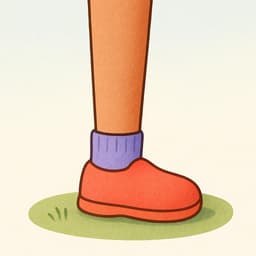



Using 'Mi' Instead of 'Me'
Mistake: “Mi pierna duele.”
Correction: Me duele la pierna.
meh DWAY-leh lah PYER-nah
This is the most common and natural way to say 'my leg hurts.' It uses the verb 'doler,' which works a bit differently than in English, literally meaning 'the leg hurts me'.

Whether it's from a long walk or a sudden injury, knowing how to say 'Me duele la pierna' is essential for communicating your needs.
My leg hurts — in Spanish
TEN-goh doh-LOR deh PYER-nah
This is another very common way to express the same idea. It literally translates to 'I have leg pain,' which might feel more familiar to English speakers.
meh ess-TAH doh-LYEN-doh lah PYER-nah
This version means 'My leg is hurting me right now.' It uses a continuous tense to emphasize that the pain is happening at this very moment.
meh DWAY-len lahs PYER-nahs
This is the plural form, meaning 'My legs hurt.' Notice how 'duele' changes to 'duelen' to match the plural 'piernas.'
SYEN-toh oon doh-LOR en lah PYER-nah
This translates to 'I feel a pain in my leg.' It's a slightly more descriptive way to talk about the pain, focusing on the sensation.
TEN-goh lah PYER-nah ah-doh-loh-REE-dah
This means 'My leg is sore' or 'My leg is achy.' It describes a general soreness rather than a sharp, specific pain.
EYE, mee PYER-nah!
This is an exclamation, meaning 'Oh, my leg!' It's a spontaneous reaction to a sudden pain or injury.
Here’s a quick comparison of the most common ways to talk about leg pain.
| Phrase | Literal Meaning | Best For | Avoid When |
|---|---|---|---|
| Me duele la pierna | The leg hurts me | The most common, all-purpose way to state you have pain. | Never, this is always a good choice. |
| Tengo dolor de pierna | I have leg pain | Clearly stating the problem, especially in a medical context. | Never, this is also a very standard and correct phrase. |
| Tengo la pierna adolorida | I have the leg sore/achy | Describing general muscle soreness after physical activity. | Describing a sharp, sudden, or specific injury. |
| Me está doliendo la pierna | The leg is hurting me | Emphasizing that the pain is happening right now. | Talking about a chronic or general, non-active pain. |
Fairly easy. The 'ie' in 'pierna' and the soft 'r' might take a little practice, but there are no very difficult sounds for English speakers.
The grammar is the hardest part. The inverted sentence structure of 'doler' (like 'gustar') is a common point of confusion for learners and requires practice to feel natural.
The concept is straightforward. Expressing pain is universal, and there are no major cultural taboos or complex rules to worry about.
No puedo jugar hoy, me duele la pierna derecha.
I can't play today, my right leg hurts.
Doctor, tengo un dolor agudo en la pierna izquierda desde ayer.
Doctor, I have a sharp pain in my left leg since yesterday.
Uf, después de esa caminata, me duelen las piernas muchísimo.
Ugh, after that hike, my legs hurt so much.
¿Puedes ayudarme a subir las escaleras? Me está doliendo mucho la pierna.
Can you help me up the stairs? My leg is hurting a lot.
In English, 'I' am the one doing the action of 'hurting'. In Spanish, with the verb 'doler', the body part is the one 'doing the hurting' to you. That's why you say 'Me duele la pierna' (The leg hurts me), not 'Yo duelo mi pierna'. This structure is very common for expressing feelings, likes, and dislikes.
In many Spanish-speaking countries, it's very common to go to a pharmacy ('farmacia') for minor aches and pains. Pharmacists are highly respected and often give advice and recommend over-the-counter treatments before you'd consider seeing a doctor.
While it varies greatly by person and region, some Spanish-speaking cultures can be more outwardly expressive about physical discomfort than some English-speaking cultures. Using exclamations like '¡Ay!' or '¡Uf!' when you're in pain is very common and natural.
Mistake: “Mi pierna duele.”
Correction: Me duele la pierna.
Mistake: “Estoy dolor de pierna.”
Correction: Tengo dolor de pierna.
Mistake: “Me lastimé la pierna.”
Correction: Me duele la pierna.
Mistake: “Me duele las piernas.”
Correction: Me duelen las piernas.
You can easily change the person experiencing the pain. 'Me duele' (it hurts me), 'Te duele' (it hurts you, informal), 'Le duele' (it hurts him/her/you formal), 'Nos duele' (it hurts us).
Simply swap out 'la pierna' for any other body part. For example: 'Me duele la cabeza' (my head hurts), 'Me duele el estómago' (my stomach hurts), or 'Me duele la espalda' (my back hurts).
To give more detail, you can add adjectives after 'dolor'. For example: 'Tengo un dolor agudo' (a sharp pain), 'un dolor sordo' (a dull ache), or 'un dolor punzante' (a throbbing/stabbing pain).
To be more specific, add 'derecha' (right) or 'izquierda' (left) after the body part. For example, 'Me duele la pierna izquierda' (My left leg hurts).
These two primary phrases are the gold standard across the entire Spanish-speaking world. You can use them in Madrid, Mexico City, or Buenos Aires and be perfectly understood.
In very informal, colloquial settings among friends, you might hear 'Me duele la pata.' 'Pata' technically means 'paw' or 'animal leg,' so it's a very casual, sometimes slightly humorous, way to refer to your own leg.
In 'Lunfardo,' the slang of Buenos Aires, 'gamba' is a word for leg. Similar to Spain's 'pata,' this is highly informal and used in casual, friendly contexts. The standard 'pierna' is used in all other situations.
Mexico predominantly uses the standard forms 'Me duele la pierna' and 'Tengo dolor de pierna.' There aren't widely used slang terms for 'leg' in this context as in other regions. The expression is very direct.
¿Qué te pasó?
What happened to you?
No estoy seguro, creo que fue corriendo.
I'm not sure, I think it was from running.
¿Desde cuándo te duele?
Since when does it hurt? / How long has it been hurting?
Me empezó a doler ayer por la noche.
It started hurting me yesterday evening.
¿Quieres que te traiga algo? ¿Una pastilla?
Do you want me to bring you something? A pill?
Sí, por favor. Gracias.
Yes, please. Thank you.
This links the Spanish word for pain to an English word associated with sadness, helping you remember its meaning.
This little story helps you remember that the pain is an external thing acting upon you, which reinforces the 'me' at the beginning of the phrase.
The biggest difference is the sentence structure. English uses a Subject-Verb-Object pattern: 'My leg' (subject) 'hurts' (verb). Spanish uses a structure where the person is the indirect object: 'Me duele la pierna', which literally means 'To me, the leg hurts.' The leg is the subject causing the pain. Getting used to this 'backwards' thinking is a key step in sounding natural in Spanish.
Why it''s different: While the Spanish 'Me está doliendo la pierna' is a direct translation, it's used more specifically to emphasize the action is happening *right now*. The simple English 'My leg hurts' is almost always best translated as 'Me duele la pierna,' not the continuous form.
Use instead: Use 'Me duele la pierna' for the general statement. Use 'Me está doliendo la pierna' to add urgency or immediacy.
Practice the 'me duele' structure with another common ailment.
Expands your ability to talk about your health beyond specific pains.
This is the logical next step when the pain is serious.
A practical and common question when you're feeling unwell while traveling.
Question 1 of 3
Which is the most natural and common way to say 'My leg hurts' in Spanish?
Knowing a phrase is one thing — using it at the right moment is another. Read 200+ illustrated and narrated Spanish stories to see phrases in the contexts where they actually belong.
It's because the verb 'doler' works differently. It means 'to cause pain to someone.' So, 'Me duele la pierna' literally translates to 'The leg causes pain to me.' It's a fundamental structure in Spanish for expressing sensations, and once you get the hang of it, it becomes second nature.
Think of 'doler' as the feeling and 'lastimar' as the action. 'Doler' is the verb for the sensation of pain ('my leg hurts'). 'Lastimar(se)' is the verb for getting injured ('I hurt/injured my leg'). You might say, 'Me lastimé la pierna, y ahora me duele mucho' (I injured my leg, and now it hurts a lot).
You just change the little word at the beginning! 'Te duele' (your leg hurts - informal 'you'), 'Le duele' (his/her/your formal leg hurts), 'Nos duele' (our leg hurts), 'Les duele' (their/your plural leg hurts).
Yes, both are extremely common and completely interchangeable in most situations. 'Tengo dolor de...' might be slightly more common when speaking to a doctor because it's a very clear, almost clinical, statement, but both are perfect for everyday use.
It's easy! Just add 'derecha' for right or 'izquierda' for left after 'pierna'. For example, 'Me duele la pierna derecha' (My right leg hurts) or 'Tengo dolor en la pierna izquierda' (I have pain in my left leg).
Absolutely. You can say 'Me duele un poco' (it hurts a little) or 'Me duele mucho' (it hurts a lot). You can put these words right after the verb, for example: 'Me duele mucho la pierna'.
Strengthen the grammar behind this phrase:
Find similar phrases to expand your Spanish vocabulary:
Browse our complete collection of Spanish phrases organized by situation, from basic greetings to advanced conversations. Perfect for travelers, students, and anyone learning Spanish.
View All Spanish Phrases →