





Using the Wrong 'Ticket'
Mistake: “Using 'billete' in Mexico or 'boleto' in Spain.”
Correction: Use 'boleto' in Mexico/Latin America and 'billete' in Spain.
bee-YEH-teh deh EE-dah ee VWEHL-tah
This is the most standard and literal translation, meaning 'ticket of going and return.' It's universally understood, but is the most common term used in Spain for plane, train, or bus tickets.
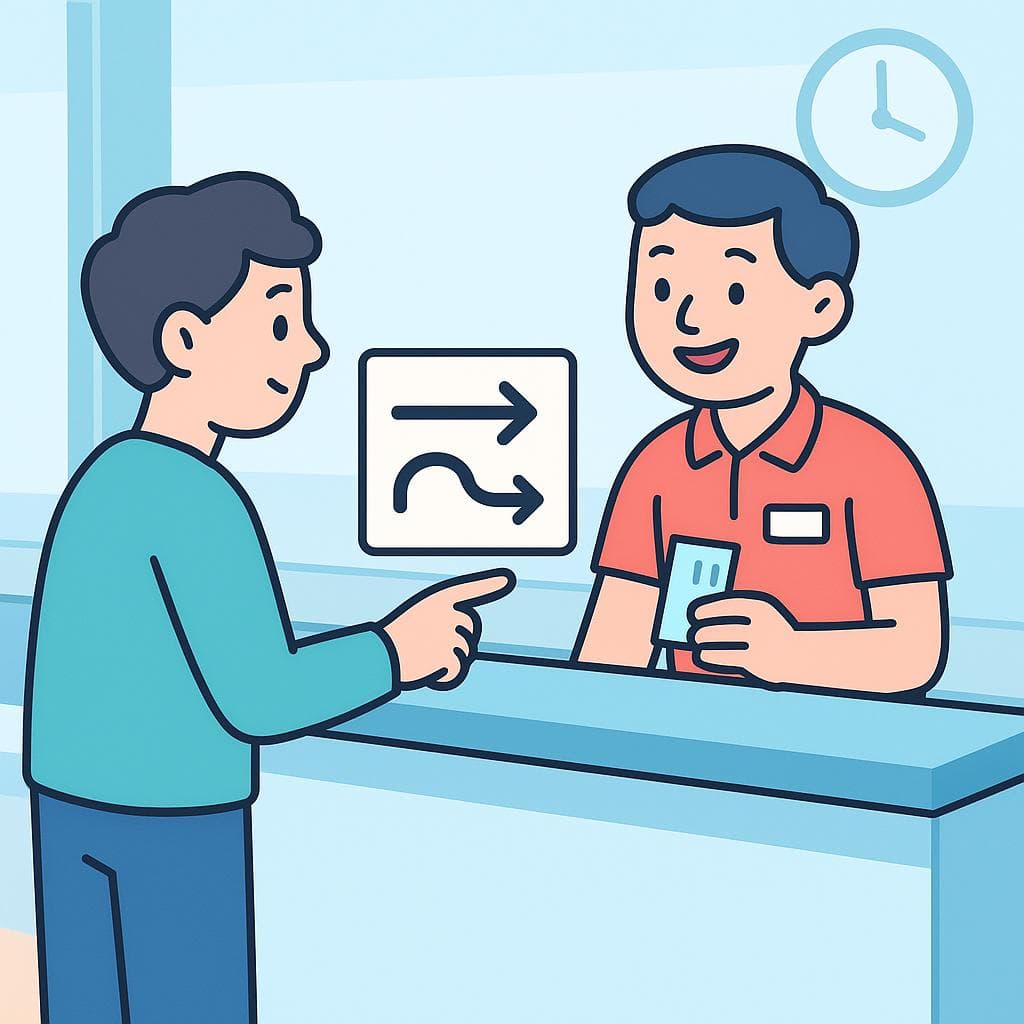
Whether you ask for a 'billete de ida y vuelta' or a 'boleto redondo,' you're planning a journey that will bring you back home.
round trip ticket — in Spanish
boh-LEH-toh deh EE-dah ee VWEHL-tah
This is the direct equivalent of the primary translation but uses 'boleto,' the preferred word for 'ticket' throughout most of Latin America. It's an extremely common and safe choice when traveling in the Americas.
boh-LEH-toh rreh-DOHN-doh
Literally 'round ticket,' this is a very common and slightly more concise way to say 'round trip ticket,' especially in Mexico. It perfectly captures the English concept of a 'round trip.'
pah-SAH-heh deh EE-dah ee VWEHL-tah
'Pasaje' can be translated as 'passage' or 'fare,' and it's often used for longer journeys, like flights or long-distance buses. In many South American countries, this is more common than 'boleto.'
bee-YEH-teh rreh-DOHN-doh
This is the Spanish (from Spain) version of 'boleto redondo.' While 'billete de ida y vuelta' is more formal and standard, 'billete redondo' is also understood and used in everyday conversation.
Choosing the right term for 'ticket' depends heavily on where you are. Here's a quick guide to the most common options.
| Phrase | Main Region | Best For | Sounds Like |
|---|---|---|---|
| billete de ida y vuelta | Spain | The most natural choice for Spain. | |
| boleto de ida y vuelta | Latin America | Less common in Spain or the Southern Cone (Argentina, Chile). | |
| boleto redondo | Mexico & C. America | Might be less common in South America or Spain. | |
| pasaje de ida y vuelta | South America | Not typically used for local city buses or subways. |
The sounds are fairly straightforward for English speakers. The main challenge might be the rolled 'rr' in 'redondo' and the soft 'd' sounds.
This is a fixed noun phrase. You just need to memorize it as a single vocabulary item; there's no complex grammar involved in using it.
The main difficulty is cultural, not grammatical. Knowing whether to use 'billete', 'boleto', or 'pasaje' based on your location is key to sounding natural.
Quisiera comprar un billete de ida y vuelta a Sevilla, por favor.
I would like to buy a round trip ticket to Seville, please.
¿Cuánto cuesta un boleto redondo a Cancún para la próxima semana?
How much does a round trip ticket to Cancun cost for next week?
Mamá, ya compré los pasajes de ida y vuelta para visitarte en Navidad.
Mom, I already bought the round trip tickets to visit you for Christmas.
Es más económico comprar el de ida y vuelta que dos billetes sencillos.
It's cheaper to buy the round trip one than two one-way tickets.
The word for 'ticket' is one of the most classic regional differences in Spanish. In Spain, you buy a 'billete.' In most of Latin America, it's a 'boleto.' In many parts of South America, especially for flights, it's a 'pasaje.' Using the local term will make you sound much more natural.
'Ida y vuelta' literally means 'going and return,' which is a very direct description of the ticket's function. 'Redondo' means 'round,' which is more figurative, just like in English. Both are perfectly normal, but 'ida y vuelta' is slightly more formal and universally understood if you're ever in doubt.
Just like in English, it's generally assumed that a round trip ticket is cheaper than two one-way tickets. While this is often true for traditional airlines and train services, the rise of budget airlines has changed things. Sometimes, two separate one-way ('sencillo' or 'sólo ida') tickets on different airlines can be cheaper, so it's worth checking!
Mistake: “Using 'billete' in Mexico or 'boleto' in Spain.”
Correction: Use 'boleto' in Mexico/Latin America and 'billete' in Spain.
Mistake: “Asking for a 'billete de ronda' or 'boleto de círculo'.”
Correction: Use 'billete/boleto redondo' or 'billete/boleto de ida y vuelta'.
Mistake: “Asking for a 'boleto' to get into a museum or concert.”
Correction: For events, use 'entrada'. For transport, use 'billete/boleto/pasaje'.
When you approach a ticket counter, the agent will often ask '¿Sencillo o de ida y vuelta?' or '¿Sencillo o redondo?' (One-way or round trip?). Be prepared to answer with your preference to speed up the process.
To ask for a one-way ticket, you can say 'un billete de sólo ida' (a ticket of only going) or, more commonly, 'un billete sencillo' (a simple ticket). The same applies to 'boleto' and 'pasaje'.
When you arrive at an airport or bus station, pay attention to the signs and announcements. You'll quickly pick up whether they're using 'billete', 'boleto', or 'pasaje', which is the easiest way to know which word to use yourself.
In Spain, 'billete' is the standard for any transport ticket. 'Boleto' is rarely used in this context and might refer to a lottery ticket instead. 'Pasaje' is understood for flights but 'billete' is still more common.
'Boleto redondo' is extremely prevalent in Mexico for both bus and air travel. It's the most colloquial and natural-sounding option. 'Pasaje' is also used, often for plane tickets ('pasaje de avión').
'Pasaje' is the dominant term, especially for long-distance travel ('larga distancia') by bus ('micro' or 'colectivo') or plane. 'Boleto' is more for local transport, like a city bus.
¿Para qué fechas, ida y vuelta?
For what dates, departure and return?
La ida el 10 de junio y la vuelta el 17.
The departure on June 10th and the return on the 17th.
Entonces, un boleto redondo. ¿Ventana o pasillo?
Okay, one round trip ticket. Window or aisle?
Ventana, por favor.
Window, please.
Serían ochenta euros. ¿Cómo desea pagar?
That will be eighty euros. How would you like to pay?
Con tarjeta de crédito.
With a credit card.
This sound association connects the Spanish word 'ida' (going) with the English idea of 'I would go,' making the first half of the phrase easier to remember.
This silly visual association links the common Mexican term 'boleto redondo' with another famous round thing from Mexico, making it more memorable.
The main difference is linguistic structure and regional fragmentation. English has one standard term, 'round trip ticket.' Spanish has multiple, equally valid terms that depend entirely on your geographical location ('billete', 'boleto', 'pasaje'). Additionally, the most universal Spanish phrase, 'ida y vuelta,' is a literal description ('going and return') rather than a figurative one like 'round trip.'
Why it''s different: While 'ticket' translates to 'boleto' or 'billete', it's crucial to remember that the Spanish words for admission tickets (to a concert, museum, etc.) are different. You need an 'entrada' for those.
Use instead: Use 'boleto/billete/pasaje' for transportation. Use 'entrada' for admission to a place or event.
This is the natural opposite and the other essential option when buying tickets.
This is the polite sentence starter you'll need to actually ask for the ticket.
After you ask for the ticket, the next logical step is to ask for the price.
This is a common follow-up question you'll be asked when booking a flight or train.
Question 1 of 3
You're at the main bus station in Mexico City. What is the most natural way to ask for a round trip ticket to Oaxaca?
Knowing a phrase is one thing — using it at the right moment is another. Read 200+ illustrated and narrated Spanish stories to see phrases in the contexts where they actually belong.
The main difference is regional. Think of it like 'soda' vs. 'pop' vs. 'coke' in the US. 'Billete' is the standard in Spain. 'Boleto' is the most common term in Latin America. 'Pasaje' is also widely used in Latin America, especially for longer trips like flights or intercity buses.
Yes, it will likely be understood in most of Latin America due to context and cultural exchange, but it's not the most common term everywhere. In South America, 'pasaje de ida y vuelta' might be more common. If you're unsure, 'boleto de ida y vuelta' is a very safe and universally understood option in the Americas.
The most common ways are 'un billete/boleto sencillo' (a simple ticket) or 'un billete/boleto de sólo ida' (a ticket of only going). 'Sencillo' is very frequently used and easy to remember.
Absolutely. In context, like at a ticket counter, you can simply say 'Uno de ida y vuelta, por favor' (One round trip, please). The 'ticket' part is implied by the situation, making your request quick and natural.
It's a figurative expression, just like in English. The idea is that you make a 'round' journey, leaving and then returning to your starting point, completing a circle or loop. It's a more conceptual way of describing the trip than the literal 'ida y vuelta' (going and return).
Strengthen the grammar behind this phrase:
Dive deeper into related topics:
Find similar phrases to expand your Spanish vocabulary:
Browse our complete collection of Spanish phrases organized by situation, from basic greetings to advanced conversations. Perfect for travelers, students, and anyone learning Spanish.
View All Spanish Phrases →