
Inklingo

Los de afuera son de palo

/lohs deh ah-FWEH-rah sohn deh PAH-loh/

The opinions of outsiders or spectators don't count. It's used to tell people who aren't directly involved to not interfere.

Level:B2Register:InformalCommon:★★★☆☆

💡 Understanding the Idiom

Literal Translation:
"Those from the outside are made of wood."
What It Really Means:
The opinions of outsiders or spectators don't count. It's used to tell people who aren't directly involved to not interfere.
English Equivalents:
The peanut gallery should keep quietMind your own businessSpectators don't get a say

🎨 Literal vs. Figurative

💭 Literal
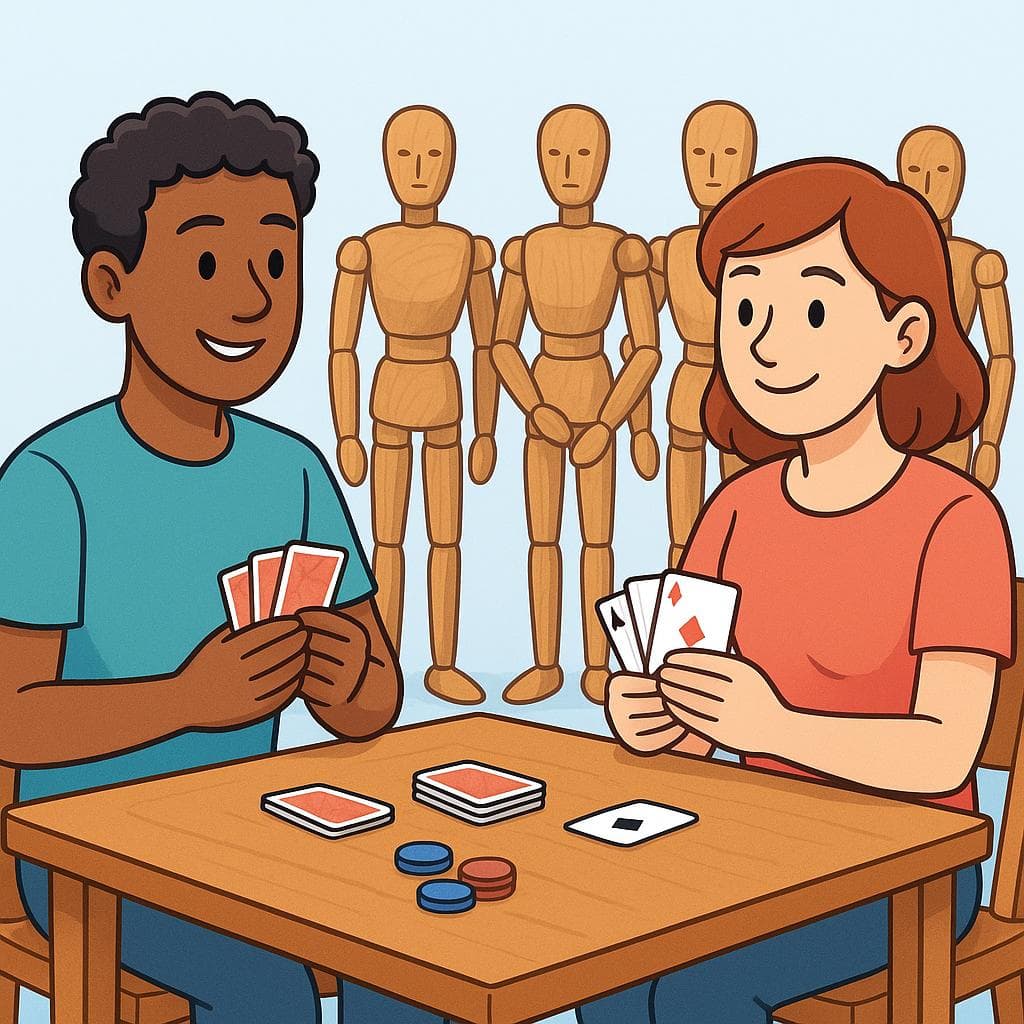
A literal depiction showing people watching a game who are made of wood.

Literally, this means 'Those on the outside are made of wood.'

✨ Figurative
The actual meaning, showing a player dismissing advice from a spectator during a board game.

In practice, it means that the opinions of spectators or outsiders are irrelevant to the matter at hand.

Key Words in This Idiom:

📝 In Action

No le hagas caso a tu primo, que no está jugando. ¡Los de afuera son de palo!

B2

Don't listen to your cousin, he's not playing. Outsiders don't get a say!

En esta discusión de pareja, tus amigos no deberían opinar. Los de afuera son de palo.

B2

In this argument between us as a couple, your friends shouldn't give their opinion. Their input doesn't count.

📜 Origin Story

This phrase comes from the world of card games, especially 'Truco,' which is wildly popular in Argentina and Uruguay. In the game, only the players' signals and words matter. Anyone watching (the 'outsiders') is expected to remain completely silent and not interfere, as if they were inanimate objects like wooden posts ('palos'). The expression eventually expanded from games to any situation where an outsider's opinion is considered irrelevant.

⭐ Usage Tips

Perfect for Games and Arguments

Use this to playfully tell spectators at a card game, board game, or even a sports match to stop giving advice. It can also be used more seriously to tell someone to mind their own business during a private discussion.

It's All About Tone

While it dismisses someone's opinion, the tone is key. Among friends playing a game, it's lighthearted and fun. In a serious argument, it can be a firm but still informal way to set a boundary.

❌ Common Pitfalls

Using It in Formal Settings

Mistake: "Telling your boss their feedback doesn't count during a business meeting by saying, 'Los de afuera son de palo'."

Correction: This is a very informal phrase. Stick to using it with friends, family, or in casual social settings. It would be considered disrespectful and unprofessional in a formal or work environment.

🌎 Where It's Used

🇦🇷

Argentina

Extremely common and a core part of the culture, especially in the context of card games like 'Truco', but used in all kinds of situations.

🇺🇾

Uruguay

Very common and widely used, similar to its usage in Argentina.

🇪🇸

Spain

Not commonly used and likely would not be understood. Different expressions are used for similar situations.

🌍

Other Latin American countries

Its use varies. It might be understood in some places due to cultural exchange (like TV and movies), but it's not a native idiom in most other countries.

🔗 Related Idioms

↔️ Similar Meanings

no tener ni voz ni voto

To have neither voice nor vote; to have no say in a matter.

Opposite Meanings

meter la cuchara

To stick one's spoon in; to butt in or meddle.

✏️ Quick Practice

💡 Quick Quiz: Los de afuera son de palo

Question 1 of 1

You're playing a card game and your friend, who is just watching, tells you which card to play. What's a perfect, playful response?

🏷️ Tags

SportsSocial InteractionsLatin America

Frequently Asked Questions

Is 'los de afuera son de palo' considered rude?

It depends entirely on the context and tone. In a friendly game, it's a normal, playful thing to say. If said angrily during a serious personal argument, it can definitely be perceived as rude, as you're bluntly telling someone their opinion is worthless.