How to Say "hearing" in Spanish
The most common Spanish word for “hearing” is “oyendo” — use this when describing the ongoing action of perceiving sound, similar to 'listening' or 'hearing' in English.






oyendo
oh-YEN-dohoˈʝen.do

Examples
Estoy oyendo música clásica ahora mismo.
I am listening to classical music right now.
¿Qué estás oyendo? Hay mucho ruido.
What are you hearing? There is a lot of noise.
Ellos pasaron la noche oyendo las olas del mar.
They spent the night listening to the waves of the sea.
The Continuous Action Form
Oyendo is the '-ing' form of the verb 'oír.' We use it with a form of 'estar' (like 'estoy' or 'estás') to talk about an action happening right now (e.g., 'Estamos oyendo la radio').
The 'Y' Rule (Vowel Change)
The base verb 'oír' ends in a vowel (o-í-r). When forming the continuous action word, Spanish often changes the 'i' to a 'y' before the '-endo' ending to make it flow better: 'oyendo' instead of the awkward 'oiendo.' This is common in verbs like 'leer' (leyendo) and 'creer' (creyendo).
Confusing Oír and Escuchar
Mistake: “Using 'oyendo' when you mean focused, intentional listening (like 'listening to a lecture').”
Correction: Use 'escuchando' for intentional focus. Use 'oyendo' for the simple perception of sound or when the listening is passive. Example: 'Estoy escuchando al profesor' (I am listening to the professor).
audición
Examples
La pérdida de audición puede afectar a los adultos mayores.
Hearing loss can affect older adults.
audiencia
ow-dee-EN-see-ahawˈðjen.sja

Examples
La audiencia por el caso de divorcio será mañana por la mañana.
The hearing for the divorce case will be tomorrow morning.
El abogado solicitó una audiencia preliminar para revisar las pruebas.
The lawyer requested a preliminary hearing to review the evidence.
comparecencia
kom-pah-reh-THEN-thyahkompaɾeˈθenθja

Examples
La comparecencia del testigo ante el juez será mañana.
The witness's appearance before the judge will be tomorrow.
El ministro solicitó una comparecencia en el Congreso.
The minister requested a hearing in Congress.
Es obligatoria la comparecencia de todos los involucrados.
The appearance of all involved parties is mandatory.
A 'Noun' from a 'Verb'
This word comes from the verb 'comparecer' (to appear). It follows a common pattern where verbs ending in -ecer turn into nouns ending in -encia.
Always Feminine
Even though it deals with serious legal matters, it is always 'la comparecencia'. Just remember that words ending in -encia are almost always feminine.
Appearance vs. Appearance
Mistake: “Using 'apariencia' for a court date.”
Correction: Use 'comparecencia'. 'Apariencia' is how someone looks (their physical looks), while 'comparecencia' is the act of showing up officially.
vista
BEES-tahˈbista

Examples
La vista del juicio fue pospuesta para el próximo mes.
The court hearing was postponed until next month.
El juez escuchó a los testigos durante la vista oral.
The judge listened to the witnesses during the oral hearing.
Trabaja como vista de aduanas en el puerto.
He works as a customs agent at the port.
escuchando
ess-koo-CHAHN-dohes.kuˈtʃan.do

Examples
Estoy escuchando la radio mientras cocino.
I am listening to the radio while I cook.
¿Qué música has estado escuchando últimamente?
What music have you been listening to lately?
Ella sigue escuchando esa banda aunque ya no está de moda.
She keeps listening to that band even though it's not fashionable anymore.
The '-ing' of Spanish
This form, ending in '-ando' for AR verbs, is called the 'gerund' and is used just like the '-ing' in English to talk about ongoing actions.
The 'Estar' Partnership
To say you 'are listening,' you must use the verb estar (to be, in a temporary sense) followed immediately by escuchando (e.g., estoy escuchando).
Mixing up 'ser' and 'estar'
Mistake: “Soy escuchando (Incorrect use of 'ser').”
Correction: Estoy escuchando. Remember, ongoing actions always use a form of *estar*.
Forgetting the 'to be' verb
Mistake: “Yo escuchando la música. (Missing 'I am').”
Correction: Yo estoy escuchando la música. Spanish requires the auxiliary verb *estar* to form the continuous tense.
oído
oh-EE-dohoˈiðo
Examples
El doctor revisó mi oído porque me dolía.
The doctor checked my ear because it was hurting me.
Necesitas buen oído para tocar el violín.
You need good hearing (a good ear) to play the violin.
Oído vs. Oreja
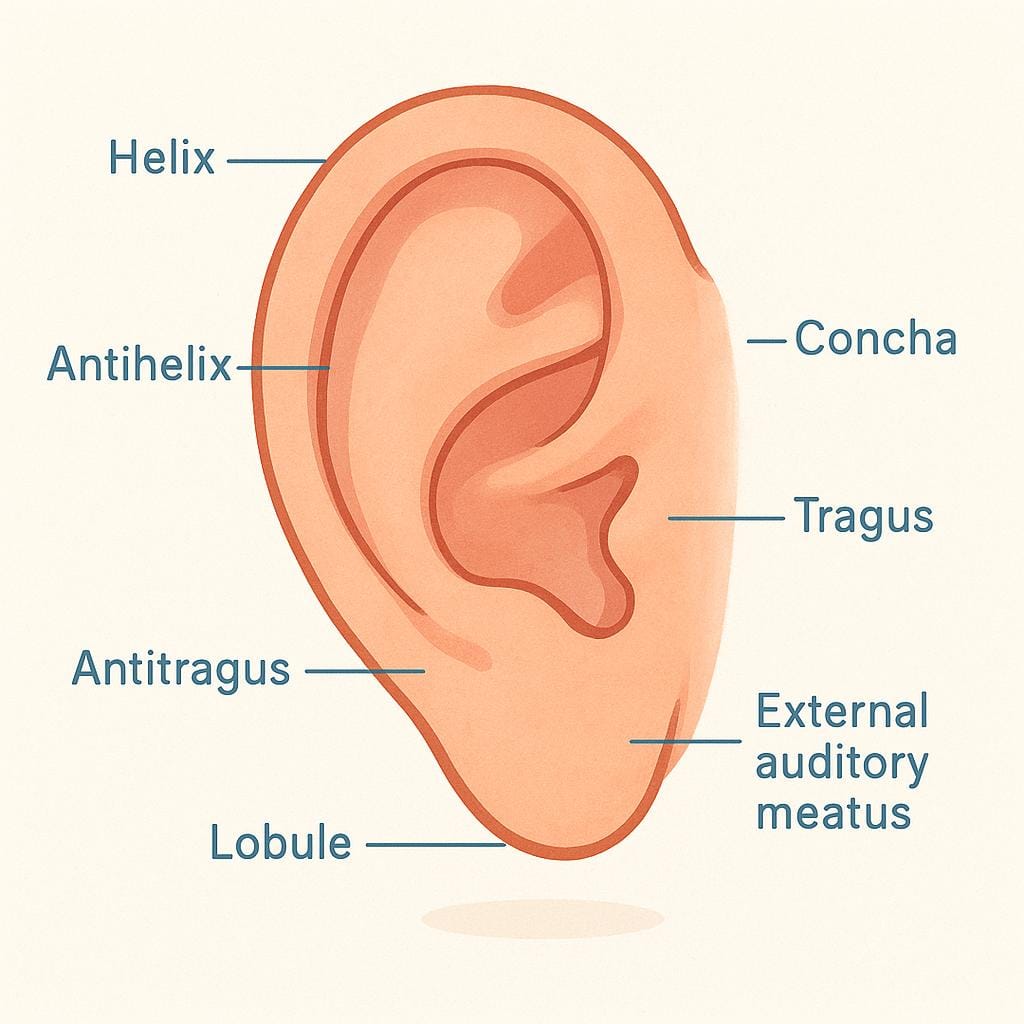
Use 'oído' for the sense of hearing and the internal part of the ear. Use 'oreja' for the visible, external part (the flap on the side of your head).
Using 'Oreja' for Pain
Mistake: “Me duele la oreja.”
Correction: Me duele el oído. (Unless the pain is specifically in the outer visible part, 'oído' is the correct term for an earache.)
orejas
oh-REH-hasoˈɾexas

Examples
Las orejas de mi perro son muy grandes y puntiagudas.
My dog's ears are very large and pointed.
Me puse pendientes nuevos en las orejas.
I put new earrings in my ears.
Ella tiene las orejas rojas de tanto frío.
Her ears are red from the cold.
Gender and Number
Since 'orejas' is the plural of 'oreja' (ear), it is always a feminine noun and requires feminine plural articles (las) and adjectives (rojas, grandes).
Oreja vs. Oído
Mistake: “Using 'orejas' when referring to the sense of hearing or the inner ear.”
Correction: Use 'oído' (inner ear/sense of hearing) for things like earaches or listening ability, and 'orejas' only for the visible, external part.
Legal vs. General Hearing
Related Translations
Learn Spanish with Inklingo
Interactive stories, personalized learning, and more.