
Parecido vs Similar
Use `parecido` for everyday look-alikes. Use `similar` for more formal or abstract comparisons.
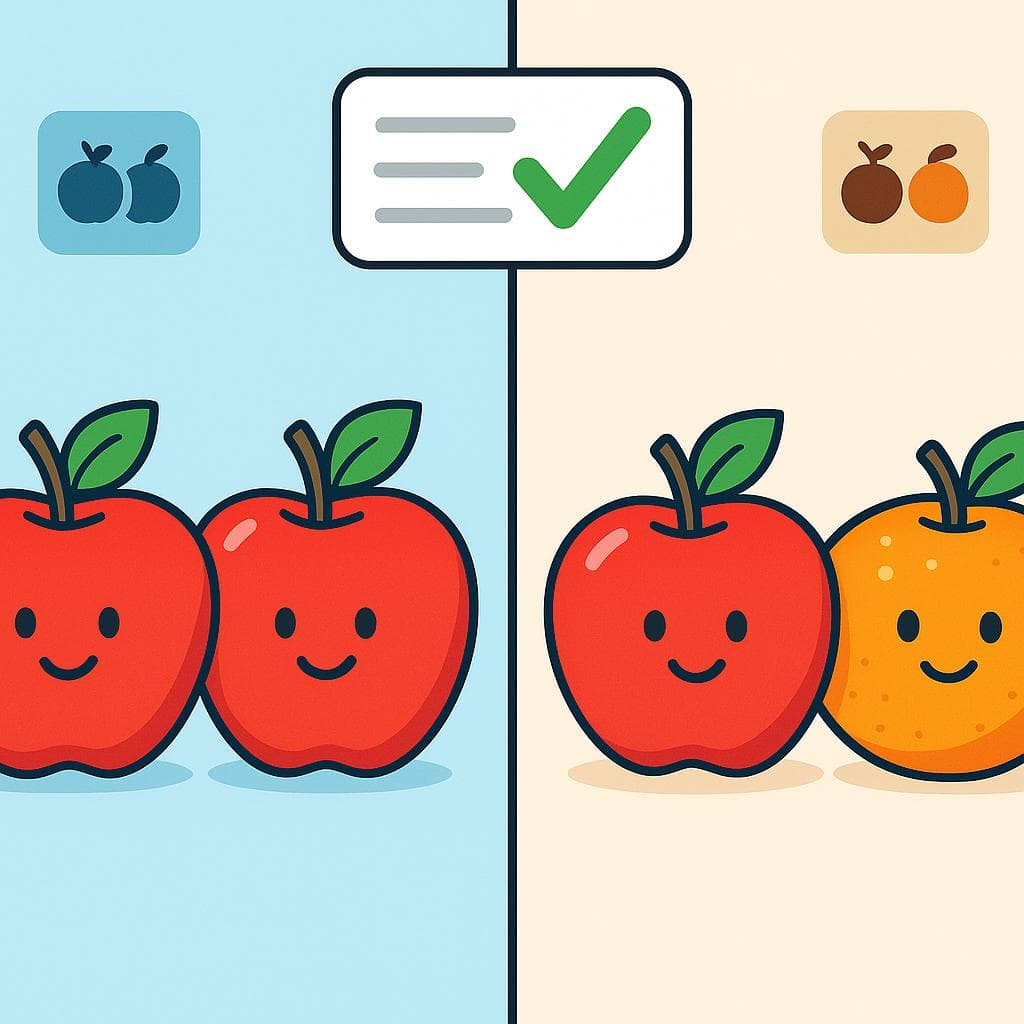
parecido
Alike, resembling (used for physical appearance, general resemblances in everyday talk).
pa-reh-SEE-dohsimilar
Similar (used for comparing characteristics, functions, or abstract concepts, often in a more formal or technical context).
see-mee-LARQuick Rule
Use `parecido` for everyday look-alikes. Use `similar` for more formal or abstract comparisons.
Think: Parecido for People and Physical things. Similar for Science and Systems.
- In casual conversation, they are often used interchangeably, but `similar` always sounds a bit more formal or technical.
Comparison Table
| Context | parecido | similar | Why? |
|---|---|---|---|
| Comparing People | Es muy parecido a su padre. | Tenemos personalidades similares. | `Parecido` is best for physical looks. `Similar` is better for non-visual traits like personality. |
| Comparing Objects | Este vestido es parecido al que vi ayer. | Los dos teléfonos tienen un rendimiento similar. | `Parecido` is great for a general, visual likeness. `Similar` is better for comparing specific functions or technical specs. |
| Comparing Situations | Viví una situación muy parecida. | Las condiciones económicas son similares a las del año pasado. | `Parecido` feels more personal and story-like. `Similar` sounds more analytical and formal. |
When to Use "parecido / similar"
parecido
Alike, resembling (used for physical appearance, general resemblances in everyday talk).
pa-reh-SEE-doh
Physical resemblance
Mi hermano y yo somos muy parecidos.
My brother and I look very much alike.
General likeness (informal)
Esa idea es parecida a la tuya.
That idea is like yours.
Describing something as '-like'
Tiene un sabor parecido al limón.
It has a lemon-like flavor.
As a noun ('the likeness')
Nunca he visto un parecido tan grande.
I've never seen such a strong likeness.
similar
Similar (used for comparing characteristics, functions, or abstract concepts, often in a more formal or technical context).
see-mee-LAR
Comparing features or functions
Ambos coches tienen características similares.
Both cars have similar features.
Formal or technical comparisons
Los dos estudios llegaron a conclusiones similares.
The two studies reached similar conclusions.
Comparing abstract concepts
Tenemos gustos similares en música.
We have similar tastes in music.
Scientific or mathematical context
En geometría, dos triángulos son similares si sus ángulos son iguales.
In geometry, two triangles are similar if their angles are equal.
Contrast Examples
With "parecido":
Los hermanos son muy parecidos.
The brothers look very much alike.
With "similar":
Los hermanos tienen intereses similares.
The brothers have similar interests.
The Difference: `Parecido` is the go-to for physical appearance. `Similar` is better for comparing non-physical things like hobbies, personalities, or tastes.
With "parecido":
Este móvil es parecido al iPhone.
This phone looks like the iPhone. (It's about the design.)
With "similar":
Este móvil tiene especificaciones similares al iPhone.
This phone has similar specs to the iPhone. (It's about the technical details.)
The Difference: Use `parecido` for a visual or general comparison. Use `similar` when you're comparing specific, often technical, features or data points.
Common Mistakes
En matemáticas, los dos triángulos son parecidos.
En matemáticas, los dos triángulos son similares.
In technical, scientific, or mathematical contexts, 'similar' is the correct term. 'Parecido' is too informal.
Los dos programas tienen funciones parecidas.
Los dos programas tienen funciones similares.
While not strictly wrong, 'similares' is more natural for technical features or specs. 'Parecidas' works in casual chat but sounds less precise.
Quick Practice
Quick Quiz: Parecido vs Similar
Question 1 of 2
Los dos países tienen problemas económicos ____.
Related Grammar
Want to understand the grammar behind this pair? Explore these lessons for a deep dive:
Key Words




Tags
Build the instinct, not just the rule
Rules help you get it right; context makes it automatic. Read 200+ illustrated and narrated Spanish stories to see confusing pairs chosen correctly — over and over — until you stop thinking about it.
Frequently Asked Questions
Can I just always use 'parecido' and forget 'similar'?
In casual, everyday conversation, you can get away with using 'parecido' most of the time. However, as soon as the context becomes more formal, academic, or technical, 'similar' becomes the much better, and sometimes only, correct choice. It's good to know both!
Do I always need the preposition 'a' after them?
Yes, when you are specifying what something is similar TO. For example, 'Tu coche es parecido al mío' (Your car is similar to mine) or 'Sus métodos son similares a los nuestros' (Their methods are similar to ours). If you just say 'They are similar' ('Son parecidos' or 'Son similares'), you don't need 'a'.