
Pegar vs Golpear
Use `golpear` for a forceful blow (a punch, a crash). Use `pegar` for a general hit, a slap, or to stick something.
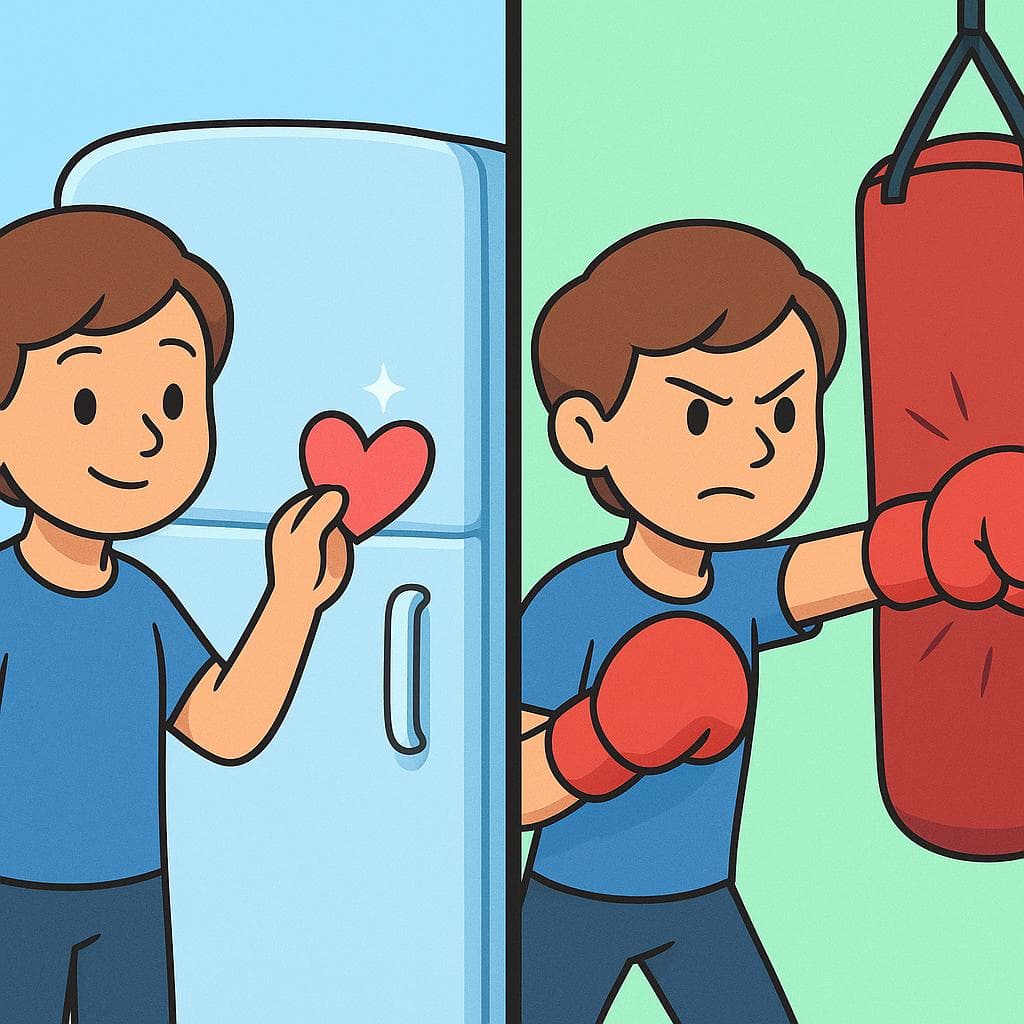
pegar
To hit, strike (general or less formal), OR to stick/glue something.
peh-GARgolpear
To hit, strike, punch, or knock, usually implying more force or intention.
gohl-peh-ARQuick Rule
Use `golpear` for a forceful blow (a punch, a crash). Use `pegar` for a general hit, a slap, or to stick something.
Think: `Golpear` has 'golpe' (a blow) inside it. `Pegar` can come from 'pega' (glue).
- In sports, 'pegarle a la pelota' (to hit the ball) is very common, even for forceful hits.
- The main point of confusion is that 'pegar' has a totally different meaning: 'to stick/glue'.
Comparison Table
| Context | pegar | golpear | Why? |
|---|---|---|---|
| Interpersonal Conflict | Le pegó una bofetada. | Lo golpeó en el estómago. | Pegar is often used for slaps or general hits. Golpear implies a stronger, more forceful blow like a punch. |
| Interacting with a Wall | Pega el póster en la pared. | Golpeó la pared con el puño. | Here the meanings are totally different. Pegar means 'to stick', while golpear means 'to strike'. |
| Car Accidents | El coche de atrás me pegó. | El camión golpeó al coche. | Pegar is common for a minor bump or being rear-ended. Golpear suggests a more serious, forceful collision. |
| Sports | Pégale a la pelota. | Golpeó la pelota fuera del parque. | Pegar is the common, all-purpose verb for 'hit the ball'. Golpear can be used to emphasize the power of the hit. |
When to Use "pegar / golpear"
pegar
To hit, strike (general or less formal), OR to stick/glue something.
peh-GAR
To hit or strike (general)
El niño le pegó a su hermano con un juguete.
The boy hit his brother with a toy.
To stick or attach with adhesive
Necesito pegar este cartel en la pared.
I need to stick this poster on the wall.
For accidental bumps
¡Ay! Me pegué en el codo.
Ouch! I hit my elbow.
To match or go well with
Ese color no te pega.
That color doesn't suit you.
golpear
To hit, strike, punch, or knock, usually implying more force or intention.
gohl-peh-AR
To punch or strike with force
El boxeador golpeó a su oponente.
The boxer punched his opponent.
For objects colliding forcefully
El coche golpeó la farola.
The car hit the lamppost.
To knock on a door
Alguien está golpeando la puerta.
Someone is knocking on the door.
To slam something
Se enojó y golpeó la mesa.
He got angry and slammed the table.
Contrast Examples
With "pegar":
Pega este aviso en la puerta.
Stick this notice on the door.
With "golpear":
No golpees la puerta al salir.
Don't slam the door when you leave.
The Difference: This shows the most fundamental difference. 'Pegar' is about attaching things (like with glue), while 'golpear' is about forceful impact.
With "pegar":
Me pegué contra la silla.
I bumped into the chair.
With "golpear":
Me golpeé fuertemente contra la silla.
I hit myself hard against the chair.
The Difference: Both describe an accident, but 'pegarse' is the more common, general term for a bump. 'Golpearse' emphasizes that the impact was strong and forceful.
With "pegar":
Le pegó en el brazo.
He hit him on the arm.
With "golpear":
Le golpeó en la cara.
He punched him in the face.
The Difference: 'Pegar' is a general term for hitting that could be a slap or a push. 'Golpear' is more specific and implies a deliberate, forceful strike or punch.
Common Mistakes
Voy a golpear la foto en mi cuaderno.
Voy a pegar la foto en mi cuaderno.
When you mean 'to stick' or 'to glue', you must use pegar. Golpear only means to strike or hit with force.
La canción me golpeó y no puedo dejar de cantarla.
La canción se me pegó y no puedo dejar de cantarla.
The expression for a song getting 'stuck' in your head is 'pegarse'. 'Golpear' would imply the song physically hit you.
Pegué a la puerta para ver si había alguien.
Golpeé la puerta para ver si había alguien.
The action of 'knocking' on a door is golpear la puerta. Using pegar here would sound very strange.
Quick Practice
Quick Quiz: Pegar vs Golpear
Question 1 of 3
To say 'I need to glue this paper', which verb do you use?
Related Grammar
Want to understand the grammar behind this pair? Explore these lessons for a deep dive:
Key Words

Tags
Build the instinct, not just the rule
Rules help you get it right; context makes it automatic. Read 200+ illustrated and narrated Spanish stories to see confusing pairs chosen correctly — over and over — until you stop thinking about it.
Frequently Asked Questions
Can 'pegar' and 'golpear' ever be used interchangeably?
Sometimes, when talking about hitting a person or an object, they can be. For example, 'Le pegó en la cara' and 'Le golpeó en la cara' both mean 'He hit him in the face'. However, 'golpear' always implies more force. And remember, you can NEVER interchange them when 'pegar' means 'to stick'.
Why does 'pegar' have two such different meanings (to hit and to stick)?
It's a quirk of language evolution! The Latin word 'picāre' (to cover with pitch/tar) led to the 'sticking' sense. The 'hitting' sense is thought to have developed later, perhaps from the idea of delivering a 'sticky' blow. It's confusing, but remembering the 'glue' connection ('pega') helps keep the meanings separate.