
Sentar vs Sentarse
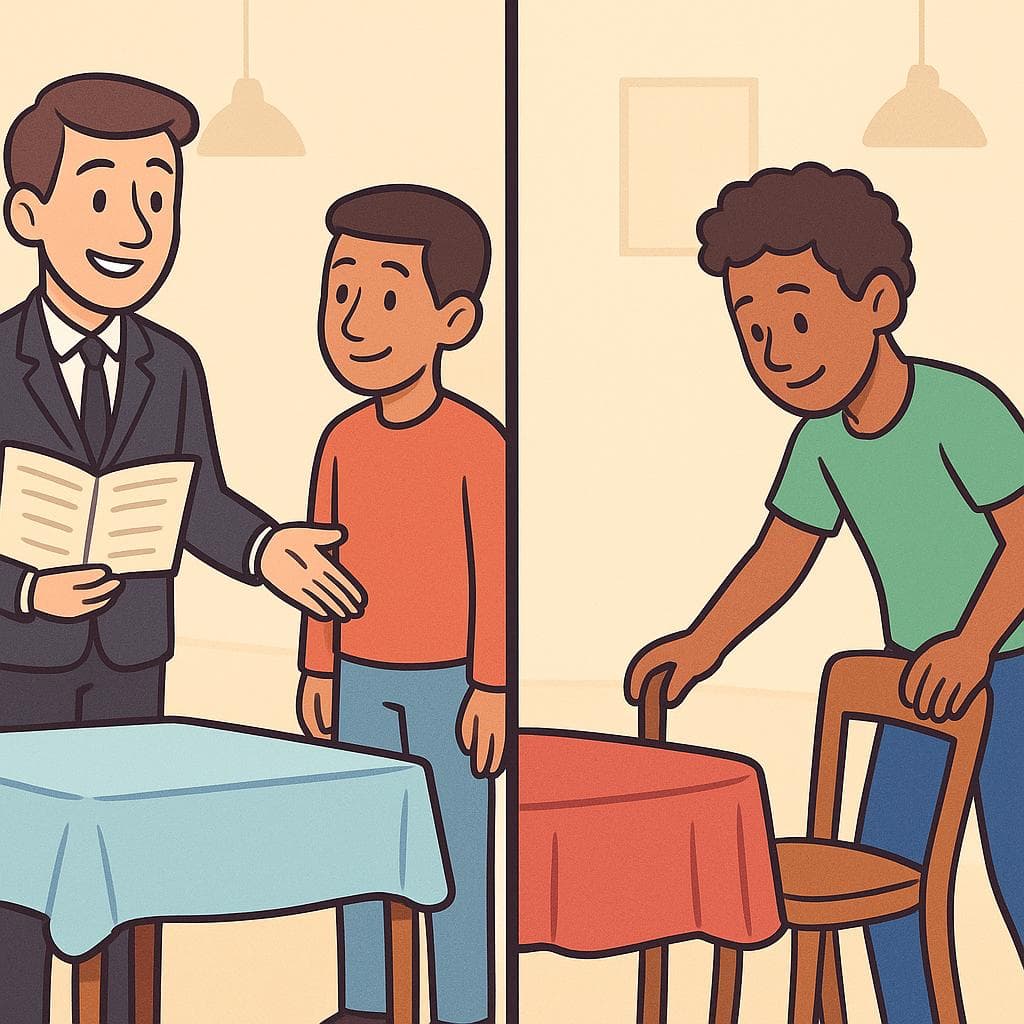
Sentar = to seat someone/something. Sentarse = to sit yourself down.
sentar
To seat someone, to place something, or for something to suit you.
sen-TARsentarse
To sit down; the action of taking a seat yourself.
sen-TAR-sehQuick Rule
Sentar = to seat someone/something. Sentarse = to sit yourself down.
Think: `sentarse` has 'se' for 'self'. You sit your'se'lf down.
- The phrase 'sentar bien/mal' means something 'suits you' or 'agrees with you' (like food).
Comparison Table
| Context | sentar | sentarse | Why? |
|---|---|---|---|
| Action at a table | El mesero te va a sentar. | Puedes sentarte aquí. | Sentar = someone else does the action *to* you. Sentarse = you do the action *to yourself*. |
| Giving a command | ¡Sienta al niño en su silla! | ¡Siéntate ahora mismo! | Use 'sentar' to command someone to seat a third person/object. Use 'sentarse' to command someone to sit themselves down. |
| Figurative vs. Literal | La noticia me sentó fatal. | Me senté para escuchar la noticia. | Sentar can describe how news/food affects you. Sentarse is the literal, physical act of taking a seat. |
When to Use "sentar / sentarse"
sentar
To seat someone, to place something, or for something to suit you.
sen-TAR
Seating someone else
El anfitrión nos sentó en la mejor mesa.
The host seated us at the best table.
How something affects you (suits you)
Ese color te sienta muy bien.
That color suits you very well.
How food affects your stomach
La comida picante no me sienta bien.
Spicy food doesn't agree with me.
Establishing something (figurative)
Su discurso sentó un precedente.
His speech set a precedent.
sentarse
To sit down; the action of taking a seat yourself.
sen-TAR-seh
The act of sitting down
Voy a sentarme en el sofá.
I'm going to sit down on the sofa.
Giving a command to sit
Siéntate, por favor.
Sit down, please.
Describing the state of being seated
Estábamos sentados en el parque.
We were sitting in the park.
Contrast Examples
With "sentar":
El camarero nos sentó junto a la ventana.
The waiter seated us next to the window.
With "sentarse":
Nos sentamos junto a la ventana.
We sat down next to the window.
The Difference: Sentar is what the waiter did TO us. Sentarse is what WE did ourselves. The first focuses on the waiter's action, the second on our own.
With "sentar":
¡Sienta a tu perro!
Seat your dog! (Make your dog sit!)
With "sentarse":
¡Siéntate con tu perro!
Sit down with your dog!
The Difference: Use 'sentar' when the object of the action is someone/something else (the dog). Use 'sentarse' when the person you're talking to is the one performing the action.
With "sentar":
El café fuerte no me sienta bien por la noche.
Strong coffee doesn't agree with me at night.
With "sentarse":
Me gusta sentarme a tomar un café por la mañana.
I like to sit down to have a coffee in the morning.
The Difference: Here 'sentar' has a completely different, idiomatic meaning of 'agreeing with' your body. 'Sentarse' remains the simple physical act of sitting.
Common Mistakes
Yo siento en la silla.
Yo me siento en la silla.
When you are the one sitting, you must use the reflexive form 'sentarse'. 'Siento' by itself means 'I feel' (from 'sentir') or 'I seat (someone)', neither of which fits here.
El vestido se sienta bien.
El vestido te sienta bien.
When talking about how something suits a person, use 'sentar' with an indirect object pronoun (me, te, le). The dress isn't sitting itself down; it 'sits well' on you.
Quick Practice
Quick Quiz: Sentar vs Sentarse
Question 1 of 3
Which sentence is correct for 'I'm going to sit here'?
Related Grammar
Want to understand the grammar behind this pair? Explore these lessons for a deep dive:
Key Words


Tags
Build the instinct, not just the rule
Rules help you get it right; context makes it automatic. Read 200+ illustrated and narrated Spanish stories to see confusing pairs chosen correctly — over and over — until you stop thinking about it.
Frequently Asked Questions
So 'sentarse' is just the verb 'sentar' with 'se' added?
Exactly! In Spanish, adding 'se' to a verb often makes it 'reflexive,' which means the person doing the action is also the person receiving the action. So 'sentar' (to seat) becomes 'sentarse' (to seat oneself).
Why does 'siento' mean 'I feel' sometimes? Is that related?
Great question! That's actually a different verb: 'sentir' (to feel). It's a classic 'false friend' because the 'yo' form ('siento') looks and sounds exactly like the 'yo' form of 'sentar'. You have to use the context of the sentence to know if someone is talking about sitting or feeling.