
Tomar vs Tomarse
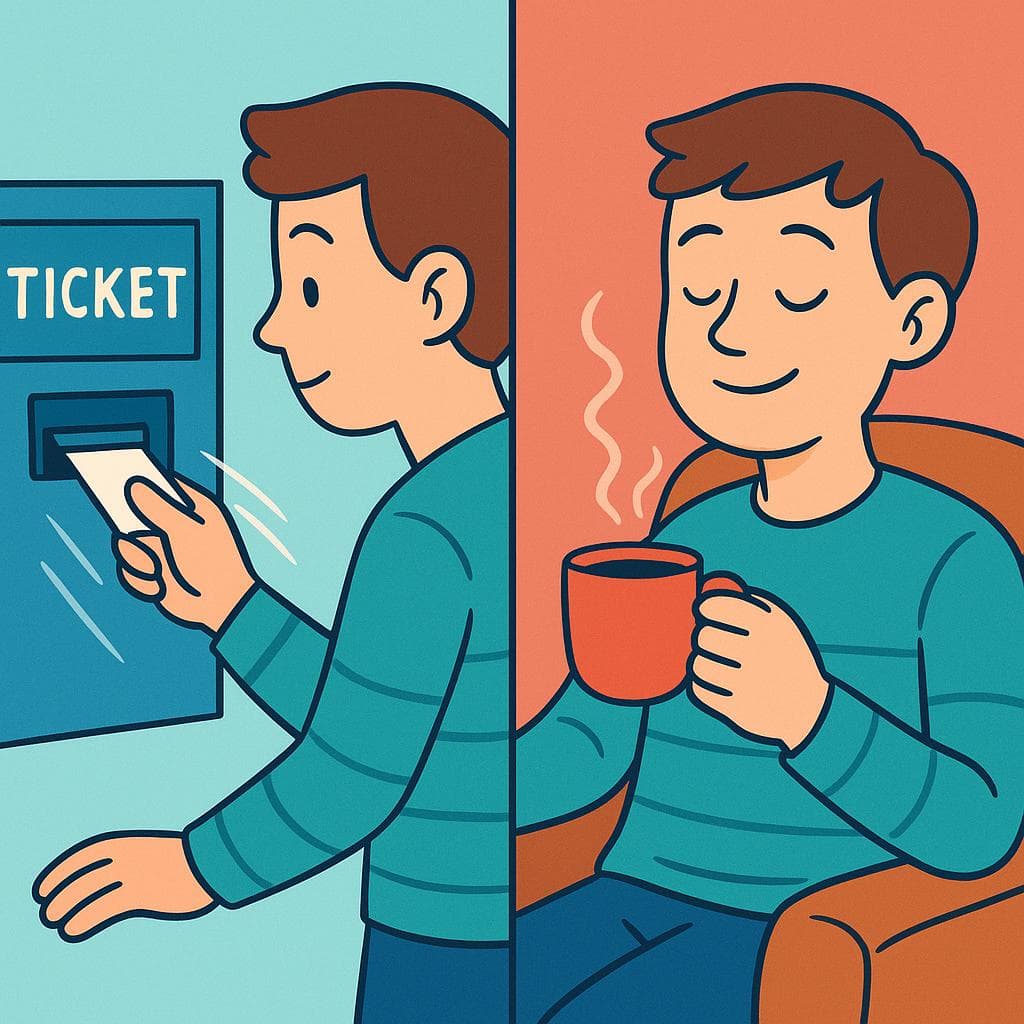
Tomar = the action. Tomarse = the personal experience or completion.
tomar
To take, drink, eat, or grab (focuses on the general action)
toh-MARtomarse
To take/drink/eat (emphasizing personal involvement, completion, or reaction)
toh-MAR-sehQuick Rule
Tomar = the action. Tomarse = the personal experience or completion.
Think: You 'tomar' the bus (an action), but you 'te tomas' a break (an experience for you).
- For drinks, they are often interchangeable. 'Tomo un café' and 'Me tomo un café' are both very common.
Comparison Table
| Context | tomar | tomarse | Why? |
|---|---|---|---|
| Consuming a Drink | Tomo café por la mañana. | Me tomé un café para despertarme. | Tomar describes a general habit. Tomarse focuses on a specific, complete act and its purpose. |
| Using Time | Este trabajo toma mucho tiempo. | Tómate tu tiempo. | Tomar means 'to require' time. Tomarse means to 'use' or 'grant yourself' time. |
| Attitude | Hay que tomar las cosas con calma. | Se tomó la noticia muy mal. | Tomar for general advice. Tomarse for a specific person's reaction to something. |
| Eating Soup | El niño no quería tomar la sopa. | ¡Al final se tomó toda la sopa! | Tomar is the general act of eating it. Tomarse implies he finished it all up. |
When to Use "tomar / tomarse"
tomar
To take, drink, eat, or grab (focuses on the general action)
toh-MAR
To drink or eat (in general)
¿Quieres tomar algo?
Do you want to drink something?
To take transportation
Tomo el metro para ir al trabajo.
I take the subway to go to work.
To take or grab an object
Tomó las llaves y salió.
He took the keys and left.
To make a choice or decision
Tenemos que tomar una decisión importante.
We have to make an important decision.
tomarse
To take/drink/eat (emphasizing personal involvement, completion, or reaction)
toh-MAR-seh
To consume something completely
Se tomó toda la botella de agua.
He drank the whole bottle of water.
To take time or a break for oneself
Voy a tomarme un descanso de cinco minutos.
I'm going to take a five-minute break.
To take something in a certain way (personally)
No te tomes a mal mi comentario.
Don't take my comment the wrong way.
To take medicine
Me tomo dos pastillas por la mañana.
I take two pills in the morning.
Contrast Examples
With "tomar":
Ella toma su trabajo en serio.
She takes her job seriously. (It's her general attitude.)
With "tomarse":
Ella se tomó el comentario muy en serio.
She took the comment very seriously. (Her personal reaction to one thing.)
The Difference: Tomar describes a general approach or attitude. Tomarse describes a specific, personal reaction to an event or comment.
With "tomar":
Anoche tomamos pizza para cenar.
Last night we had pizza for dinner. (This is what we ate.)
With "tomarse":
¡Nos tomamos la pizza entera!
We ate the entire pizza! (We finished the whole thing.)
The Difference: Tomar states what you ate or drank. Tomarse often adds the emphasis of completion or indulgence.
With "tomar":
Toma esto como una broma.
Take this as a joke. (General instruction.)
With "tomarse":
Me estás tomando el pelo.
You're pulling my leg. (Idiomatic expression, always reflexive.)
The Difference: The reflexive form is essential for certain idiomatic expressions. 'Tomarse el pelo a alguien' means to tease someone.
Common Mistakes
Se toma el autobús todos los días.
Toma el autobús todos los días.
For taking transportation, the simple form 'tomar' is standard. Using 'tomarse' here sounds like you are consuming the bus.
Voy a tomar un descanso.
Voy a tomarme un descanso.
When you 'take a break' for yourself, the reflexive form 'tomarse' is used to show it's a personal experience.
Quick Practice
Quick Quiz: Tomar vs Tomarse
Question 1 of 3
Which is the most natural way to say 'Take your time'?
Related Grammar
Want to understand the grammar behind this pair? Explore these lessons for a deep dive:
Key Words
.jpg&w=256&q=75)

Tags
Build the instinct, not just the rule
Rules help you get it right; context makes it automatic. Read 200+ illustrated and narrated Spanish stories to see confusing pairs chosen correctly — over and over — until you stop thinking about it.
Frequently Asked Questions
Can I always use 'tomar' instead of 'tomarse' for drinks?
Often, yes, and you will be understood. 'Tomo un café' is perfectly correct. Using 'me tomo un café' adds a subtle, personal emphasis, as if you're really enjoying it or it's a specific treat for yourself. In many situations, they are interchangeable.
Is 'tomarse' a completely different verb from 'tomar'?
No, it's the reflexive form of 'tomar'. This means you use the verb 'tomar' but add a reflexive pronoun (me, te, se, nos, os, se) before the conjugated verb. This pronoun changes the meaning slightly to be more personal, internal, or complete.