Inklingo

quitarle

/kee-TAHR-leh/

to take (something) away from him/her/it

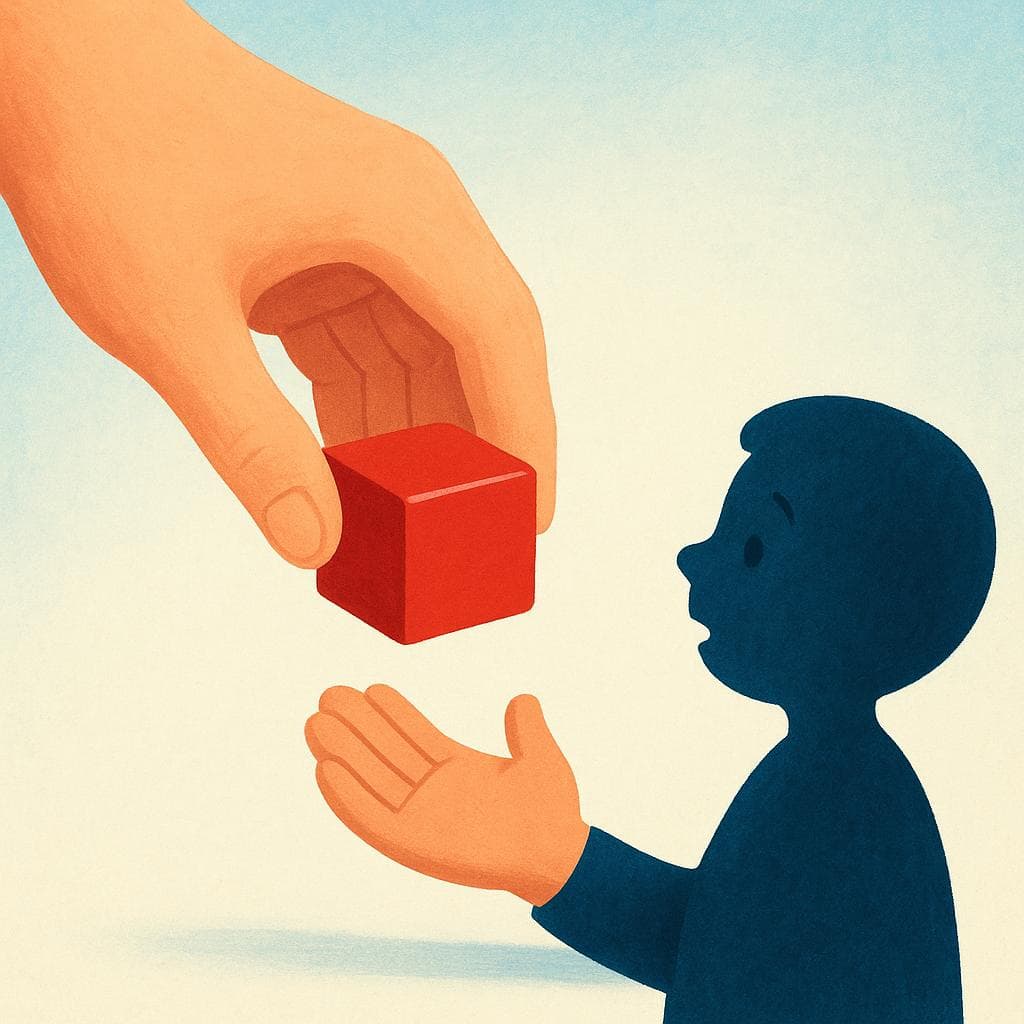
A large hand gently takes a bright red toy block away from the smaller, open hand of a child.

Quitarle can mean to physically take an object away from someone.

quitarle(Verb)

A2regular ar

to take (something) away from him/her/it

?

physical removal of an object

,

to remove (something) from you (formal)

?

formal address

Also:

to steal from him/her

?

in the context of theft

📝 In Action

Necesito quitarle las llaves antes de que se vaya.

A2

I need to take his keys away before he leaves.

¡Quitarle ese juguete, por favor! Es peligroso.

A2

Take that toy away from her, please! It's dangerous.

El camarero vino a quitarle el plato vacío.

B1

The waiter came to take the empty plate away from him.

Word Connections

Synonyms

  • sacarle (to take out from him/her)
  • retirarle (to withdraw from him/her)

Antonyms

Common Collocations

  • quitarle la ropato take his/her clothes off
  • quitarle la vidato take his/her life

💡 Grammar Points

Pronoun Placement

When using a verb in its base form (infinitive) or the command form (imperative), the pronoun 'le' is attached directly to the end of the verb, forming one word: 'quitarle'.

The Meaning of 'le'

The 'le' tells you who is losing the item. It means 'from him,' 'from her,' 'from it,' or 'from you (formal)'.

❌ Common Pitfalls

Confusing 'le' and 'lo/la'

Mistake: "Using 'quitarlo' when meaning 'to take it away from him.'"

Correction: The person affected is always 'le' (indirect object). 'Lo' or 'la' refers to the thing being removed. Example: 'Voy a quitarle (a él) el libro (el objeto).' (I'm going to take the book from him.)

⭐ Usage Tips

Using 'le' with compound tenses

When using two verbs (like 'I want to remove'), you can either attach 'le' to the end of the infinitive ('quiero quitarle') or place it before the conjugated verb ('le quiero quitar').

A figure looks peaceful as a small, dark cloud symbolizing worry dissolves above their head.

Quitarle is also used metaphorically to mean relieving someone of pain or worry.

quitarle(Verb)

B1regular ar

to relieve him/her of (pain/worry)

?

easing a condition

,

to take away (a feeling) from him/her

?

emotional relief

Also:

to alleviate for him/her

?

medical context

📝 In Action

La aspirina le va a quitarle el dolor de cabeza.

B1

The aspirin is going to take away his headache.

Su presencia logró quitarle el miedo a la oscuridad.

B2

His presence managed to take away her fear of the dark.

Es difícil quitarle la costumbre de hablar en voz alta.

C1

It is difficult to break him of the habit of speaking loudly.

Word Connections

Synonyms

  • aliviarle (to relieve him/her)
  • disminuirle (to lessen for him/her)

Antonyms

  • aumentarle (to increase for him/her)

Common Collocations

  • quitarle el hambreto take away his/her hunger
  • quitarle el sueñoto take away his/her sleep (keep him/her awake)

💡 Grammar Points

Figurative Use

In this context, 'quitarle' means removing an abstract thing (like pain or a feeling) rather than a physical object. The structure remains the same: the person affected is 'le'.

⭐ Usage Tips

Expressing Relief

This verb is the most natural way to talk about medicine or actions that relieve symptoms or feelings. For example, 'Me quitó la sed' means 'It quenched my thirst.'

🔄 Conjugations

indicative

present

él/ella/ustedquita
yoquito
quitas
ellos/ellas/ustedesquitan
nosotrosquitamos
vosotrosquitáis

imperfect

él/ella/ustedquitaba
yoquitaba
quitabas
ellos/ellas/ustedesquitaban
nosotrosquitábamos
vosotrosquitabais

preterite

él/ella/ustedquitó
yoquité
quitaste
ellos/ellas/ustedesquitaron
nosotrosquitamos
vosotrosquitasteis

subjunctive

present

él/ella/ustedquite
yoquite
quites
ellos/ellas/ustedesquiten
nosotrosquitemos
vosotrosquitéis

imperfect

él/ella/ustedquitara/quitase
yoquitara/quitase
quitaras/quitases
ellos/ellas/ustedesquitaran/quitasen
nosotrosquitáramos/quitásemos
vosotrosquitarais/quitaseis

✏️ Quick Practice

💡 Quick Quiz: quitarle

Question 1 of 2

Which sentence correctly uses 'quitarle' to mean 'to take away the pain'?

Frequently Asked Questions

How do I use 'quitarle' in a command?

When giving a command, you attach 'le' directly to the affirmative command form. For example, '¡Quítale el teléfono!' (Take the phone away from him!). For negative commands, 'le' goes before the verb: '¡No le quites el teléfono!'

If I am removing something from a woman, should I use 'quitarla' instead of 'quitarle'?

No. 'La' or 'lo' refers to the *thing* being removed (the direct object, like a jacket). 'Le' refers to the *person* who is losing the item (the indirect object, the woman). You should say: 'Voy a quitarle la chaqueta' (I am going to remove the jacket from her).