confesar
“confesar” means “to confess” in Spanish. It has 2 different meanings depending on context:

to confess, to admitAlso: to own up

📝 In Action
El ladrón confesó su crimen a la policía.
A2The thief confessed his crime to the police.
Debo confesar que no me gustó la película.
B1I must admit that I didn't like the movie.
Ella confiesa la verdad solo cuando la presionan.
B2She only reveals the truth when they pressure her.
Word Connections
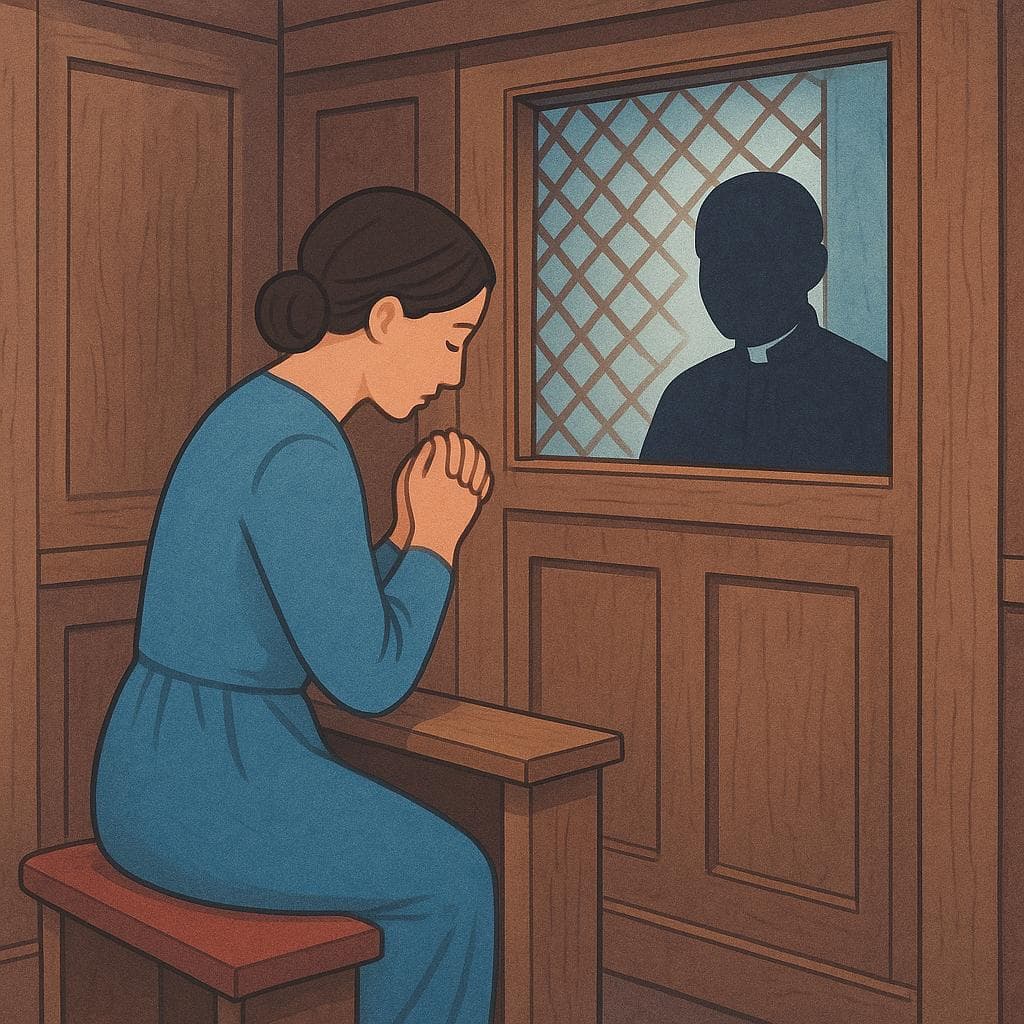
to go to confessionAlso: to confess oneself

📝 In Action
Antes de la Pascua, muchas personas se confiesan.
B1Before Easter, many people go to confession.
Mi abuela se confiesa todos los meses.
B2My grandmother confesses (goes to confession) every month.
Word Connections
Indicative
Present
Imperfect
Preterite
Subjunctive
Present Subjunctive
Imperfect Subjunctive
Translate to Spanish
Words that translate to "confesar" in Spanish:
✏️ Quick Practice
Quick Quiz: confesar
Question 1 of 2
Which sentence correctly uses the E>IE stem change for 'confesar'?
📚 More Resources
👥 Word Family
📚 Etymology
The word comes from the Latin verb *confessari*, which is an intensified form of *confiteri*, meaning 'to acknowledge' or 'to admit fully'. It has always carried the meaning of openly declaring something, often a fault or belief.
First recorded: 13th century
Cognates (Related words)
💡 Master Spanish
Take your Spanish to the next level. Read 200+ illustrated and narrated Spanish stories tailored to your level with the Inklingo app!
Frequently Asked Questions
Is 'confesar' a regular verb?
No, 'confesar' is a stem-changing verb. In the present tense, the 'e' changes to 'ie' in most forms (like 'confieso' and 'confiesas'), but the 'nosotros' and 'vosotros' forms are regular.
How do I use 'confesar' when talking about revealing a secret?
You use the standard form: 'Él confesó su secreto.' (He confessed his secret.) If you want to say 'I must confess,' you can use the phrase 'Debo confesar que...' followed by what you are admitting.