How to Say "watches" in Spanish
The most common Spanish word for “watches” is “vigila” — use 'vigila' when referring to the act of guarding or keeping watch over something, often for security purposes.



vigila
vee-HEE-lahbiˈxila

Examples
El perro vigila la casa de noche.
The dog guards the house at night.
Ella siempre vigila que todo esté en orden antes de irse.
She always checks (monitors) that everything is in order before leaving.
¡Vigila que nadie entre al almacén!
Watch (make sure) that no one enters the warehouse!
Two Uses of 'Vigila'
'Vigila' can be a statement about someone else ('Ella vigila' = She watches) OR a command to a friend ('¡Vigila!' = Watch!). Context tells you which one is being used.
Regular -AR Verb
This verb follows the most common Spanish pattern. If you learn 'vigilar,' you can easily conjugate hundreds of other verbs like 'hablar' (to talk) and 'caminar' (to walk).
Confusing the Command Forms
Mistake: “Using 'vigile' when telling a friend what to do.”
Correction: For friendly, informal commands, use the 'tú' form: '¡Vigila el perro!'. The 'vigile' form is reserved for formal commands (Usted).
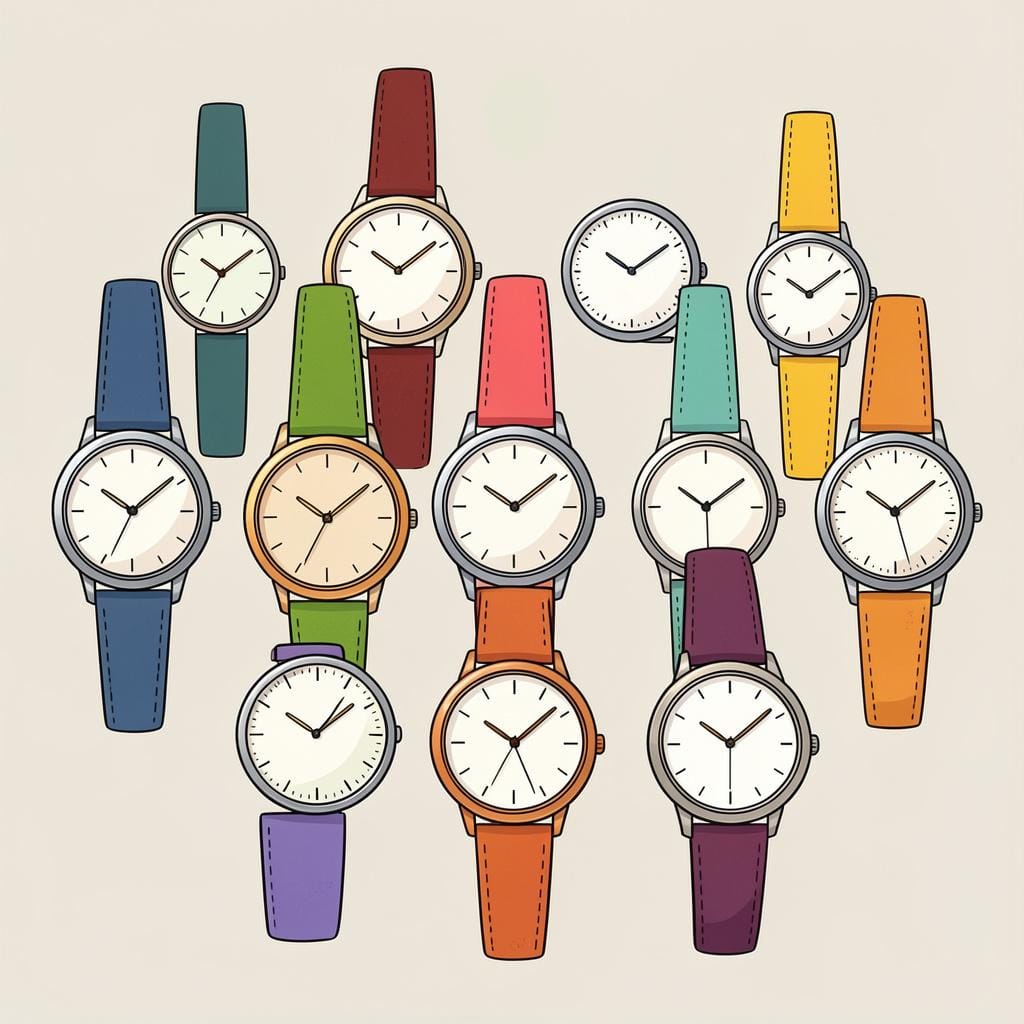
relojes
reh-LOH-hesreˈloxes
Examples
Me encantan los relojes antiguos.
I love antique clocks.
Él tiene una colección de relojes suizos.
He has a collection of Swiss watches.
Los relojes de la torre suenan a las doce.
The tower clocks ring at twelve.
One word for both
Unlike English which has two different words (clock and watch), Spanish uses 'relojes' for any device that measures time.
Making it plural
To make the singular 'reloj' plural, you add '-es' because it ends in a consonant (j). This changes the sound slightly at the end.
Gender confusion
Mistake: “las relojes”
Correction: los relojes
observa
ohb-sehr-vahoβˈseɾ.βa

Examples
Ella observa el cielo buscando estrellas fugaces.
She watches the sky looking for shooting stars.
¡Observa cómo lo hace el instructor antes de intentarlo tú mismo!
Observe how the instructor does it before trying it yourself!
Usted observa los detalles con mucha precisión, señor Torres.
You (formal) observe the details with great precision, Mr. Torres.
Use as a Command
"Observa" is the friendly, informal command form (tú) to tell someone to watch or pay attention.
Present Tense Action
In the present tense, 'observa' describes an action happening now or a habitual action performed by one person (he, she, or formal you).
Confusing 'Observa' and 'Mira'
Mistake: “Using 'observa' when you mean a quick glance, like 'Mira la televisión'.”
Correction: Use 'observa' for detailed, careful watching. 'Mira' is better for simply looking or watching TV.
vela
VAY-lahˈbe.la

Examples
La enfermera vela por el paciente toda la noche.
The nurse watches over the patient all night.
Él vela para terminar su proyecto a tiempo.
He stays awake (keeps vigil) to finish his project on time.
Usted vela por la seguridad de todos.
You (formal) ensure the safety of everyone.
The 'Por' Connection
When 'velar' means 'to watch over' or 'to ensure,' it almost always requires the preposition 'por' immediately after it: 'velar por algo/alguien'.
Confusing Verb and Noun
Mistake: “Using 'vela' (the verb conjugation) when you mean 'la vela' (the object).”
Correction: Remember that the verb 'vela' needs a subject (he/she/it) and context, while the noun 'la vela' refers to the object itself.
Distinguishing Observation from Guarding
Learn Spanish with Inklingo
Interactive stories, personalized learning, and more.