
Marchar vs Marcharse
Marchar = to march or function. Marcharse = to leave.
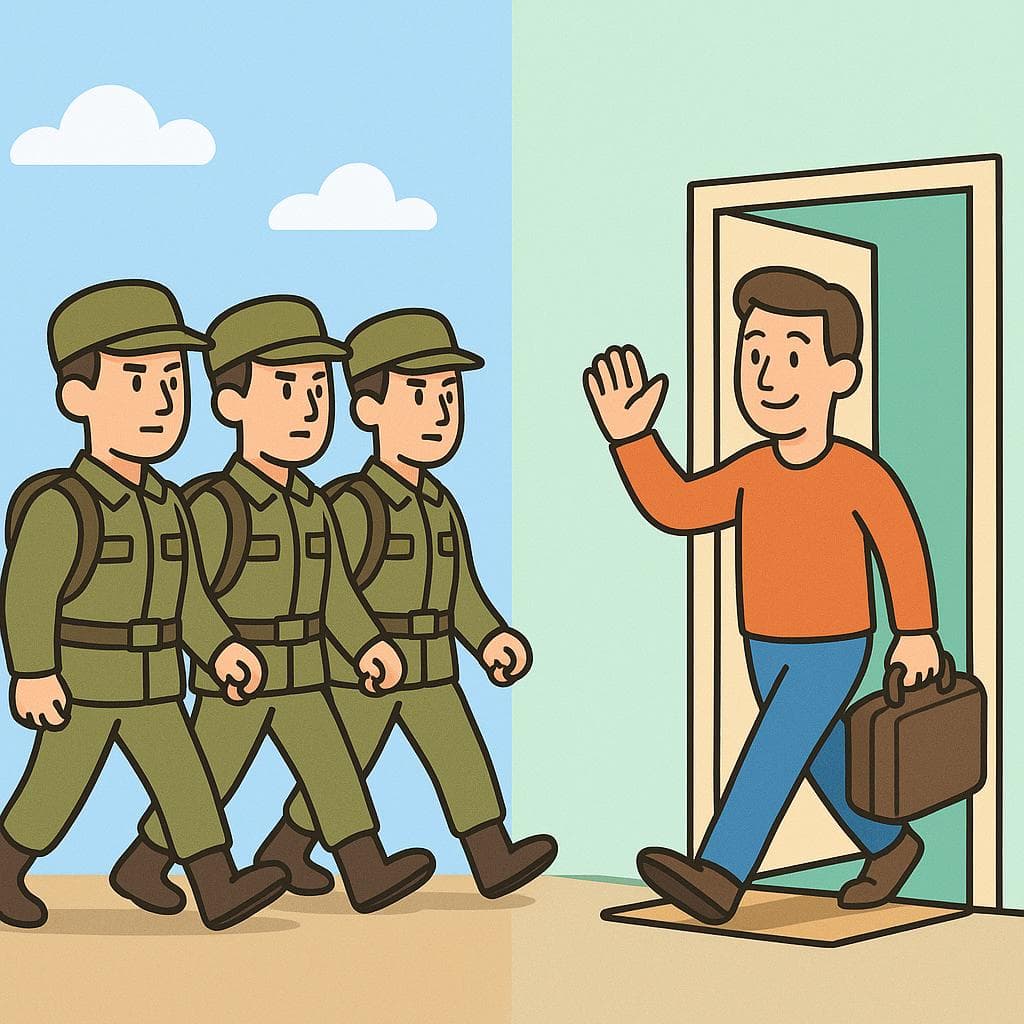
marchar
To march (like a soldier); to function or work (like a machine); to proceed.
mar-CHARmarcharse
To leave, to go away, to depart from a place.
mar-CHAR-sehQuick Rule
Marchar = to march or function. Marcharse = to leave.
Think: You 'make yourself scarce' when you 'marcharse'. The '-se' is you leaving.
- 'Marchar' can sometimes mean 'to go' or 'to proceed' in a general sense, like 'Todo marcha bien' (Everything is going well).
Comparison Table
| Context | marchar | marcharse | Why? |
|---|---|---|---|
| Movement | El pelotón marcha. | El soldado se marcha. | Marchar describes the specific action of marching. Marcharse describes the general act of leaving. |
| A Business | El negocio marcha bien. | El jefe se marcha del negocio. | Marchar describes how the business is functioning. Marcharse means the boss is leaving the company. |
| Core Meaning | To function / To march | To leave / To go away | Marchar focuses on the process or type of movement. Marcharse focuses on the act of departure. |
When to Use "marchar / marcharse"
marchar
To march (like a soldier); to function or work (like a machine); to proceed.
mar-CHAR
Military-style marching
Los soldados marchan en el desfile.
The soldiers are marching in the parade.
How something functions or works
Mi viejo reloj todavía marcha perfectamente.
My old watch still works perfectly.
How a plan or project is proceeding
¿Cómo marcha el proyecto?
How is the project going?
To march in a protest
Miles de personas marcharon por el clima.
Thousands of people marched for the climate.
marcharse
To leave, to go away, to depart from a place.
mar-CHAR-seh
Leaving a place (home, work, a party)
Ya es tarde, tengo que marcharme.
It's late, I have to leave.
Stating your intention to depart
Nos marchamos a la playa mañana.
We're leaving for the beach tomorrow.
Describing someone else's departure
Se marchó sin decir adiós.
He left without saying goodbye.
Contrast Examples
With "marchar":
El general marcha por la plaza.
The general is marching through the square.
With "marcharse":
El general se marcha de la plaza.
The general is leaving the square.
The Difference: 'Marchar' describes the *way* he is moving (marching). 'Marcharse' describes his *departure from* the location.
With "marchar":
Los manifestantes marchan hacia el ayuntamiento.
The protesters are marching towards city hall.
With "marcharse":
Los manifestantes se marchan del lugar.
The protesters are leaving the place.
The Difference: 'Marchar' implies a protest or organized walk with a destination. 'Marcharse' simply means they are departing the area.
Common Mistakes
Yo marcho de la oficina a las cinco.
Yo me marcho de la oficina a las cinco.
When you mean 'to leave' a place, you must use the pronominal form 'marcharse'. 'Yo marcho' sounds like you are marching like a soldier inside the office.
El motor no se marcha bien.
El motor no marcha bien.
To describe how a machine or system is functioning, use 'marchar' without the '-se'. The engine isn't a person that can leave.
Quick Practice
Quick Quiz: Marchar vs Marcharse
Question 1 of 2
Which is correct? 'La fiesta se acabó. Es hora de ___.'
Related Grammar
Want to understand the grammar behind this pair? Explore these lessons for a deep dive:
Key Words





Tags
Build the instinct, not just the rule
Rules help you get it right; context makes it automatic. Read 200+ illustrated and narrated Spanish stories to see confusing pairs chosen correctly — over and over — until you stop thinking about it.
Frequently Asked Questions
Is 'marcharse' the same as 'irse' or 'salir'?
They are very similar and often interchangeable for 'to leave'. 'Marcharse' can sometimes sound a bit more formal or definitive than 'irse'. 'Salir' specifically means 'to exit' or 'to go out of' a place.
Why does adding '-se' change the verb's meaning?
This is a common feature in Spanish with what are called pronominal verbs. Adding the pronoun (me, te, se, nos, os, se) can change the meaning, often making it more personal, emphasizing the start or end of an action, or indicating a change of state. You see the same pattern in 'ir' (to go) vs. 'irse' (to leave).