How to Say "badge" in Spanish
The most common Spanish word for “badge” is “chapa” — use 'chapa' when referring to the metal body of a car, not a pin or emblem.


chapa
CHAH-pahˈtʃapa
Examples
El coche tiene una abolladura en la chapa.
The car has a dent in the metal body.
¿Tienes un abridor? No puedo quitar la chapa.
Do you have an opener? I can't get the bottle cap off.
Los niños juegan con chapas en el recreo.
The children play with bottle caps during recess.
Describing Material
When saying something is made of sheet metal, always use 'de' followed by 'chapa', like 'una caja de chapa' (a metal box).
Always Feminine
Even if referring to a hard, masculine-looking car part, the word 'chapa' is always feminine: 'la chapa'.
Cap vs. Cork
Mistake: “Using 'tapón' for a metal beer cap.”
Correction: Use 'chapa' for metal crown caps and 'tapón' for plastic screw caps or corks.
credencial
kre-den-syalkɾeðenˈsjal

Examples
Por favor, muestra tu credencial al guardia de seguridad.
Please, show your badge to the security guard.
Perdí mi credencial de elector y tengo que tramitar una nueva.
I lost my voter ID card and I have to apply for a new one.
El candidato tiene credenciales académicas muy impresionantes.
The candidate has very impressive academic credentials.
Always Feminine
Even though it ends in 'l', this word is feminine. Always use 'la' or 'una' with it (la credencial).
Making it Plural
To talk about more than one, add '-es' at the end to get 'credenciales'.
Gender confusion
Mistake: “el credencial”
Correction: la credencial (it is a feminine noun).
distintivo
dees-teen-TEE-bohdis.tin.ˈti.βo

Examples
Todos los empleados deben llevar su distintivo en la solapa.
All employees must wear their badge on their lapel.
El oficial mostró su distintivo antes de entrar al edificio.
The officer showed his badge before entering the building.
La calidad es el distintivo de nuestra empresa.
Quality is the hallmark of our company.
Always Masculine
As a noun meaning 'badge' or 'emblem,' it is always masculine: 'el distintivo,' even if a woman is wearing it.
Badge of Honor
Mistake: “Using 'distintivo' for a police badge in a very casual way.”
Correction: While 'distintivo' is correct, many people use 'placa' specifically for a police shield or metal badge.
insignia
een-SEEG-nyahinˈsiɣnja

Examples
El oficial lleva una insignia de plata en su uniforme.
The officer wears a silver badge on his uniform.
¡Felicidades! Has ganado una insignia por completar el curso de español.
Congratulations! You've earned a badge for completing the Spanish course.
Cada club tiene su propia insignia bordada en la chaqueta.
Every club has its own emblem embroidered on the jacket.
Always Feminine
Even if a man is wearing it, the word remains 'la insignia.' It doesn't change to match the person.
Plural Form
To talk about more than one, simply add an 's' to get 'insignias.'
Confusing with 'Sign'
Mistake: “Using 'insignia' to mean a street sign.”
Correction: Use 'señal' for street or traffic signs. Use 'insignia' for badges or symbolic emblems.
placa
PLAH-kahˈplaka
Examples
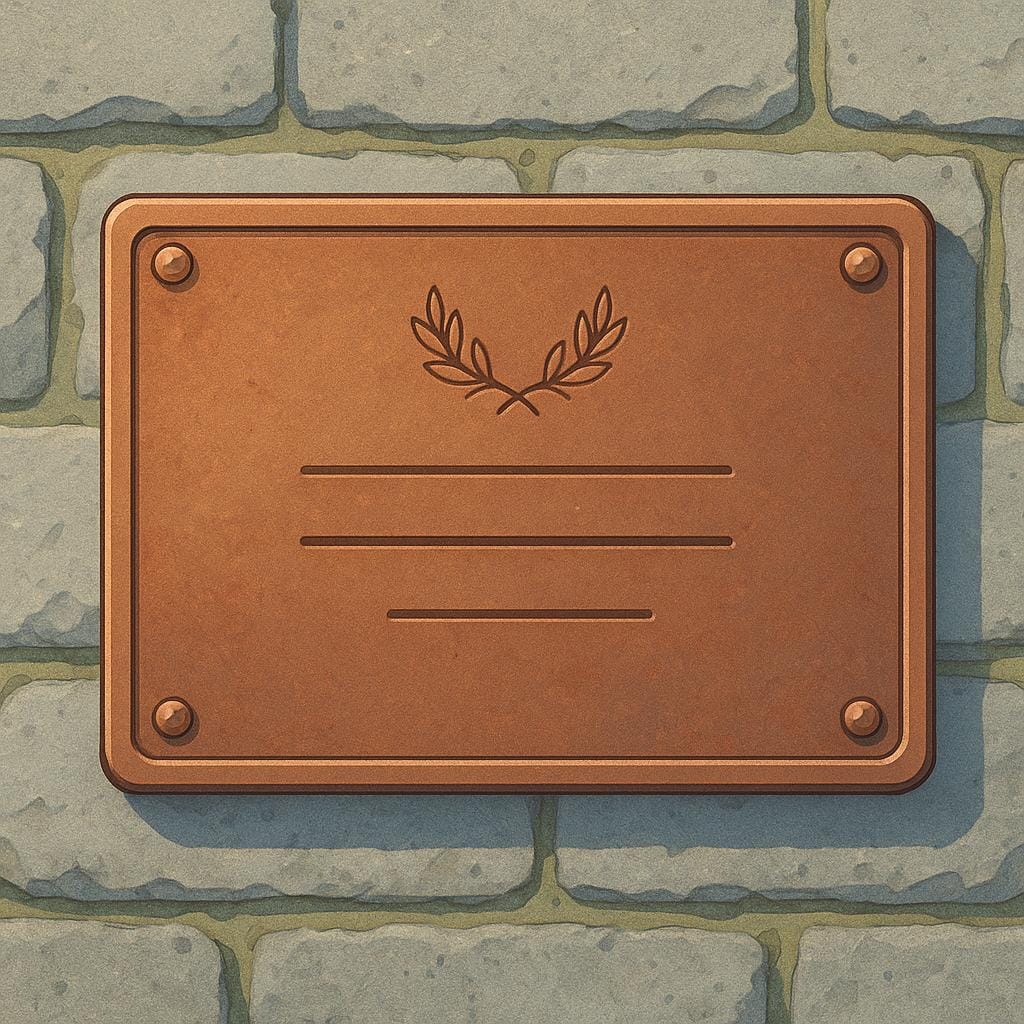
Colocaron una placa conmemorativa en la pared del edificio antiguo.
They placed a commemorative plaque on the wall of the old building.
El detective mostró su placa antes de entrar a la casa.
The detective showed his badge before entering the house.
Plaque vs. Sign
'Placa' usually implies a small, flat, rigid sign, often made of metal or stone. For larger, general signs, use 'cartel' or 'señal'.
Distinguishing 'Chapa' from Emblematic Badges
Related Translations
Learn Spanish with Inklingo
Interactive stories, personalized learning, and more.