How to Say "to veer" in Spanish
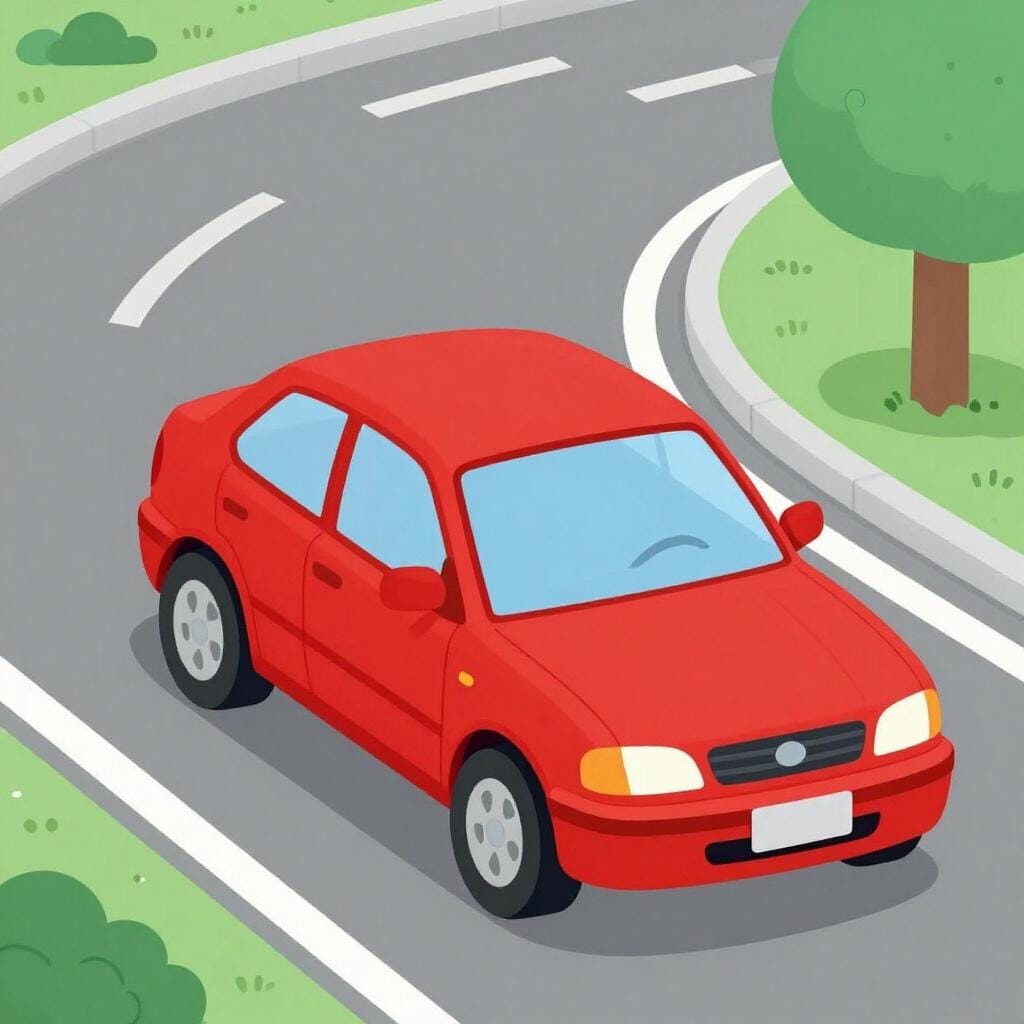
The most common Spanish word for “to veer” is “girar” — use 'girar' when describing a standard turn, like at an intersection or when changing lanes, often indicated by a turn signal.

Use 'girar' when describing a standard turn, like at an intersection or when changing lanes, often indicated by a turn signal.
Learn more →
Choose 'torcer' when you need to indicate moving off a straight course, particularly when making a turn at a corner or intersection.
Learn more →
Use 'virar' for a sudden or sharp change in direction, often seen in nautical or aviation contexts, or a decisive turn.
Learn more →
Employ 'desviar' when a path is suddenly changed or diverted, often due to an obstruction or an unexpected event, affecting a broader area like traffic.
Learn more →hee-RAHRxiˈɾaɾ

Examples
Tienes que girar a la izquierda en el semáforo.
You have to turn left at the traffic light.
El coche giró bruscamente para evitar el perro.
The car turned sharply to avoid the dog.
Directional Use
When giving directions, always use 'a la derecha' (to the right) or 'a la izquierda' (to the left) after 'girar'.
tor-SEHRtorˈθer
Examples
Tienes que torcer a la derecha en la próxima esquina.
You have to turn right at the next corner.
El camino tuerce hacia el bosque.
The path turns towards the forest.
Tuerza a la izquierda después del semáforo.
Turn left after the traffic light.
Directional Prepositions
When using torcer to mean 'turn,' always use the preposition 'a' before the direction (a la derecha, a la izquierda).
bee-RAHRbiˈɾaɾ

Examples
Tienes que virar a la derecha en el semáforo.
You have to turn right at the traffic light.
El barco viró para evitar la tormenta.
The boat veered to avoid the storm.
No puedes virar en U en esta avenida.
You cannot make a U-turn on this avenue.
Using 'a' for direction
When you want to say which way to turn, always use the word 'a' before 'la derecha' (the right) or 'la izquierda' (the left).
A regular -ar verb
This verb follows the standard pattern for verbs ending in -ar, so if you know how to conjugate 'hablar,' you know how to conjugate 'virar'!
Virar vs. Volver
Mistake: “Using 'virar' for 'to return' in Spain.”
Correction: In Spain, use 'volver.' Use 'virar' for returning only in specific Caribbean regions like Cuba.
des-bee-ahrdesˈβjaɾ

Examples
Tuvieron que desviar el tráfico por el accidente.
They had to divert traffic because of the accident.
El piloto desvió el avión hacia el sur.
The pilot redirected the plane toward the south.
No dejes que nada te desvíe de tus metas.
Don't let anything stray you from your goals.
The 'í' Accent Rule
In the present tense, the 'i' gets an accent mark (desvío, desvías) when it is the part of the word we stress. This keeps the 'i' and 'o/a' as separate sounds rather than blending them together.
Moving 'From' and 'To'
Use 'de' to say what you are moving away from (desviar de la ruta) and 'hacia' or 'a' for the new direction.
Missing the Accent
Mistake: “Yo desvio el tráfico.”
Correction: Yo desvío el tráfico. (The accent is needed on the 'i' to show it is the stressed syllable.)
Distinguishing between 'girar', 'torcer', and 'virar'
Learners often confuse 'girar', 'torcer', and 'virar' as they all describe turns. 'Girar' is the most general for everyday turns. 'Torcer' emphasizes moving off a straight line, and 'virar' implies a more sudden or decisive change in direction.
Related Translations
Learn Spanish with Inklingo
Interactive stories, personalized learning, and more.