How to Say "arm" in Spanish
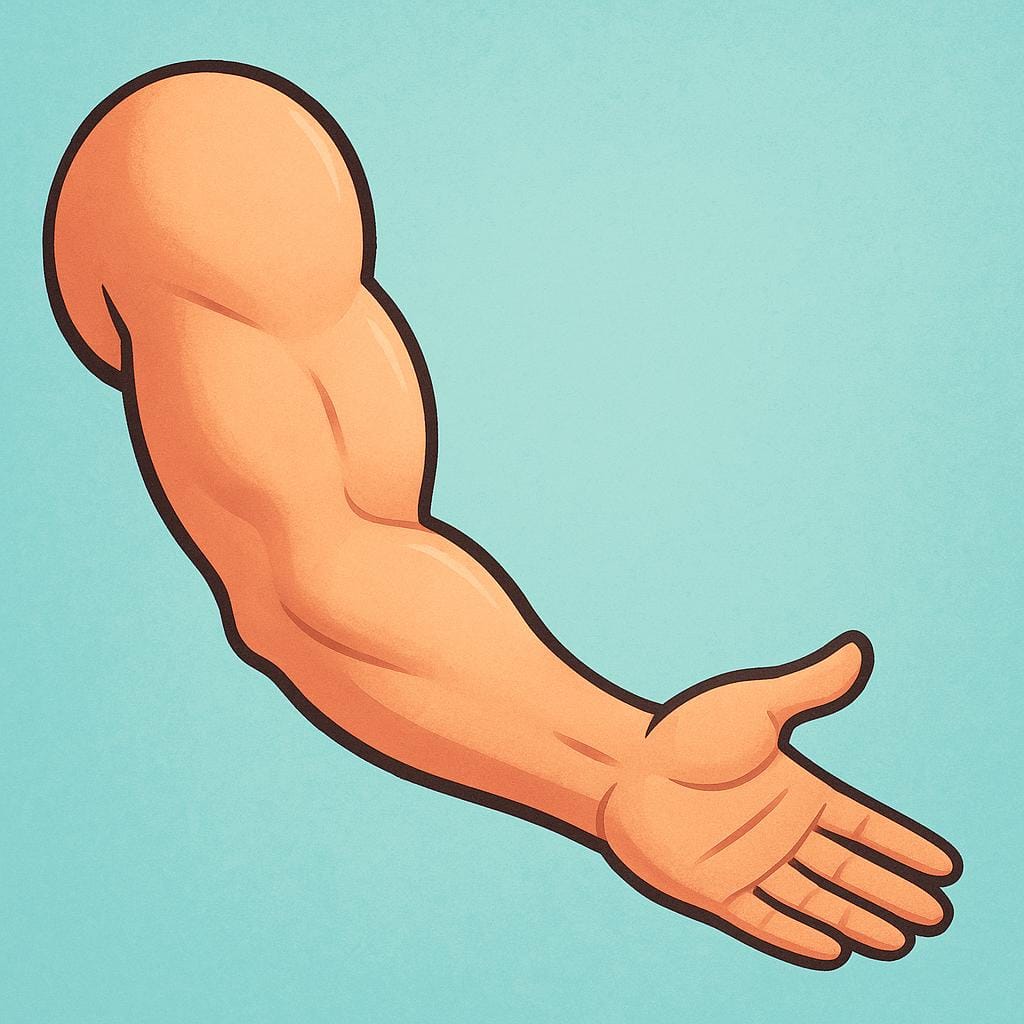
The most common Spanish word for “arm” is “brazo” — use 'brazo' for the physical limb of the human body or for a projecting part of an object like a chair or machine, or a section of a river.


brazo
BRAH-sohˈbɾaθo
Examples
Me duele el brazo después de cargar las cajas.
My arm hurts after carrying the boxes.
Ella cruzó los brazos cuando se enojó.
She crossed her arms when she got angry.
Mi bebé solo quiere estar en mis brazos.
My baby only wants to be in my arms.
Este brazo del río es muy profundo.
This branch of the river is very deep.
Use with Articles
When talking about your own body parts, Spanish usually uses 'el/la/los/las' instead of 'mi/tu' (my/your). Example: 'Me duele el brazo' (My arm hurts).
Confusing Brazo and Mano
Mistake: “Using 'brazo' when referring specifically to the hand.”
Correction: 'Brazo' is the entire limb from shoulder to wrist; 'mano' is the hand.
arma
AR-maˈaɾma

Examples
El soldado llevaba un arma para protegerse.
The soldier carried a weapon to protect himself.
La policía encontró el arma del crimen en el parque.
The police found the murder weapon in the park.
Tener un arma de fuego requiere una licencia especial.
Having a firearm requires a special license.
The 'el arma' Rule
Even though 'arma' is a feminine word (meaning you'd say 'las armas' for plural), we use 'el' in the singular ('el arma'). This is just to make it sound better and avoid the two 'a' sounds running together in 'la arma'. This happens with other feminine words that start with a stressed 'a' sound, like 'agua' ('el agua').
Using 'la' instead of 'el'
Mistake: “Vi la arma en la mesa.”
Correction: Vi el arma en la mesa. Remember, for singular feminine nouns starting with a stressed 'a', we borrow 'el' to make it flow nicely. But if you add an adjective, it goes back to 'la'! For example: 'la potente arma' (the powerful weapon).
Confusing 'brazo' and 'arma'
Learn Spanish with Inklingo
Interactive stories, personalized learning, and more.