How to Say "to link" in Spanish
The most common Spanish word for “to link” is “conectar” — use 'conectar' for physical connections like joining electronic devices to networks or power, or for simple, direct links.
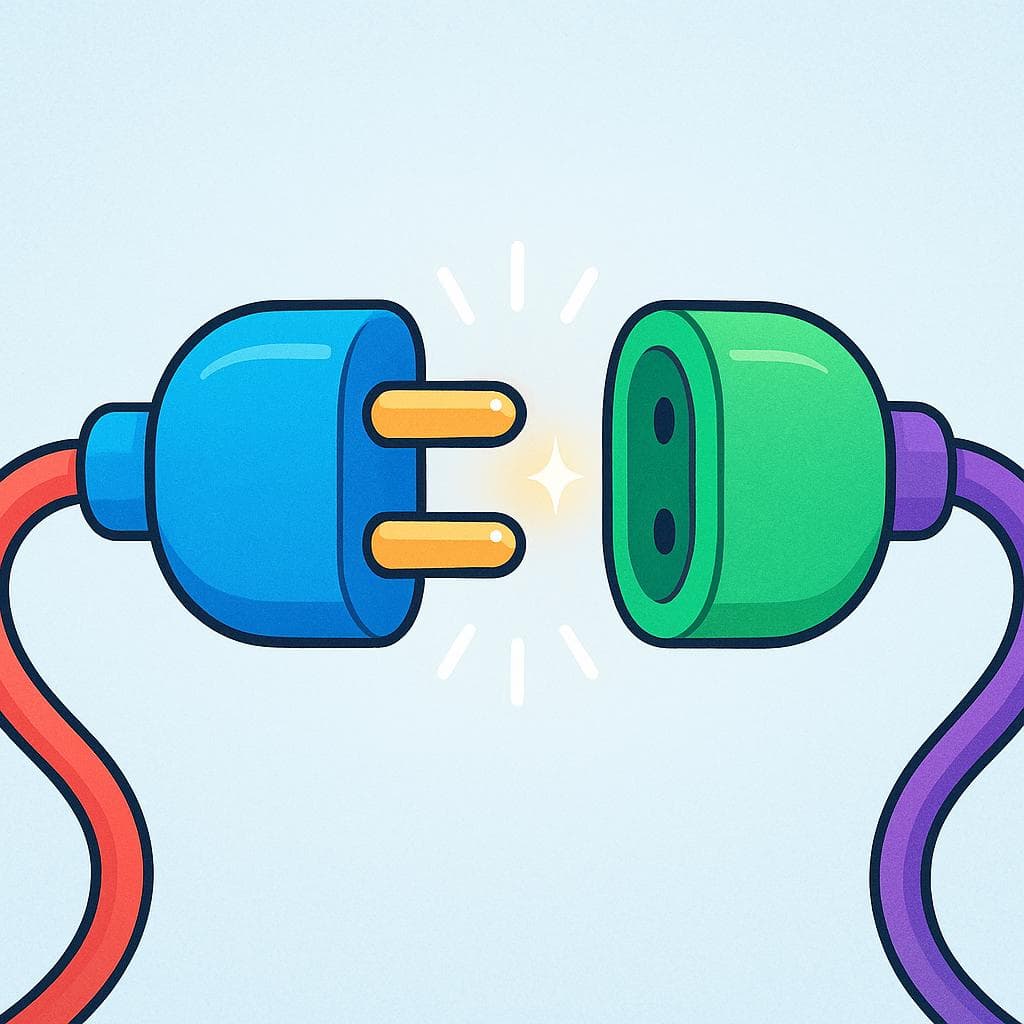
Use 'conectar' for physical connections like joining electronic devices to networks or power, or for simple, direct links.
Learn more →
Use 'enlazar' for connecting digital items like social media accounts or website links, and also for logically connecting written or spoken ideas.
Learn more →
Use 'asociar' when talking about mental connections, like linking a concept, feeling, or idea with something else.
Learn more →
Use 'relacionar' to show how two or more things are connected or have a bearing on each other, often used in academic or analytical contexts.
Learn more →
Use 'unir' for physically joining two or more separate things together to form a single unit.
Learn more →
Use 'vincular' for making a formal or strong connection, especially between accounts, data, or people in a professional or official capacity.
Learn more →
Use 'comunicar' when one space or area directly connects to and allows passage into another.
Learn more →
Use 'ligar' when there's a strong, often causal or fated, connection between two things, like success and effort, or when referring to romantic relationships.
Learn more →koh-nek-TARko.nekˈtaɾ
Examples
¿Puedes conectar el teléfono al Wi-Fi?
Can you connect the phone to the Wi-Fi?
Esta carretera conecta la ciudad con el aeropuerto.
This highway links the city with the airport.
Conectaron todos los cables antes de encender la máquina.
They connected all the cables before turning on the machine.
Es difícil conectar la falta de sueño con la pérdida de memoria.
It is difficult to link the lack of sleep with memory loss.
Regular -AR Verb
Conectar is a regular verb, meaning its endings follow the standard pattern for all verbs that end in -ar. Once you know the pattern, you can conjugate hundreds of verbs!
Formal Usage
In this abstract sense, 'conectar' often appears in passive constructions or formal statements, emphasizing the relationship between two concepts rather than the person doing the connecting.
Using the wrong preposition
Mistake: “Conectar con el internet.”
Correction: Conectar a internet (or a la red). In Spanish, we usually use 'a' when connecting to a service or network.
en-lah-SAHRenlaˈsaɾ

Examples
Enlaza tu cuenta de Twitter a tu perfil.
Link your Twitter account to your profile.
Debemos enlazar los dos párrafos con una transición.
We should link the two paragraphs with a transition.
El puente enlaza la isla con el continente.
The bridge links the island with the continent.
Es importante enlazar estos conceptos en tu mente.
It is important to connect these concepts in your mind.
The 'Z' to 'C' spelling change
When the verb ending starts with 'e', the 'z' in enlazar changes to 'c' to keep the soft 's' sound. For example, 'enlacé' (I linked).
Using the 'Personal A'
If you are 'linking' or 'joining' people together in a social sense, remember to use 'a' before the person you are linking.
Prepositions with Digital Linking
When linking one digital item to another, you usually use 'a' or 'con' (e.g., enlazar una cuenta CON otra).
Keeping the Z in the Preterite
Mistake: “Yo enlazé.”
Correction: Yo enlacé. (Spanish spelling rules don't like 'ze' or 'zi' in most words; 'ce' is the correct spelling for that sound.)
ah-so-sy-ahrasoˈsjaɾ

Examples
Mucha gente asocia el color rojo con el amor.
Many people associate the color red with love.
Es difícil asociar este nombre con esa persona.
It is difficult to associate this name with that person.
Los científicos asocian el tabaquismo con varias enfermedades.
Scientists link smoking with several diseases.
The 'Con' Connection
When you want to say you associate A 'with' B, always use the word 'con' in Spanish, just like in English!
Mental vs. Physical Joining
Use 'asociar' for connecting ideas or business partners. If you are physically joining two objects like Lego bricks, use 'unir' or 'juntar' instead.
Using 'a' instead of 'con'
Mistake: “Asocio el verano a la playa.”
Correction: Asocio el verano con la playa. (We use 'con' to show the link between the two things.)
re-la-syo-NARrelasjoˈnaɾ

Examples
Intenta relacionar cada palabra con su dibujo.
Try to relate each word to its drawing.
Es difícil relacionar estos dos sucesos.
It is difficult to connect these two events.
Los científicos relacionan el estrés con la falta de sueño.
Scientists link stress to a lack of sleep.
Using 'con'
In Spanish, we almost always use the word 'con' (with) after 'relacionar' to show what the second thing is. Example: 'Relaciono A con B'.
Spelling Change
The 'c' in 'relacionar' changes to a 'ce' or 'ci' sound depending on the vowel that follows, but in the subjunctive, the 'c' stays a 'c' because it's followed by 'e' (relacione), maintaining that 's' or 'th' sound.
Wrong Preposition
Mistake: “Relacionar a una cosa a otra.”
Correction: Relacionar una cosa con otra. We use 'con' to bridge the two related items.
oo-NEERuˈniɾ

Examples
Tienes que unir las dos piezas con pegamento.
You have to join the two pieces with glue.
El director quiere unir los esfuerzos de ambos equipos.
The director wants to unite the efforts of both teams.
La costurera unió la tela con hilo rojo.
The seamstress joined the fabric with red thread.
Regular -IR Verb
Unir is a regular verb, meaning its endings follow the standard pattern for verbs ending in -ir, making it easy to conjugate.
Mixing up 'unir' and 'estar unido'
Mistake: “Los cables son unidos. (The cables are joined.)”
Correction: Los cables están unidos. (The cables are joined.) 'Unir' is the action, 'estar unido' is the resulting state.
been-koo-larbiŋkuˈlaɾ

Examples
Tienes que vincular tu cuenta de correo al teléfono.
You have to link your email account to the phone.
El sistema permite vincular varios dispositivos a la vez.
The system allows pairing several devices at once.
He vinculado mis redes sociales para compartir contenido.
I have linked my social networks to share content.
Using the preposition 'a'
When you connect one thing to another, you almost always use the word 'a'. Think of it as 'linking A to B'.
Missing the 'a'
Mistake: “Vincula el teléfono con el ordenador.”
Correction: Vincula el teléfono al ordenador.
koh-moo-nee-karkomuniˈkaɾ

Examples
Esta puerta comunica con el salón principal.
This door connects to the main living room.
El pasillo comunica todas las habitaciones.
The hallway links all the rooms.
La nueva carretera comunica los dos pueblos.
The new road connects the two towns.
Physical Connection
When talking about rooms or roads connecting, use 'con' to show what it is connected to.
Confusing with 'Connect'
Mistake: “El cable comunica el monitor.”
Correction: El cable conecta el monitor. (Use 'conectar' for technology/plugs, and 'comunicar' for physical spaces like rooms.)
lee-GAHRliˈɣaɾ

Examples
Su éxito está ligado a su esfuerzo.
His success is linked to his effort.
Tienes que ligar bien los ingredientes.
You have to bind the ingredients well.
Añade un poco de harina para ligar la salsa.
Add a bit of flour to thicken the sauce.
Passive usage
This meaning is often used with 'estar' + 'ligado' (to be linked) to describe how two things are connected.
Abstract connections
You don't just bind physical objects; you use it to show how ideas or consequences are 'tied' together.
Confusing with 'leer'
Mistake: “Ligo el libro.”
Correction: Leo el libro. Be careful not to confuse the 'yo' form 'ligo' (I flirt/bind) with 'leo' (I read).
koh-nek-TARko.nekˈtaɾ
Examples
Es difícil conectar la falta de sueño con la pérdida de memoria.
It is difficult to link the lack of sleep with memory loss.
¿Puedes conectar el teléfono al Wi-Fi?
Can you connect the phone to the Wi-Fi?
Esta carretera conecta la ciudad con el aeropuerto.
This highway links the city with the airport.
Conectaron todos los cables antes de encender la máquina.
They connected all the cables before turning on the machine.
Regular -AR Verb
Conectar is a regular verb, meaning its endings follow the standard pattern for all verbs that end in -ar. Once you know the pattern, you can conjugate hundreds of verbs!
Formal Usage
In this abstract sense, 'conectar' often appears in passive constructions or formal statements, emphasizing the relationship between two concepts rather than the person doing the connecting.
Using the wrong preposition
Mistake: “Conectar con el internet.”
Correction: Conectar a internet (or a la red). In Spanish, we usually use 'a' when connecting to a service or network.
Conectar vs. Enlazar vs. Vincular
Learners often confuse 'conectar', 'enlazar', and 'vincular'. Remember, 'conectar' is often for physical or electronic links (Wi-Fi, power), 'enlazar' is common for digital accounts and linking ideas in text, while 'vincular' implies a more formal or strong official connection, like linking an official account.
Related Translations
Learn Spanish with Inklingo
Interactive stories, personalized learning, and more.