Inklingo

How to Say "wife" in Spanish

The most common Spanish word forwifeis esposathis is the most standard and widely understood term for 'wife' in Spanish, suitable for most formal and informal contexts..

esposa🔊A1

This is the most standard and widely understood term for 'wife' in Spanish, suitable for most formal and informal contexts.


{ui.learnMore}
mujer🔊A2

Often used informally to refer to one's spouse, especially when the context makes it clear you are not just referring to 'woman' in general.

{ui.learnMore}
señoraB1

Use this term when referring to your wife with a possessive pronoun ('mi', 'tu', 'su'), often implying a slightly more formal or respectful tone than 'esposa' in some regions.

{ui.learnMore}
vieja🔊B2

A colloquial and sometimes affectionate term for one's wife or girlfriend, similar to 'my old lady' in English; use with caution as it can be seen as disrespectful.

{ui.learnMore}
casada🔊B1

While literally meaning 'married woman,' it can refer to one's wife, though it's less common and more formal than 'esposa'. It emphasizes the married status.

{ui.learnMore}
jefa🔊C1

This is a slang term, particularly in Mexico, used informally to refer to one's spouse or girlfriend, often implying a playful or slightly dominant role.

{ui.learnMore}
English → Spanish

esposa

/es-PO-sa//esˈposa/

NounA1General
This is the most standard and widely understood term for 'wife' in Spanish, suitable for most formal and informal contexts.
A portrait of a smiling adult woman wearing a simple gold wedding band on her ring finger, symbolizing her role as a wife.

Examples

Mi esposa es abogada.

My wife is a lawyer.

Fui de vacaciones con mi esposa y mis hijos.

I went on vacation with my wife and my children.

El señor López y su esposa son muy amables.

Mr. Lopez and his wife are very kind.

A Word with a Partner

'Esposa' is a feminine noun, so you'll use it with feminine words like 'la' or 'una'. Its partner is 'esposo' (husband), which is masculine.

'Esposa' vs. 'Mujer'

Mistake:Sometimes learners use 'mujer' (woman) when they specifically mean 'wife'.

Correction: While you can say 'mi mujer' for 'my wife' in a casual way, 'mi esposa' is clearer and works in any situation, from casual to formal.

mujer

/moo-HER//muˈxeɾ/

NounA2Informal
Often used informally to refer to one's spouse, especially when the context makes it clear you are not just referring to 'woman' in general.
A man and a woman, clearly a couple, standing side-by-side with their arms around each other.

Examples

Mi mujer es de Argentina.

My wife is from Argentina.

Voy a ir al cine con mi mujer esta noche.

I'm going to the movies with my wife tonight.

¿Cómo se llama tu mujer?

What is your wife's name?

Possessive Words

This meaning is almost always used with a word that shows ownership, like 'mi' (my), 'tu' (your), or 'su' (his/her). For example, 'mi mujer' (my wife).

Confusing with 'Girlfriend'

Mistake:Te presento a mi mujer, llevamos dos meses saliendo.

Correction: Te presento a mi novia, llevamos dos meses saliendo. 'Mujer' implies a very serious, long-term relationship, usually marriage. For a girlfriend, you should use 'novia'.

señora

NounB1Formal/Respectful
Use this term when referring to your wife with a possessive pronoun ('mi', 'tu', 'su'), often implying a slightly more formal or respectful tone than 'esposa' in some regions.

Examples

Voy a la fiesta con mi señora.

I'm going to the party with my wife.

vieja

/BYEH-hah//'bjexa/

NounB2Colloquial/Slang
A colloquial and sometimes affectionate term for one's wife or girlfriend, similar to 'my old lady' in English; use with caution as it can be seen as disrespectful.
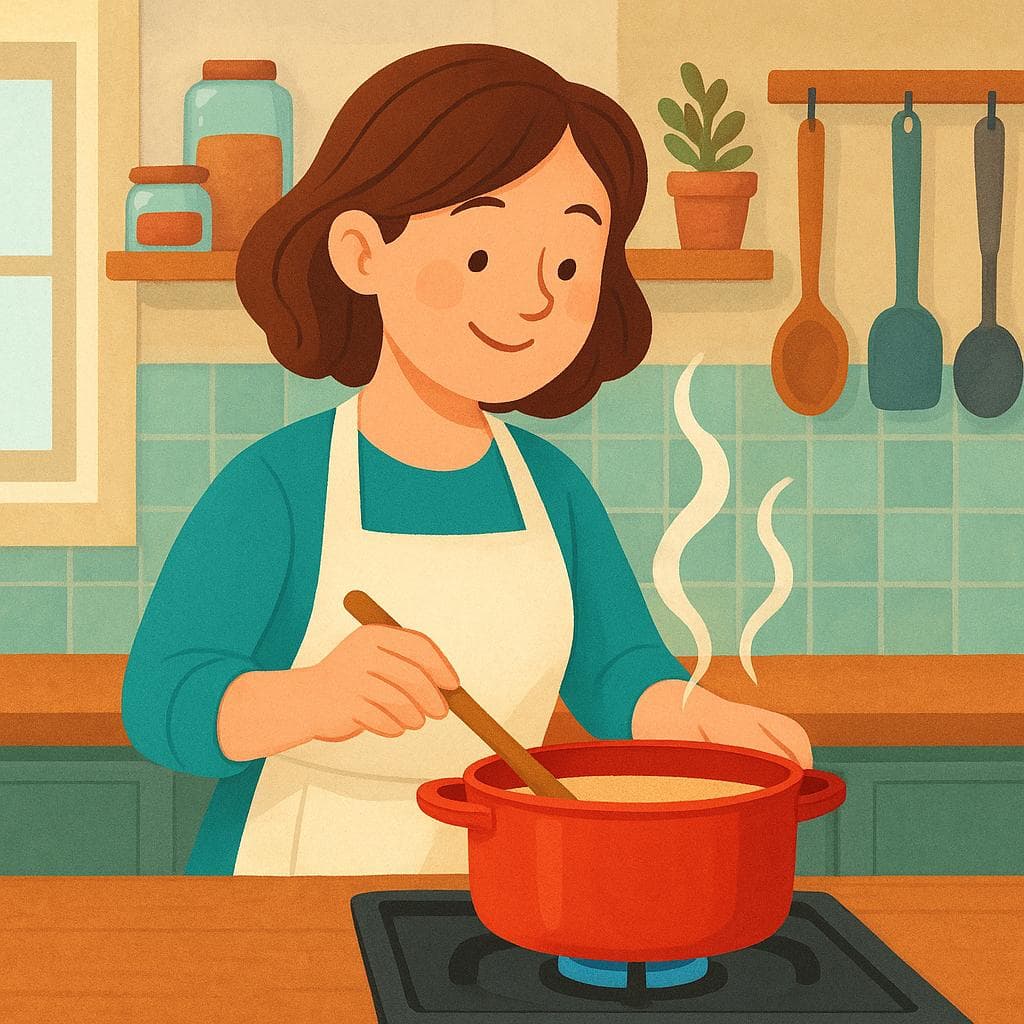
A cheerful woman standing in a warm kitchen, stirring a large pot on the stove.

Examples

Voy al cine con mi vieja.

I'm going to the movies with my girlfriend/wife.

Mi vieja cocina el mejor pozole.

My mom makes the best pozole.

casada

/kah-SAH-dah//kaˈsaða/

NounB1Formal/Less Common
While literally meaning 'married woman,' it can refer to one's wife, though it's less common and more formal than 'esposa'. It emphasizes the married status.
A simple illustration of a smiling woman standing affectionately next to a man, symbolizing a married couple.

Examples

La casada y su esposo compraron una casa nueva.

The married woman and her husband bought a new house.

Ella es la casada que mencionaste.

She is the wife/married woman you mentioned.

The Noun Form

When used as a noun, 'casada' refers directly to the person. It usually needs an article (like 'la') before it.

jefa

HEH-fah/'xefa/

NounC1Slang (Mexico)
This is a slang term, particularly in Mexico, used informally to refer to one's spouse or girlfriend, often implying a playful or slightly dominant role.
A couple consisting of a woman and a man standing close together, looking affectionately at each other and holding hands, symbolizing romantic partners.

Examples

¿Vas a ir al cine con tu jefa esta noche?

Are you going to the movies with your girlfriend tonight?

Le tengo que avisar a la jefa que llegaré tarde.

I have to let the wife know I'll be late. (Slang)

Context is Key

This slang meaning relies heavily on context. If someone is talking about their personal life, 'jefa' likely means partner or wife, not manager.

Using Slang Universally

Mistake:Using 'jefa' to mean 'girlfriend' in Spain or Argentina.

Correction: This usage is highly regional (especially Mexican). Stick to 'novia' or 'pareja' in other countries to avoid confusion.

Choosing Between 'Esposa', 'Mujer', and 'Señora'

Learners often confuse 'esposa' (wife), 'mujer' (woman/wife), and 'señora' (madam/wife). While 'esposa' is always safe, 'mujer' is informal and 'señora' can be more respectful or even slightly distant. Be mindful of context and your relationship with the person you're speaking to.

Learn Spanish with Inklingo

Interactive stories, personalized learning, and more.