How to Say "bank" in Spanish
The most common Spanish word for “bank” is “banco” — use 'banco' for a financial institution, a place to store or supply things (like blood), or a submerged sandbar.



banco
BAN-kohˈbaŋ.ko

Examples
Voy al banco para depositar un cheque.
I'm going to the bank to deposit a check.
¿A qué hora abre el banco los sábados?
What time does the bank open on Saturdays?
Necesito pedir un préstamo al banco para comprar un coche.
I need to ask the bank for a loan to buy a car.
Mi hermano es donante del banco de sangre.
My brother is a blood bank donor.
It's a Masculine Noun
Even though it doesn't end in '-o' in English, 'banco' in Spanish is masculine. Always say 'el banco' (the bank) or 'un banco' (a bank).
orilla
oh-REE-yahoˈɾiʝa

Examples
Nos sentamos en la orilla del mar a ver las olas.
We sat on the shore of the sea to watch the waves.
Los pescadores tienen sus redes en la orilla del río.
The fishermen have their nets on the bank of the river.
Always Feminine
Since 'orilla' is a noun that ends in -a, it is feminine. Always use 'la' or 'una' with it.
Confusing 'Orilla' and 'Costa'
Mistake: “Using 'costa' to mean the narrow line where the water meets the sand.”
Correction: 'Orilla' is the very edge where you walk (the shoreline). 'Costa' is the much larger, general coastal region.
margen
MAHR-henˈmaɾxen

Examples
Por favor, no escribas en el margen del examen.
Please, do not write in the margin of the exam.
Caminamos por el margen del río hasta encontrar un puente.
We walked along the bank of the river until we found a bridge.
El coche se detuvo en el margen de la carretera.
The car stopped on the side (verge) of the road.
Gender Note
Even though 'margen' ends in '-en', it is a masculine noun ('el margen'). However, in older usage or specifically referring to a riverbank, you might occasionally hear 'la margen'.
Using the wrong gender
Mistake: “La margen es muy estrecha.”
Correction: El margen es muy estrecho. (Always use the masculine article 'el' for the paper margin or general edge.)
ribera
ree-BEH-rahriˈβeɾa

Examples
Caminamos por la ribera del río Ebro durante el atardecer.
We walked along the bank of the Ebro River during sunset.
Las aves construyen sus nidos en la ribera de la laguna.
The birds build their nests on the shore of the lagoon.
Esta región es famosa por sus viñedos de ribera.
This region is famous for its riverside vineyards.
Gender Consistency
Even though it ends in 'a', just remember it's always feminine: 'la ribera' or 'las riberas'.
Describing Location
When saying something is located there, use the word 'en' (in/on) or 'por' (along/through).
Don't use 'Banco' for Water
Mistake: “El banco del río es bonito.”
Correction: La ribera del río es bonita. 'Banco' is for money or sitting; use 'ribera' or 'orilla' for the edge of water.
vera
VAY-rahˈbeɾa
Examples
Caminamos por la vera del camino hasta encontrar el pueblo.
We walked along the edge of the road until we found the town.
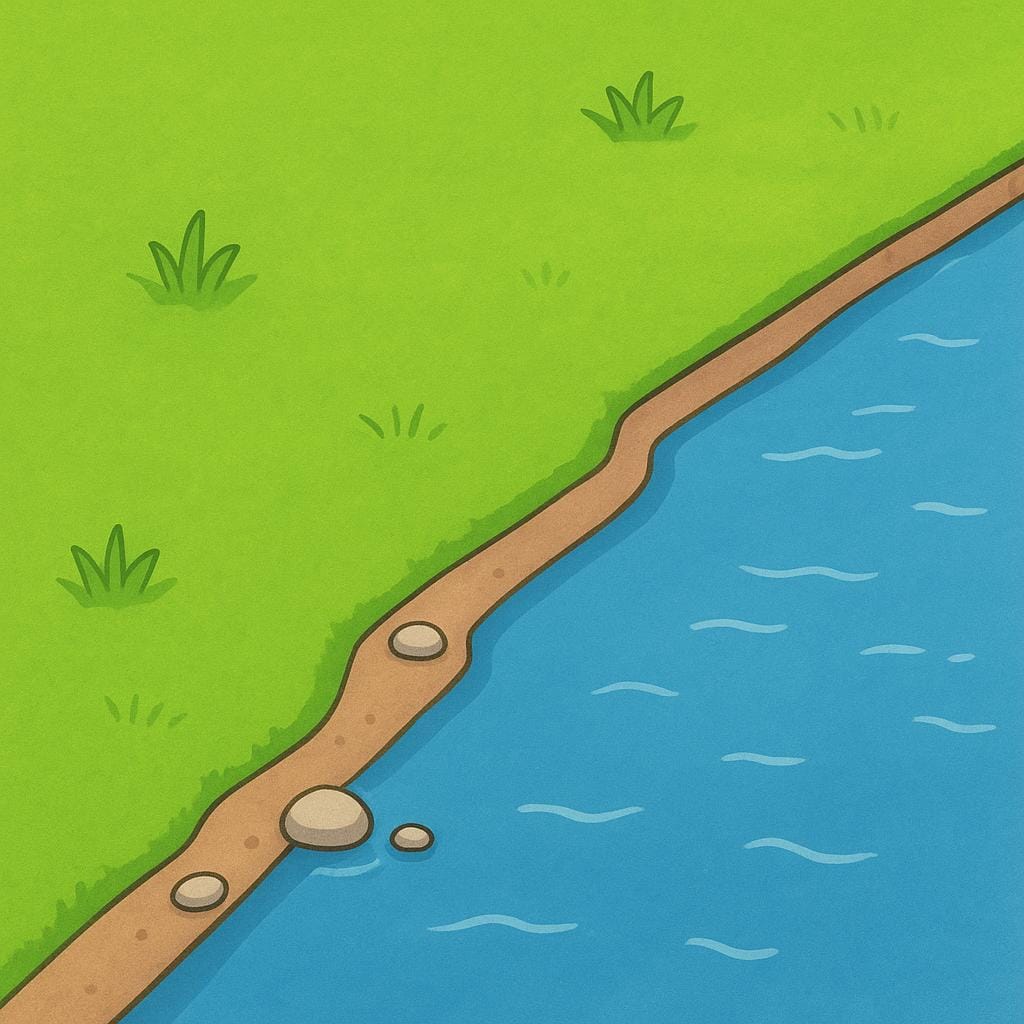
El picnic fue a la vera del río, bajo un gran árbol.
The picnic was on the bank of the river, under a large tree.
Always Feminine
Remember to always use the feminine article 'la' with 'vera': 'la vera'.
Confusing with 'Verdad'
Mistake: “Using 'vera' when you mean 'truth' (verdad).”
Correction: 'Vera' refers to a physical edge; use 'verdad' for truth.
Confusing River Banks
Learn Spanish with Inklingo
Interactive stories, personalized learning, and more.