How to Say "stop" in Spanish
The most common Spanish word for “stop” is “parada” — use 'parada' when referring to a designated place where a bus, metro, or tram stops, or for a general break or halt in an activity.











parada
pah-RAH-dahpaˈɾaða

Examples
La parada de autobús está justo aquí al lado.
The bus stop is right next door here.
¿Dónde está la parada de taxis más cercana?
Where is the nearest taxi stand?
Hagamos una parada para comer algo antes de seguir el camino.
Let's make a stop to eat something before continuing the journey.
El vuelo tiene una parada de tres horas en Madrid.
The flight has a three-hour layover in Madrid.
Gender Reminder
Even though it ends in 'a', remember that this word is feminine, so you always use 'la parada' or 'una parada'.
Common Verb Partner
The most frequent way to use this meaning is with the verb 'hacer' (to do/make): 'hacer una parada'.
pare
PAH-rehpa.ɾe
Examples
Por favor, pare el coche frente al banco.
Please, stop the car in front of the bank.
Señorita, pare aquí, hemos llegado.
Miss, stop here, we have arrived.
Formal Command (Usted)
When you want to give a command formally (to someone you call 'Usted'), you use the same form as the 'él/ella/usted' version of the present subjunctive. This is why 'pare' is used here.
Using the wrong command form
Mistake: “Using 'para' (the informal command) when speaking to a boss or elder: 'Jefe, para aquí.'”
Correction: Use 'pare' for formal situations: 'Jefe, pare aquí.' The choice depends on your relationship with the person.
paren
PAHR-ehn'pa.ɾen
Examples
¡Paren! No crucen la calle sin mirar.
Stop! Don't cross the street without looking.
Señores, paren el motor inmediatamente.
Gentlemen, stop the engine immediately.
Paren de hacer ruido, por favor.
Stop making noise, please.
A Command for Many People
"Paren" is the command form used when you are giving an order or instruction to a group of people (ustedes).
Regular Verb Pattern
Since 'parar' is a regular -ar verb, its command form follows the pattern of the subjunctive mood, which makes it easy to remember.
Using the wrong ending for commands
Mistake: “Using 'paran' (present tense) instead of 'paren' (command form) for an order.”
Correction: Say '¡Paren! (Stop!)' not '¡Paran!'. The '-en' ending is required for plural commands.
párate
PAH-rah-tehˈpaɾate

Examples
¡Párate un momento, por favor!
Stop for a moment, please!
Párate en la siguiente esquina.
Stop at the next corner.
The attached 'te'
The 'te' at the end of the word means you are doing the action to yourself. It is a command used for friends or family.
Missing the accent
Mistake: “parate”
Correction: párate
detén
deh-TENdeˈten

Examples
¡Detén el coche, hay un perro en la calle!
Stop the car, there is a dog in the street!
Detén un segundo lo que haces y mírame.
Stop what you're doing for a second and look at me.
Detén el avance de los enemigos.
Hold back the enemies' progress.
A Special Short Command
Most verbs use their 'he/she' form for commands, but 'detener' is special. Instead of 'detiene', we use 'detén' when telling a friend to stop.
Don't forget the accent
Mistake: “deten”
Correction: detén
deténgase
deh-TEN-gah-sehdeˈten.ɡa.se

Examples
¡Deténgase! No puede cruzar la línea amarilla.
Stop! You cannot cross the yellow line.
Por favor, deténgase un momento y escuche mi explicación.
Please, stop for a moment and listen to my explanation.
El oficial le gritó: '¡Deténgase inmediatamente o abro fuego!'
The officer yelled at him: 'Stop immediately or I'll open fire!'
Formal Commands and the 'You' (Usted) Form
Deténgase is how you give a direct command to someone you address formally (Usted). It uses a special verb form that also appears when expressing wishes or desires.
Reflexive Action: Stopping 'Yourself'
Because the verb is detenerse (to stop oneself), the 'se' (meaning 'yourself') must be attached directly to the end of the positive command. This is why the word is so long!
Why the Accent Mark?
The accent mark on the 'é' is necessary to keep the stress on the correct syllable (de-TÉN-ga-se). Without it, the stress would incorrectly fall on the third-to-last syllable.
Mixing Formal and Informal
Mistake: “Using '¡Deténgase!' with a friend you call 'tú'.”
Correction: Use '¡Detente!' (informal) for friends. Save '¡Deténgase!' for formal situations, like talking to an elder or a police officer.
Forgetting the 'se' when stopping movement
Mistake: “¡Detenga el coche!”
Correction: ¡Deténgase! (If you mean 'stop yourself/pull over'). If you say 'detenga el coche,' it means 'detain the car,' which is less natural than telling the driver to stop.
detengan
deh-TEHN-gahndeˈten.ɡan
Examples
¡Detengan la música! Es demasiado tarde.
Stop the music! It's too late.
Es crucial que detengan el coche antes de la curva.
It is crucial that they stop the car before the curve.
No permitan que estas dificultades los detengan.
Don't let these difficulties hold you (formal plural) back.
Formal Plural Command
"Detengan" is the formal way (using 'ustedes') to tell a group of people to stop doing something. It comes directly from the special verb form used for wishes and commands.
Subjunctive Use
When used as 'they stop,' it appears after phrases expressing desire, necessity, doubt, or emotion, like 'Quiero que...' (I want that...) or 'Es necesario que...' (It is necessary that...).
Confusing Formal Command
Mistake: “Using *detienen* (the indicative form) for a command: ¡Detienen el carro!”
Correction: Use the command form: ¡Detengan el carro! (The verb form changes when you give an order or instruction).
parad
pah-RAHDpaˈɾað
Examples
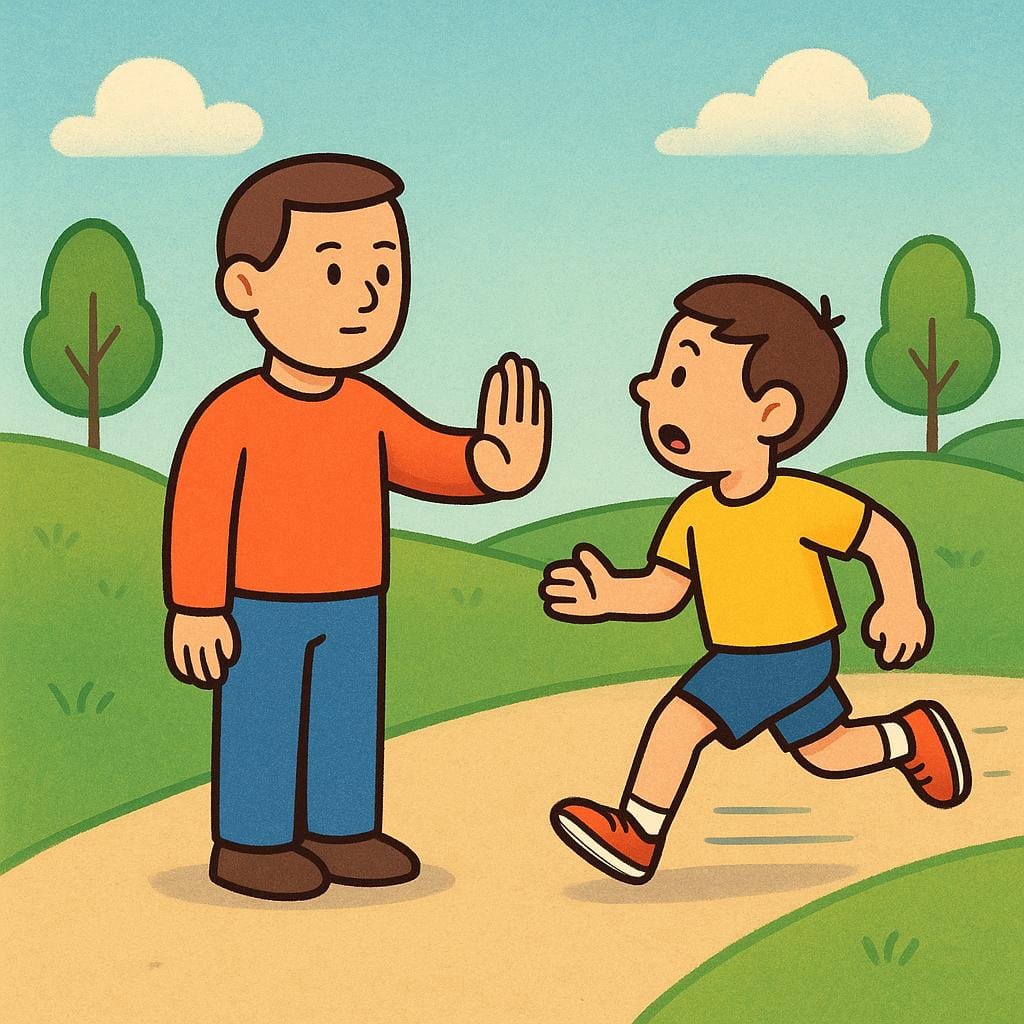
¡Parad inmediatamente! Hay un peligro más adelante.
Stop immediately! There is danger ahead.
Chicos, parad de gritar, por favor.
Kids, stop shouting, please.
Si estáis cansados, parad un momento y bebed agua.
If you are tired, stop a moment and drink water.
The 'You All' Command
'Parad' is the command form for 'vosotros' (you all, informal). This form is used when giving an order or instruction to a group of friends or peers, primarily in Spain.
Affirmative vs. Negative
This is an affirmative command ('Do this'). If you want to tell them 'Don't stop,' you must use the subjunctive form: 'No paréis'.
Using 'ar' ending incorrectly
Mistake: “Using *parais* instead of *parad* for the command.”
Correction: The *vosotros* command for -ar verbs always ends in -d (e.g., *hablad, mirad, parad*). The form *paráis* is the present tense statement ('You all stop').
tope
toh-pehˈto.pe

Examples
El cajón tiene un tope para que no se caiga.
The drawer has a stop so it doesn't fall out.
Gira el volante hasta el tope.
Turn the steering wheel as far as it will go.
Necesitas poner un tope en la puerta.
You need to put a doorstop on the door.
Masculine Gender
Even though it ends in 'e', this word is always masculine: 'el tope'.
Gender confusion
Mistake: “la tope”
Correction: el tope (Nouns ending in 'e' can be tricky, but this one is always masculine).
alto
al-tohˈalto

Examples
Hicimos un alto en el camino para comer.
We made a stop on the way to eat.
La policía le dio el alto al coche.
The police ordered the car to halt.
En la carretera, hay una señal de alto.
On the road, there is a stop sign.
cese
SAY-sayˈθese

Examples
Espero que cese el ruido pronto.
I hope the noise stops soon.
Dudo que el viento cese esta noche.
I doubt the wind will cease tonight.
Cese usted de gritar immediately.
Stop shouting immediately (formal command).
The 'Special Form' for Wishes
The word 'cese' is used as a special verb form (present subjunctive) when you are wishing for something to stop, like 'Espero que cese la lluvia' (I hope the rain stops).
Formal Commands
To tell someone politely to stop doing something, use 'Cese de...' followed by the action. For example: 'Cese de fumar' (Stop smoking).
Preposition Use
Mistake: “Cese gritar.”
Correction: Cese DE gritar.
detención
deh-ten-SYOHNde.tenˈθjon

Examples
La detención del tren duró solo dos minutos.
The stopping of the train lasted only two minutes.
El motor sufrió una detención inesperada.
The engine suffered an unexpected halt.
Se requirió la detención total de la producción para hacer reparaciones.
The complete stop of production was required to make repairs.
Source Verb
This noun comes from the verb 'detener' (to stop or detain). If you understand how 'detener' works, you understand 'detención'.
detenga
deh-TENG-gahdeˈteŋ.ɡa

Examples
Es crucial que el tren se detenga antes del cruce.
It is crucial that the train stop before the crossing.
No detenga el proceso; siga trabajando.
Don't stop the process; keep working.
El presidente pidió que nadie detenga las negociaciones.
The president asked that no one hold up the negotiations.
Subjunctive Use
The form 'detenga' is used after expressions of desire, necessity, or emotion (e.g., 'Quiero que...' or 'Es necesario que...'). It expresses uncertainty or influence.
Formal Command
When giving a formal instruction to 'Usted' (formal you), 'detenga' is the affirmative command, and 'no detenga' is the negative command.
Misusing the Base Verb
Mistake: “Espero que la policía lo detiene.”
Correction: Espero que la policía lo detenga. (The wish/hope triggers the special subjunctive form.)
deténganse
deh-TEN-gahn-sehdeˈteŋɡanse

Examples
¡Deténganse! No pueden cruzar por aquí.
Stop! You cannot cross through here.
Por favor, deténganse un momento para escuchar las instrucciones.
Please, stop for a moment to listen to the instructions.
Deténganse antes de llegar a la línea roja.
Stop before reaching the red line.
Understanding 'se'
The 'se' at the end tells you that the people are stopping themselves. In Spanish, when you give a command and include a word like 'me', 'te', or 'se', it attaches directly to the end of the action word.
The Accent Mark
Notice the accent on the second 'e'. When we add 'se' to the end of 'detengan', the stress stays on that syllable, so we must draw an accent mark to show it.
Missing the 'se'
Mistake: “Detengan!”
Correction: Deténganse!
dejen
DEH-hen (like 'day-hen')ˈde.xen
Examples
¡Dejen de comer dulces! Es hora de cenar.
Stop eating sweets! It's dinner time.
El doctor sugirió que dejen el café por unos días.
The doctor suggested that they quit coffee for a few days.
Stopping an Action
To command someone to stop doing something, you must use 'Dejen de' followed by the verb in the '-ing' form (gerundio): 'Dejen de correr'.
Missing 'de'
Mistake: “Saying 'Dejen comer' (which means 'Allow eating').”
Correction: To mean 'Stop eating', you must include the preposition: 'Dejen de comer'.
dejad
deh-HAHDdeˈxað

Examples
¡Dejad de discutir ahora mismo!
Stop arguing right now!
Dejad las maletas en la entrada y subid.
Leave the suitcases at the entrance and come up.
Dejad que os explique lo que pasó.
Let me explain what happened to you all.
The Vosotros Command
This form, 'dejad', is the command for 'you all' (plural informal) and is only used in Spain. It tells a group of friends or family what to do.
Forming the Affirmative Command
For -ar verbs like 'dejar', the affirmative command for 'vosotros' is always the infinitive form ('dejar') with the 'r' changed to 'd'. (dejad)
Using the wrong pronoun
Mistake: “Using 'dejad' when speaking to people in Latin America.”
Correction: In Latin America, use 'dejen' (the 'ustedes' command form) instead of 'dejad', even for informal groups.
Command Forms vs. Infinitives
Learn Spanish with Inklingo
Interactive stories, personalized learning, and more.