
THE INKLINGO LANGUAGE GUIDES
German Poems: Short Classics and Seasonal Verse
Read nine complete German poems with an original English translation for every line. Begin with a quiet eight-line Goethe poem or Morgenstern’s three sparrows, then explore love, nature, Christmas and Advent. The historical editions are identified, and older spellings are explained.

Start here
- Above All the PeaksAbove all the peaks
- The Three SparrowsIn a bare hazel bush
- It Is SpringSpring lets its blue ribbon
- Wanderer’s Night SongYou who come from heaven,
- Autumn DayLord: it is time. The summer was very great.
- The PantherHis gaze, from the passing of the bars,
- The LoreleiI do not know what it means
- ChristmasMarket and streets stand deserted,
- AdventIn the winter forest the wind drives
Short German Poems for Beginners
Short does not always mean simple: notice how familiar words build images of rest, affection and winter.
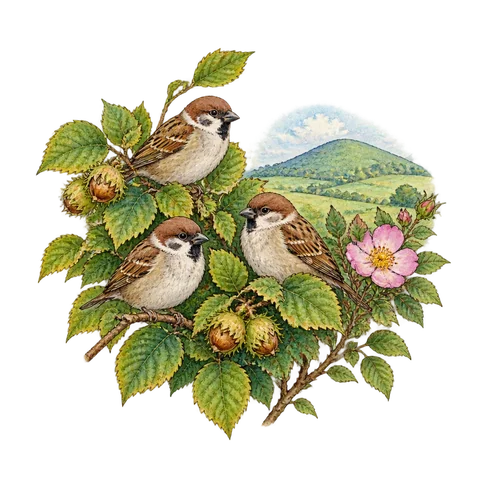
Above All the Peaks
Full public-domain text · Johann Wolfgang von Goethe died in 1832; the cited text was published in 1827, before 1930. Original English translation by Inklingo.
Intermediate
— Johann Wolfgang von Goethe (1749–1832), Ein gleiches, Werke, volume 1 (1827), p. 99
The still landscape leads into a personal promise of rest. Ueber is the edition’s spelling of Über; balde is a poetic form of bald.
 Source note
Wanderer’s Night Song
Full public-domain text · Johann Wolfgang von Goethe died in 1832; the cited text was published in 1827, before 1930. Original English translation by Inklingo.
Intermediate
— Johann Wolfgang von Goethe (1749–1832), Wandrers Nachtlied, Werke, volume 1 (1827), p. 99
A direct appeal to peace. Stillest and füllest are older poetic verb forms. The other night song on this page is titled Ein gleiches in the edition.
 Source note
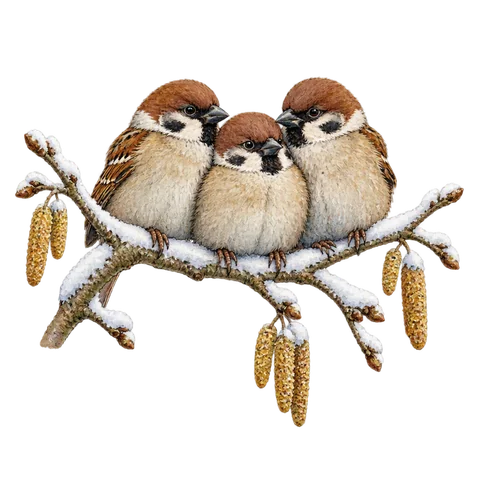
The Three Sparrows
Full public-domain text · Christian Morgenstern died in 1914; the cited text was published in 1921, before 1930. Original English translation by Inklingo.
Intermediate
— Christian Morgenstern (1871–1914), Klein Irmchen (1921), p. 19
A playful poem for children, with clear positions and repeated sounds. Niemand nicht is a humorous nonstandard double negative; the translation gives its intended meaning. Text only: the later illustration in the source is not reused.
 Source note
Explore these words: Directions & position (flashcards) · Health & medicine (flashcards) · Emotions & feelings (flashcards)
Put these words into context with a story at your level.
Read German storiesFamous German Poems About Nature and Life
Rilke, Mörike and Heine turn weather, animals and a river into reflections on change and feeling.
It Is Spring
Full public-domain text · Eduard Mörike died in 1875; the cited text was published in 1878, before 1930. Original English translation by Inklingo.
Intermediate
— Eduard Mörike (1804–1875), Er ist’s, Gesammelte Schriften, volume 1 (1878), p. 32
The blue ribbon and awakening violets announce spring through several senses. The source identifies the 1832 publication and reproduces the 1878 collected edition used here.
 Source note
Autumn Day
Full public-domain text · Rainer Maria Rilke died in 1926; the cited text was published in 1906, before 1930. Original English translation by Inklingo.
Intermediate
— Rainer Maria Rilke (1875–1926), Herbsttag, Das Buch der Bilder, second edition (1906), p. 48
The poem moves from ripening fruit to human solitude. Gieb is the older spelling of gib. The punctuation follows the cited edition.
 Source note
The Panther
Full public-domain text · Rainer Maria Rilke died in 1926; the cited text was published in 1907, before 1930. Original English translation by Inklingo.
Intermediate
— Rainer Maria Rilke (1875–1926), Der Panther, Neue Gedichte (1907), p. 37
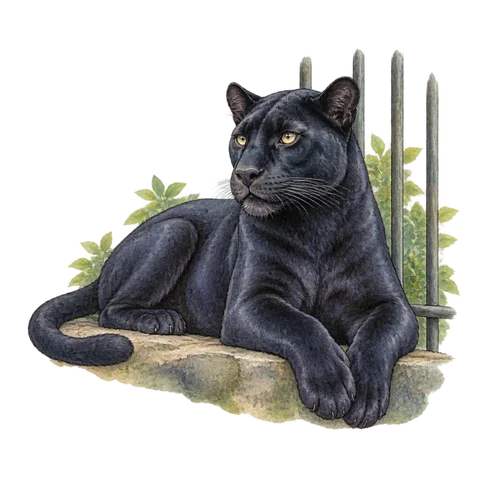
The subtitle locates the animal in the Jardin des Plantes, Paris. The poem imagines how captivity narrows perception, rather than describing a free wild cat.
 Source note
The Lorelei
Full public-domain text · Heinrich Heine died in 1856; the cited text was published in 1827, before 1930. Original English translation by Inklingo.
Intermediate
— Heinrich Heine (1797–1856), Ich weiß nicht, was soll es bedeuten, Buch der Lieder (1827), pp. 178–179
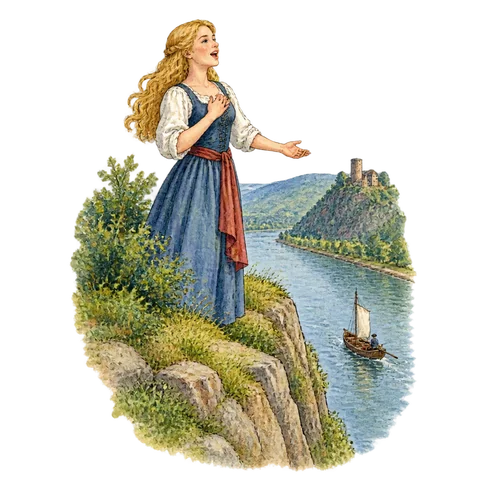
Heine’s river legend is narrated through uncertainty: Ich glaube means “I believe.” Mährchen and gethan are historical spellings of Märchen and getan.
 Source note
Explore these words: Time & dates (flashcards) · Transport (flashcards) · Directions & position (flashcards)
Put these words into context with a story at your level.
Read German storiesGerman Christmas and Advent Poems
Two seasonal poems picture light, stillness and expectation. Their religious imagery belongs to the original texts.

Christmas
Full public-domain text · Joseph von Eichendorff died in 1857; the cited text was published in 1864, before 1930. Original English translation by Inklingo.
Intermediate
— Joseph von Eichendorff (1788–1857), Weihnachten, Sämmtliche Werke, volume 1, second edition (1864), p. 603
The speaker leaves the decorated town for open snowy fields. Hehr means sublime or exalted; Schneees is an older spelling of Schnees.
 Source note
Advent
Full public-domain text · Rainer Maria Rilke died in 1926; the cited text was published in 1898, before 1930. Original English translation by Inklingo.
Intermediate
— Rainer Maria Rilke (1875–1926), Advent, first edition (1898), p. 5
This is the eight-line 1898 version, dated December 1897 in the source, not the later revised 1913 text. The fir anticipates becoming a Christmas tree.
 Source note
Explore these words: Weather (flashcards) · City & places (flashcards) · Shopping (flashcards)
Put these words into context with a story at your level.
Read German storiesGerman poems: frequently asked questions
Which German poems are easiest for beginners?
Try Goethe’s Ein gleiches or Morgenstern’s Die drei Spatzen. Both are short and use concrete images. Read one line at a time, compare its English translation, then listen to the whole poem.
Who are famous German-language poets?
Goethe, Heinrich Heine and Rainer Maria Rilke are represented here, alongside Eduard Mörike, Joseph von Eichendorff and Christian Morgenstern. German-language poetry includes writers from several countries.
Are there German Christmas poems here?
Yes. Eichendorff’s Weihnachten describes quiet streets and a festive night; Rilke’s Advent imagines a fir tree waiting for its night of lights.
Why do some words have unusual spelling?
These texts follow identified historical editions. Forms such as Ueber, Wehmuth, gieb and Flockenheerde correspond to modern über, Wehmut, gib and Flockenherde. They do not require an invented historical accent.
Are these complete German poems?
Yes. All nine are complete in the identified historical versions, including Rilke’s eight-line 1898 Advent. No stanza is presented as a whole poem when it is only an excerpt.
Are the English translations literal or rhyming?
They are original meaning-focused translations for learners. They preserve images and connections between lines, without forcing English rhyme or copying an existing literary translation.
Make these words part of your day
Explore German stories, listen along, and save vocabulary as you go.
Find a story at your levelSources and verification
English translations and examples were written for this guide. Source notes distinguish documented expressions, original practice sentences, and literary quotations. Literary excerpts retain the language of their original period.
- Ein gleiches, Werke, volume 1 (1827), p. 99 — Historical source text, cited edition 1827. The date describes the edition used, not necessarily first publication.
- Wandrers Nachtlied, Werke, volume 1 (1827), p. 99 — Historical source text, cited edition 1827. The date describes the edition used, not necessarily first publication.
- Buch der Lieder, Die Heimkehr XLVII (1827), p. 223 — Historical source text, cited edition 1827. The date describes the edition used, not necessarily first publication.
- Klein Irmchen (1921), p. 19 — Historical source text, cited edition 1921. The date describes the edition used, not necessarily first publication.
- Er ist’s, Gesammelte Schriften, volume 1 (1878), p. 32 — Historical source text, cited edition 1878. The date describes the edition used, not necessarily first publication.
- Herbsttag, Das Buch der Bilder, second edition (1906), p. 48 — Historical source text, cited edition 1906. The date describes the edition used, not necessarily first publication.
- Der Panther, Neue Gedichte (1907), p. 37 — Historical source text, cited edition 1907. The date describes the edition used, not necessarily first publication.
- Ich weiß nicht, was soll es bedeuten, Buch der Lieder (1827), pp. 178–179 — Historical source text, cited edition 1827. The date describes the edition used, not necessarily first publication.
- Weihnachten, Sämmtliche Werke, volume 1, second edition (1864), p. 603 — Historical source text, cited edition 1864. The date describes the edition used, not necessarily first publication.
- Advent, first edition (1898), p. 5 — Historical source text, cited edition 1898. The date describes the edition used, not necessarily first publication.
Source notes for all 9 entries
- Above All the Peaks: Complete poem from the cited 1827 edition; linebreaks retained, typographic spacing normalized. English translation by Inklingo. [de-poem-gipfel] [de-author-goethe]
- Wanderer’s Night Song: Complete poem from the cited 1827 edition; linebreaks retained, typographic spacing normalized. English translation by Inklingo. [de-poem-night] [de-author-goethe]
- The Three Sparrows: Complete poem from the cited 1921 edition; linebreaks retained, typographic spacing normalized. English translation by Inklingo. [de-poem-sparrows] [de-author-morgenstern]
- It Is Spring: Complete poem from the cited 1878 edition; linebreaks retained, typographic spacing normalized. English translation by Inklingo. [de-poem-spring] [de-author-moerike]
- Autumn Day: Complete poem from the cited 1906 edition; linebreaks retained, typographic spacing normalized. English translation by Inklingo. [de-poem-herbst] [de-author-rilke]
- The Panther: Complete poem from the cited 1907 edition; linebreaks retained, typographic spacing normalized. English translation by Inklingo. [de-poem-panther] [de-author-rilke]
- The Lorelei: Complete poem from the cited 1827 edition; linebreaks retained, typographic spacing normalized. English translation by Inklingo. [de-poem-loreley] [de-author-heine]
- Christmas: Complete poem from the cited 1864 edition; linebreaks retained, typographic spacing normalized. English translation by Inklingo. [de-poem-christmas] [de-author-eichendorff]
- Advent: Complete poem from the cited 1898 edition; linebreaks retained, typographic spacing normalized. English translation by Inklingo. [de-poem-advent] [de-author-rilke]