
THE INKLINGO LANGUAGE GUIDES
10 Korean Poems with Romanization and English Translations
Begin with a flower, follow a parting traveler, then meet the water, stone, pine, bamboo and moon of classical sijo. These ten complete individual poems include the six-part Five Friends cycle and four modern poems printed before 1930. Modern Hangul reading transcriptions keep older works approachable; the notes identify the editorial treatment.

Start here
- Flowers on the MountainOn the mountain, flowers bloom.
- Five Friends: OpeningHow many friends have I? Water, stone, pine and bamboo.
- Five Friends: MoonA small thing floats high and shines on everything.
- Five Friends: BambooNeither a tree nor a grass, this thing—
- AzaleasWhen the sight of me becomes hateful to you
- On the WayI miss you.
- Five Friends: WaterThey call the clouds' color lovely, but often it turns dark.
- Five Friends: StoneWhy do flowers fall so soon after blooming?
- Five Friends: PineFlowers bloom in warmth and leaves fall in cold,
- The Ferryboat and the TravelerI am a ferryboat.
An Easy Korean Poem for Beginners
Short repeated lines make a first encounter with literary Korean manageable. Read the whole poem before memorizing the opening.
Flowers on the Mountain
Full public-domain text · Kim Sowol died in 1934; this poem was published in the 1925 collection, before 1930. No later posthumous first publication is being assumed.
Easy
— Kim Sowol (Died 1934), Azaleas (1925)
Repetition makes this a useful first recitation, while the solitary flower gives it more than a simple nature description. The clipped gal means autumn. The text uses modern Hangul spelling, including jageun for the older jeogeun meaning little.
 Source note
Explore these words: Plants & trees (flashcards) · Nature & landscape (flashcards) · Animals (flashcards)
Put these words into context with a story at your level.
Read Korean storiesFamous Korean Poems About Love and Parting
These poems turn a farewell into a series of concrete actions and sounds. The English translation keeps their hesitation and emotional tension.

Azaleas
Full public-domain text · Kim Sowol died in 1934; this poem was published in the 1925 collection, before 1930. No later posthumous first publication is being assumed.
Intermediate
— Kim Sowol (Died 1934), Azaleas (1925)
First published in 1922 and included in the 1925 collection. The courtesy of the speaker's farewell sits beside an intense refusal to admit grief. Jeuryeobapgo is the poem's distinctive verb for treading down; it has not been replaced with an easier verb. Modern Hangul spelling and spacing are used.
 Source note
On the Way
Full public-domain text · Kim Sowol died in 1934; this poem was published in the 1925 collection, before 1930. No later posthumous first publication is being assumed.
Intermediate
— Kim Sowol (Died 1934), Azaleas (1925)
The broken opening lines enact hesitation before departure; the uninterrupted river pulls the speaker onward. The final heureupdidaryeo is a regional poetic ending, retained rather than standardized into ordinary present-day speech. Hanja glosses are rendered in Hangul.
 Source note
Explore these words: Directions & position (flashcards) · Body parts (flashcards) · Emotions & feelings (flashcards)
Put these words into context with a story at your level.
Read Korean storiesTraditional Korean Sijo: The Five Friends
Read the complete six-poem cycle in order. Each three-line sijo is complete in itself, and the opening names the five companions explored by the remaining poems.
Five Friends: Opening
Full public-domain text · Yun Seon-do died in 1671. The cycle was composed in 1642 and published in Gosan Yugo in 1791, with a revised printing in 1798.
Advanced
— Yun Seon-do (Died 1671), Five Friends, in New Songs from the Mountains; Gosan Yugo, volume 6
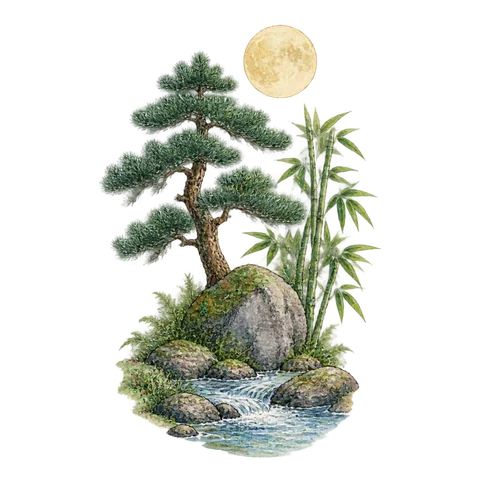
This opening sijo introduces the five natural companions praised in the next five poems. Each item here is one complete three-line sijo, not an unrelated fragment. The cycle was composed in 1642. This is a modern-Hangul reading transcription of the older Korean, with the classical syntax retained.
 Source note
Five Friends: Water
Full public-domain text · Yun Seon-do died in 1671. The cycle was composed in 1642 and published in Gosan Yugo in 1791, with a revised printing in 1798.
Advanced
— Yun Seon-do (Died 1671), Five Friends, in New Songs from the Mountains; Gosan Yugo, volume 6
The second sijo values constancy through a contrast between water, cloud and wind. Jaro means often, and nwi here refers to a time or occasion. Older forms are retained in a modern-Hangul reading transcription; the English explains their sense.
 Source note
Five Friends: Stone
Full public-domain text · Yun Seon-do died in 1671. The cycle was composed in 1642 and published in Gosan Yugo in 1791, with a revised printing in 1798.
Advanced
— Yun Seon-do (Died 1671), Five Friends, in New Songs from the Mountains; Gosan Yugo, volume 6
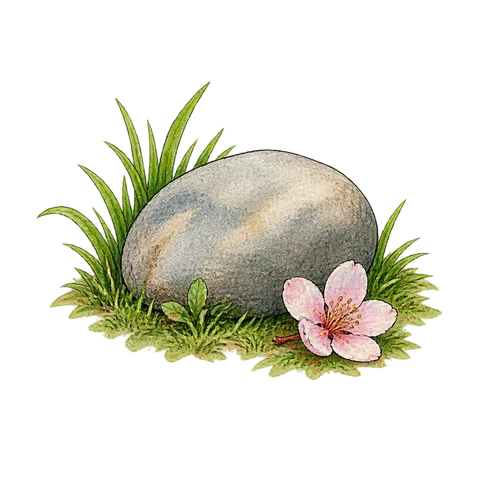
The third sijo sets the apparent permanence of stone against the brief life of flowers and grass. It is a poetic value judgment, not a claim that rocks never weather. The display modernizes the older spelling while retaining the rhetorical questions and classical ending.
 Source note
Five Friends: Pine
Full public-domain text · Yun Seon-do died in 1671. The cycle was composed in 1642 and published in Gosan Yugo in 1791, with a revised printing in 1798.
Advanced
— Yun Seon-do (Died 1671), Five Friends, in New Songs from the Mountains; Gosan Yugo, volume 6
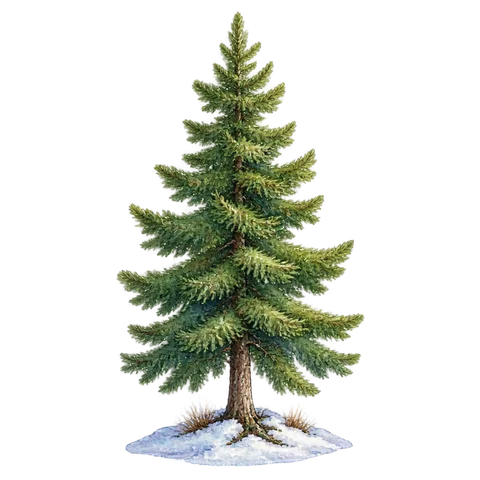
The fourth sijo reads the evergreen pine as an image of firm character. Gucheon literally means nine springs and here suggests the deep earth. Solsa emphatically singles out the pine. Modern-Hangul transcription makes the old spelling readable without replacing the image with a modern paraphrase.
 Source note
Five Friends: Bamboo
Full public-domain text · Yun Seon-do died in 1671. The cycle was composed in 1642 and published in Gosan Yugo in 1791, with a revised printing in 1798.
Advanced
— Yun Seon-do (Died 1671), Five Friends, in New Songs from the Mountains; Gosan Yugo, volume 6
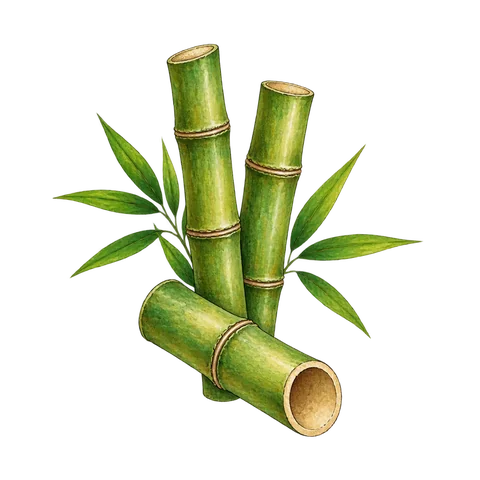
The fifth sijo admires bamboo's straight stem, hollow interior and lasting green. The opening expresses the speaker's classification puzzle; botanically bamboo is a grass. A modern-Hangul reading transcription retains the old rhetorical wording and ending.
 Source note
Five Friends: Moon
Full public-domain text · Yun Seon-do died in 1671. The cycle was composed in 1642 and published in Gosan Yugo in 1791, with a revised printing in 1798.
Advanced
— Yun Seon-do (Died 1671), Five Friends, in New Songs from the Mountains; Gosan Yugo, volume 6
The cycle's final sijo praises the moon's wide light and silence. The small visible disk illuminates a much larger world. This is a modern-Hangul reading transcription, with an original English translation rather than a copied modern rendering.
 Source note
Explore these words: Numbers (flashcards) · Weather (flashcards) · Shapes, sizes & materials (flashcards)
Put these words into context with a story at your level.
Read Korean storiesA Korean Poem About Waiting and Devotion
A speaking ferryboat gives a longer modern poem a clear organizing image. Its repeated first and last lines frame patient waiting.
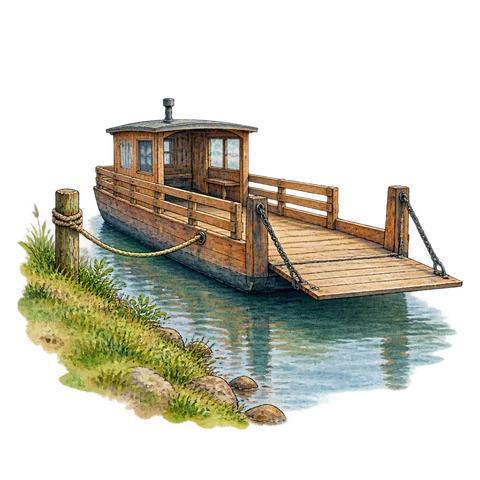
The Ferryboat and the Traveler
Full public-domain text · Han Yong-un died in 1944; this poem was published in the 1926 collection, before 1930. No later posthumous first publication is being assumed.
Intermediate
— Han Yong-un (Died 1944), The Silence of the Beloved (1926)
A boat speaks to the person it carries. The repeated opening closes the poem, while its longer central lines describe patient service and wear. Han was a Buddhist monk, poet and independence activist. This poem appeared in the 1926 collection, not a later posthumous volume. Modern Hangul spelling and spacing are used.
 Source note
Explore these words: Transport (flashcards) · Drinks (flashcards) · Body parts (flashcards)
Put these words into context with a story at your level.
Read Korean storiesKorean poems: frequently asked questions
Which Korean poem is good for beginners?
Flowers on the Mountain has short, repeated lines and concrete words for flowers, birds and mountains. It still uses poetic forms, so the line translations are useful even when the Hangul looks simple.
What is sijo?
Sijo is a traditional Korean verse form organized into three lines, commonly understood through rhythmic groups within those lines. It is not the Japanese 5–7–5 haiku form. The Five Friends entries show a connected six-poem cycle.
Why are there six poems in Five Friends?
The opening introduces the five companions: water, stone, pine, bamboo and moon. The next five poems each address one companion. The page counts six complete sijo, and identifies them as parts of one cycle.
Are these Korean poems complete?
Yes. All ten entries are complete individual poems. Six belong to a connected classical cycle. The four modern poems are complete works from collections published in 1925 or 1926.
Why does the spelling differ from a historical edition?
Older Hangul uses spellings, letter forms and spacing that modern learners may not know. The sijo are labeled modern-Hangul reading transcriptions, and the modern poems use normalized spelling and spacing. The sources let you compare the earlier text.
Does romanization replace learning Hangul?
No. Romanization is a reading aid based on Revised Romanization. Hangul represents the language more directly; sound changes and poetic diction are easier to understand when you read it alongside the audio.
Can children read these poems?
The nature images in Flowers on the Mountain and Five Friends can suit a guided lesson. Some grammar is old, and the parting poems carry adult emotional themes, so choose a poem for the reader rather than assuming every short poem is easy.
Why are later famous Korean poets not included in full?
Full texts here meet both editorial checks: the author died before 1956 and the poem was published before 1930. A poet’s early death does not make a work first published after 1929 eligible for this page’s full-text selection.
Make these words part of your day
Explore Korean stories, listen along, and save vocabulary as you go.
Find a story at your levelSources and verification
English translations and examples were written for this guide. Source notes distinguish documented expressions, original practice sentences, and literary quotations. Literary excerpts retain the language of their original period.
- National Institute of Korean History: Five Friends, original text and publication history — Provides all six original sijo, identifies Gosan Yugo volume 6, composition in 1642, author 1587–1671, printing in 1791 and revised publication in 1798. Our Hangul is an explicitly modernized reading transcription, not a facsimile of the historical spelling; our English is original.
- EBS: Five Friends, reading text and vocabulary notes — Educational reading transcription corroborates the classical forms jaro, hanomaera, nwi and geullo. Historical spelling is compared with the NIKH original rather than silently treated as present-day prose.
- Academy of Korean Studies: Gosan Yugo bibliography — Independent bibliographic description identifies the 1791 woodblock publication and the 1798 revision, with the cycle in the collected vernacular verse.
- National Library of Korea: Azaleas, early publication — Identifies the 1925 poetry collection and the title poem’s first appearance in 1922. The three selected poems also appear in the full collection index.
- Academy of Korean Studies: Kim Sowol — Author biography establishes his death in 1934 and the collection published during his lifetime; later posthumous collections are not used as the publication basis.
- Korea Copyright Commission: The Ferryboat and the Traveler — The government archive records the poem’s 1926 publication. Its original collection is The Silence of the Beloved.
- Academy of Korean Studies: Han Yong-un — Biography records the poet’s death on June 29, 1944.
- Kim Sowol: Flowers on the Mountain — original poem — Complete poem checked against the collection transcription, including the historical text where supplied. Modern spelling and spacing are identified in the entry; English translations were written directly by Codex.
- Kim Sowol: Azaleas — original poem — Complete poem checked against the collection transcription, including the historical text where supplied. Modern spelling and spacing are identified in the entry; English translations were written directly by Codex.
- Kim Sowol: On the Way — original poem — Complete poem checked against the collection transcription, including the historical text where supplied. Modern spelling and spacing are identified in the entry; English translations were written directly by Codex.
- Han Yong-un: The Ferryboat and the Traveler — original poem — Complete poem checked against the collection transcription, including the historical text where supplied. Modern spelling and spacing are identified in the entry; English translations were written directly by Codex.
Source notes for all 10 entries
- Flowers on the Mountain: Complete individual poem, presented in modern Hangul spelling and spacing. Distinctive poetic and regional forms are retained and explained. [text-mountain-flowers] [sowol-edition] [sowol-life]
- Azaleas: Complete individual poem, presented in modern Hangul spelling and spacing. Distinctive poetic and regional forms are retained and explained. [text-azaleas] [sowol-edition] [sowol-life]
- On the Way: Complete individual poem, presented in modern Hangul spelling and spacing. Distinctive poetic and regional forms are retained and explained. [text-leaving] [sowol-edition] [sowol-life]
- Five Friends: Opening: One complete sijo from the six-part cycle. Modern-Hangul reading transcription of the historical Korean, with classical vocabulary and syntax retained; it is not a photographically exact historical-spelling edition. [yun-original] [yun-reading] [gosan-edition]
- Five Friends: Water: One complete sijo from the six-part cycle. Modern-Hangul reading transcription of the historical Korean, with classical vocabulary and syntax retained; it is not a photographically exact historical-spelling edition. [yun-original] [yun-reading] [gosan-edition]
- Five Friends: Stone: One complete sijo from the six-part cycle. Modern-Hangul reading transcription of the historical Korean, with classical vocabulary and syntax retained; it is not a photographically exact historical-spelling edition. [yun-original] [yun-reading] [gosan-edition]
- Five Friends: Pine: One complete sijo from the six-part cycle. Modern-Hangul reading transcription of the historical Korean, with classical vocabulary and syntax retained; it is not a photographically exact historical-spelling edition. [yun-original] [yun-reading] [gosan-edition]
- Five Friends: Bamboo: One complete sijo from the six-part cycle. Modern-Hangul reading transcription of the historical Korean, with classical vocabulary and syntax retained; it is not a photographically exact historical-spelling edition. [yun-original] [yun-reading] [gosan-edition]
- Five Friends: Moon: One complete sijo from the six-part cycle. Modern-Hangul reading transcription of the historical Korean, with classical vocabulary and syntax retained; it is not a photographically exact historical-spelling edition. [yun-original] [yun-reading] [gosan-edition]
- The Ferryboat and the Traveler: Complete individual poem, presented in modern Hangul spelling and spacing. Distinctive poetic and regional forms are retained and explained. [text-ferry] [han-edition] [han-life]