
THE INKLINGO LANGUAGE GUIDES
20 Russian Riddles with Hints and Answers
A forest can hide a sack of needles, and a little room can be full of people without a door. Try twenty documented Russian riddles, from quick children’s clues to older folk metaphors. Each has a hint before the answer, stress marks, audio and an original English explanation.

Start here
- Зимо́й и ле́том одни́м цве́том.The same color in winter and summer.
- Сиди́т деви́ца в тёмной темни́це, коса́ на у́лице.A maiden sits in a dark dungeon, with her braid outside.
- Ни око́шек, ни двере́й, полна́ го́рница люде́й.Neither windows nor doors, yet a room full of people.
- Стои́т Анто́шка на одно́й но́жке.Antoshka stands on one little leg.
- Под со́снами, под ёлками лежи́т мешо́к с иго́лками.Beneath the pines and firs lies a sack of needles.
- Не ла́ет, не куса́ет, а в дом не пуска́ет.It does not bark or bite, but it keeps you out of the house.
- Два конца́, два кольца́, а в серёдке гво́здик.Two ends, two rings, and a little nail in the middle.
- Конь стально́й, хвост льняно́й.A horse of steel with a tail of flax.
Easy Russian Riddles for Kids and Beginners
Start with familiar plants, colors and shapes. Read the clue aloud before opening the hint.

и одни́м цве́том.
Zimój i létom odním cvétom.
The same color in winter and summer.
Easy
Source noteСиди́т деви́ца в тёмной темни́це, коса́ на у́лице.
Sidít devíca v tëmnoj temníce, kosá na úlice.
A maiden sits in a dark dungeon, with her braid outside.
Easy
Source noteНи око́шек, ни двере́й, го́рница люде́й.
Ni okóšek, ni dveréj, polná górnica ljudéj.
Neither windows nor doors, yet a room full of people.
Easy
Source noteСам а́лый, са́харный, кафта́н , ба́рхатный.
Sam ályj, sáharnyj, kaftán zelënyj, bárhatnyj.
Scarlet and sugary inside a green, velvety coat.
Easy
Source noteСтои́т Анто́шка на одно́й но́жке.
Stoít Antóška na odnój nóžke.
Antoshka stands on one little leg.
Easy
Source noteExplore these words: Seasons & celebrations · Quantities & measurements (flashcards) · Colors (flashcards)
Put these words into context with a story at your level.
Read Russian storiesAnimals and Nature
These riddles turn fleece, spines, clouds and leaves into objects or people. A traditional carrying yoke explains one of the less familiar comparisons.
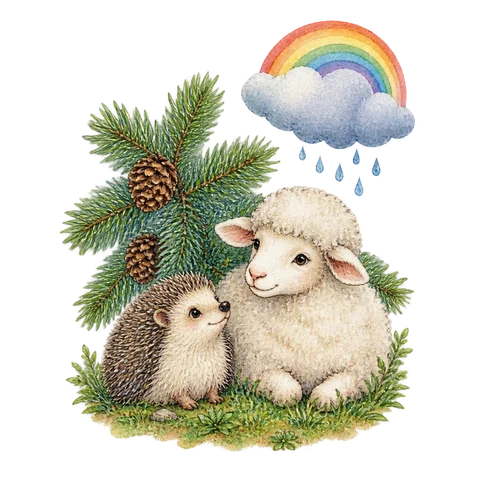
Под со́снами, под ёлками мешо́к с иго́лками.
Pod sósnami, pod ëlkami ležít mešók s igólkami.
Beneath the pines and firs lies a sack of needles.
Easy
Source noteПо гора́м, по гора́м шу́ба да кафта́н.
Po gorám, po gorám hódit šúba da kaftán.
Over the hills, over the hills, a fur coat and a long coat walk.
Easy
Source noteКра́шеное коромы́сло че́рез ре́ку пови́сло.
Krášenoe koromýslo čérez réku povíslo.
A painted carrying yoke hangs across the river.
Intermediate
Source noteНог нет, а идёт, нет, а пла́чет.
Nog net, a idët, glaz net, a pláčet.
It has no legs but moves; no eyes but cries.
Easy
Source noteПал пан на : сам не потону́л и не помути́л.
Pal pan na vódu: sam ne potonúl i vodý ne pomutíl.
A lord fell onto the water: he neither sank nor muddied it.
Intermediate
Source noteExplore these words: Directions & position (flashcards) · Drinks (flashcards) · Animals (flashcards)
Put these words into context with a story at your level.
Read Russian storiesHousehold Objects
Look closely at shape, material and movement. The answer may be a small object used for guarding a door, sewing or lighting a room.

Не ла́ет, не куса́ет, а в дом не пуска́ет.
Ne láet, ne kusáet, a v dom ne puskáet.
It does not bark or bite, but it keeps you out of the house.
Easy
Source note, , а в серёдке гво́здик.
Dva koncá, dva kolʹcá, a v serëdke gvózdik.
Two ends, two rings, and a little nail in the middle.
Easy
Source noteспит, ночь гляди́т, у́тром , друго́й сменя́ет.
Denʹ spit, nočʹ gljadít, útrom umiráet, drugój smenjáet.
It sleeps by day, watches by night, dies in the morning, and another takes its place.
Intermediate
Source noteМа́ленько, кру́гленько, а за хвост не .
Málenʹko, krúglenʹko, a za hvost ne podnjátʹ.
Small and round, but you cannot lift it by its tail.
Easy
Source noteКонь стально́й, хвост льняно́й.
Konʹ stalʹnój, hvost lʹnjanój.
A horse of steel with a tail of flax.
Easy
Source noteExplore these words: Numbers (flashcards) · Tools & building (flashcards) · Accessories & jewelry (flashcards)
Put these words into context with a story at your level.
Read Russian storiesWordplay and Figurative Clues
These are attested metaphors and personifications rather than invented English puns. Verbs such as crying, bowing and eating describe how tools and instruments work.
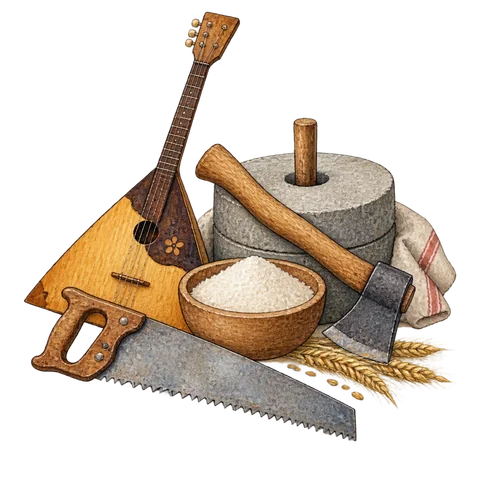
В лесу́ вы́росло, из ле́су вы́несли, на рука́х пла́чет, а по по́лу ска́чут.
V lesú výroslo, iz lésu výnesli, na rukáh pláčet, a po pólu skáčut.
It grew in the forest, was carried out of the forest, cries in someone's hands, and makes people leap across the floor.
Intermediate
Source noteКла́няется, кла́няется — придёт , растя́нется.
Klánjaetsja, klánjaetsja — pridët domój, rastjánetsja.
It bows and bows; when it comes home, it stretches out.
Intermediate
Source noteСко́ро и ме́лко жуёт, сама́ не глота́ет и други́м не .
Skóro est i mélko žuët, samá ne glotáet i drugím ne daët.
It eats quickly and chews finely, but never swallows or gives anything to others.
Intermediate
Source noteВесь ко́рмит, сама́ не .
Vesʹ mir kórmit, samá ne est.
It feeds the whole world but eats nothing itself.
Easy
Source noteКа́менное круго́м ве́ртится, за́яц по́дле ложи́тся, всему́ ми́ру годи́тся.
Kámennoe móre krugóm vértitsja, bélyj zájac pódle ložítsja, vsemú míru godítsja.
A stone sea turns around; a white hare settles beside it, useful to everyone.
Hard
Source noteExplore these words: Food & cooking (flashcards) · Nature & landscape (flashcards) · House & rooms (flashcards)
Put these words into context with a story at your level.
Read Russian storiesA Short Riddle Practice Routine
- Listen to a clue once without reading the answer.
- Name the concrete objects and notice words that could be figurative.
- Open the hint, make one guess, then reveal and listen to the answer.
- Read the explanation and repeat the clue to someone else.
Russian riddles: frequently asked questions
What is the Russian word for riddle?
A riddle is зага́дка, zagádka; the plural is зага́дки. An answer or solution is отга́дка. Stress marks are added here for learners.
Are these traditional Russian riddles?
Yes. Fifteen selections come from Dal’s collected folklore, and five familiar traditional riddles are documented with answers by ITMO University. Every entry links to its source note. No invented riddles are mixed into the collection.
Which Russian riddles are easiest for children?
Start with the pine tree, carrot, cucumber, mushroom and hedgehog clues. Their answers use visible shapes or familiar objects. Read the hint aloud if the traditional wording is unfamiliar.
Why can the same Russian riddle have different answers?
Oral riddles circulate in variants. The evergreen clue can mean a pine or a fir tree; Dal’s cited version gives pine. This guide follows each selected source’s answer and explains variants when they matter.
Why do Russian riddles mention old clothes and tools?
A кафтан is a long coat, and a коромысло is a carrying yoke. These objects supplied familiar comparisons in the collections. The notes explain them so you can solve the image without already knowing the object.
Do the wordplays work in English?
Many visual metaphors do. Rhymes, grammatical gender and stress contrasts may not. The explanations point out what is lost, including замо́к, a lock, and за́мок, a castle.
Should I read the transliteration or the Cyrillic?
Use transliteration as a temporary aid, then follow the Cyrillic while listening. Russian unstressed vowels change in speech, so the Latin spelling is not an English pronunciation guide.
How do I reveal a riddle answer?
Choose “Show a hint” first, then “Reveal the answer.” Both are keyboard-accessible buttons. Each clue and each answer has a separate recording, so you can repeat them independently.
Make these words part of your day
Explore Russian stories, listen along, and save vocabulary as you go.
Find a story at your levelSources and verification
English translations and examples were written for this guide. Source notes distinguish documented expressions, original practice sentences, and literary quotations. Literary excerpts retain the language of their original period.
- Vladimir Dal, Poslovitsy russkogo naroda: Plants — Agriculture — Primary-text transcription of the folklore collection first published in 1862, with a second edition in 1879. The parenthesized answers identify the exact variants used here. Dal collected these riddles; he is not claimed as their original author.
- Vladimir Dal, Poslovitsy russkogo naroda: Riddles — Primary-text transcription with answers, including a second group of riddles identified by the edition. Only the traditional source text is quoted; all English teaching material is original.
- ITMO University: 10 Essential Russian Riddles — Published 3 August 2020. Provides native traditional riddles and an explicit answer key; the five selected items are identified by their numbers. The article’s English translations are not reproduced.
Source notes for all 20 entries
- Зимо́й и ле́том одни́м цве́том.: Dal, Poslovitsy russkogo naroda, “Plants — Agriculture”; native clue and parenthesized answer checked in the primary-text transcription. Stress marks, ё, sentence capitalization and final punctuation normalized for learners; no words added to the riddle. [dal-plants]
- Сиди́т деви́ца в тёмной темни́це, коса́ на у́лице.: Dal, Poslovitsy russkogo naroda, “Plants — Agriculture”; native clue and parenthesized answer checked in the primary-text transcription. Stress marks, ё, sentence capitalization and final punctuation normalized for learners; no words added to the riddle. [dal-plants]
- Ни око́шек, ни двере́й, полна́ го́рница люде́й.: Dal, Poslovitsy russkogo naroda, “Plants — Agriculture”; native clue and parenthesized answer checked in the primary-text transcription. Stress marks, ё, sentence capitalization and final punctuation normalized for learners; no words added to the riddle. [dal-plants]
- Сам а́лый, са́харный, кафта́н зелёный, ба́рхатный.: Dal, Poslovitsy russkogo naroda, “Plants — Agriculture”; native clue and parenthesized answer checked in the primary-text transcription. Stress marks, ё, sentence capitalization and final punctuation normalized for learners; no words added to the riddle. [dal-plants]
- Стои́т Анто́шка на одно́й но́жке.: Dal, Poslovitsy russkogo naroda, “Plants — Agriculture”; native clue and parenthesized answer checked in the primary-text transcription. Stress marks, ё, sentence capitalization and final punctuation normalized for learners; no words added to the riddle. [dal-plants]
- Под со́снами, под ёлками лежи́т мешо́к с иго́лками.: ITMO University, “10 Essential Russian Riddles,” no. 8; traditional native wording and the published answer key checked. English translation and explanation here are independently written. Stress marks, ё, sentence capitalization and final punctuation normalized for learners; no words added to the riddle. [itmo]
- По гора́м, по гора́м хо́дит шу́ба да кафта́н.: ITMO University, “10 Essential Russian Riddles,” no. 3; traditional native wording and the published answer key checked. English translation and explanation here are independently written. Stress marks, ё, sentence capitalization and final punctuation normalized for learners; no words added to the riddle. [itmo]
- Кра́шеное коромы́сло че́рез ре́ку пови́сло.: ITMO University, “10 Essential Russian Riddles,” no. 5; traditional native wording and the published answer key checked. English translation and explanation here are independently written. Stress marks, ё, sentence capitalization and final punctuation normalized for learners; no words added to the riddle. [itmo]
- Ног нет, а идёт, глаз нет, а пла́чет.: ITMO University, “10 Essential Russian Riddles,” no. 6; traditional native wording and the published answer key checked. English translation and explanation here are independently written. Stress marks, ё, sentence capitalization and final punctuation normalized for learners; no words added to the riddle. [itmo]
- Пал пан на во́ду: сам не потону́л и воды́ не помути́л.: Dal, Poslovitsy russkogo naroda, “Plants — Agriculture”; native clue and parenthesized answer checked in the primary-text transcription. Stress marks, ё, sentence capitalization and final punctuation normalized for learners; no words added to the riddle. [dal-plants]
- Не ла́ет, не куса́ет, а в дом не пуска́ет.: ITMO University, “10 Essential Russian Riddles,” no. 4; traditional native wording and the published answer key checked. English translation and explanation here are independently written. Stress marks, ё, sentence capitalization and final punctuation normalized for learners; no words added to the riddle. [itmo]
- Два конца́, два кольца́, а в серёдке гво́здик.: Dal, Poslovitsy russkogo naroda, “Riddles”; native clue and its answer checked in the primary-text transcription. Stress marks, ё, sentence capitalization and final punctuation normalized for learners; no words added to the riddle. [dal-riddles]
- День спит, ночь гляди́т, у́тром умира́ет, друго́й сменя́ет.: Dal, Poslovitsy russkogo naroda, “Riddles”; native clue and its answer checked in the primary-text transcription. Stress marks, ё, sentence capitalization and final punctuation normalized for learners; no words added to the riddle. [dal-riddles]
- Ма́ленько, кру́гленько, а за хвост не подня́ть.: Dal, Poslovitsy russkogo naroda, “Riddles”; native clue and its answer checked in the primary-text transcription. Stress marks, ё, sentence capitalization and final punctuation normalized for learners; no words added to the riddle. [dal-riddles]
- Конь стально́й, хвост льняно́й.: Dal, Poslovitsy russkogo naroda, “Riddles”; native clue and its answer checked in the primary-text transcription. Stress marks, ё, sentence capitalization and final punctuation normalized for learners; no words added to the riddle. [dal-riddles]
- В лесу́ вы́росло, из ле́су вы́несли, на рука́х пла́чет, а по по́лу ска́чут.: Dal, Poslovitsy russkogo naroda, “Riddles”; native clue and its answer checked in the primary-text transcription. Stress marks, ё, sentence capitalization and final punctuation normalized for learners; no words added to the riddle. [dal-riddles]
- Кла́няется, кла́няется — придёт домо́й, растя́нется.: Dal, Poslovitsy russkogo naroda, “Riddles”; native clue and its answer checked in the primary-text transcription. Stress marks, ё, sentence capitalization and final punctuation normalized for learners; no words added to the riddle. [dal-riddles]
- Ско́ро ест и ме́лко жуёт, сама́ не глота́ет и други́м не даёт.: Dal, Poslovitsy russkogo naroda, “Riddles”; native clue and its answer checked in the primary-text transcription. Stress marks, ё, sentence capitalization and final punctuation normalized for learners; no words added to the riddle. [dal-riddles]
- Весь мир ко́рмит, сама́ не ест.: Dal, Poslovitsy russkogo naroda, “Riddles”; native clue and its answer checked in the primary-text transcription. Stress marks, ё, sentence capitalization and final punctuation normalized for learners; no words added to the riddle. [dal-riddles]
- Ка́менное мо́ре круго́м ве́ртится, бе́лый за́яц по́дле ложи́тся, всему́ ми́ру годи́тся.: Dal, Poslovitsy russkogo naroda, “Riddles”; native clue and its answer checked in the primary-text transcription. Stress marks, ё, sentence capitalization and final punctuation normalized for learners; no words added to the riddle. [dal-riddles]